
Dallas Asks SCOTX To Lift Injunction Against Virtual Ban on Short-Term Rentals
Share News:

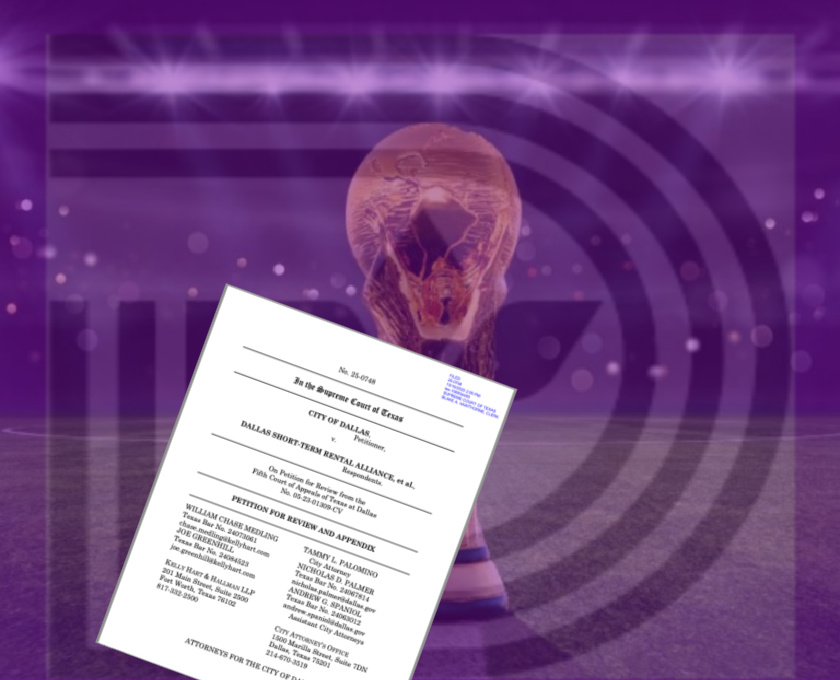
It appears the City of Dallas has decided to press on with litigation stemming from its attempt to severely restrict where short-term rentals can operate within the city limits.
As previously reported by CandysDirt.com, a trial court placed a temporary injunction against two ordinances adopted by the city in 2023 to ban short-term rentals (STRs) in single-family neighborhoods and regulate those operating elsewhere. An appeals court allowed the injunction to remain in place in July, pending an actual trial. Now, the city is taking its case to the Texas Supreme Court.
In a petition filed on Oct. 16, the city argues that both the trial and appellate court misapplied the law with regards to the injunction and that it should be lifted while litigation continues.
“The world will soon converge upon Dallas for the 2026 FIFA World Cup. STRs will be in high demand. And with the ordinances erroneously enjoined, it will be more difficult for the City to proactively ensure the health, safety, and quality of life for residents and visitors alike,” the petition reads.
No doubt the World Cup is looming large, with millions of visitors and billions of dollars expected to descend on the Dallas metro area next summer. Lodging will be tight, and city staff have acknowledged in some of their presentations that STRs will play a role in hosting out-of-town guests — it’s just a matter of where they’ll be allowed to do so. One of the city’s ordinances limits their operation to “appropriate multi-family and commercial districts.”
In a statement to CandysDirt.com, the Dallas Short-term Rental Alliance (one of the plaintiffs in the ongoing litigation with the city) expressed disappointment in the city’s insistence on continuing litigation.
“While [DSTRA] was hoping to move past City of Dallas’ lawsuits and instead work on a fair and reasonable ordinance, we are preparing for this new challenge,” the group said. “Our goal has always been to work with the City on the serious business of putting a reasonable ordinance in place that represents the interests of our membership as well as the neighborhoods in which we live and we look forward to the time when this process can begin.”
DSTRA previously engaged with officials to devise a regulatory framework for the operation of STRs. Opponents of STRs in single-family neighborhoods, however, made quite the ruckus and supported the ordinances ultimately passed by the city council. Concerns over problem properties that essentially functioned as party houses animated the anti-STR sentiment, despite their comprising a small fraction of the STRs in operation.
The city’s tab related to its efforts to restrict STRs in single-family neighborhoods hit $3.5 million back in February. It’s unclear how much more has been racked up since and how much more will be spent on the endeavor.
Despite this most recent push to get the injunction lifted, DSTRA said it’s moving forward with its plans to hold a series of classes for first-time STR operators. “[S]o that we can do our part in educating new hosts on running a responsible short-term rental and being a good neighbor,” the organization said.
CORRECTION: This article was updated at 11:12 p.m. on October 26, 2025, to address an error. The article previously stated that the city’s costs associated with the litigation totaled more than $3.5 million. However, that figure includes spending on the city’s STR code compliance program, not just the lawsuit.
2 Comments
Leave a Comment







The DSTRA can whine and moan all day long about this, but Dallas has every right to regulate hotel uses and protect residents from the consequences of their neighborhoods being usurped for commercial activity.
It should be clear from even the latest Legislative sessions that lawmakers have preserved municipalities’ right to regulate the existence and placement of STRs. It is explicitly stated in multiple 2025 bills. The district court simply got it wrong, and many other municipalities have seen their ordinances upheld. As, I suspect, we will eventually see in this case.
Color me as someone who could not care less about the needs of people who may or may not come to see the World Cup. Dallas’s first and foremost responsibility is to protect its residents. We have plenty of hotels, and that is where out-of-town guests should stay.
I’m looking forward to the day when I can enjoy my home and my neighborhood without the annoyances caused by transient guests at short term rental hotels.
Every STR and I understand there are thousands of them, means there are thousands of individual that could be living and enjoying a home in Dallas.
DSTRA makes it sound like, given Dallas wins in court, STRs will be out of business. Let me say that STR operators own tangible real estate, property that can certainly be rented long term. These STR owners can then join the ranks of landlords, like me.
Lastly, as for the statement that Dallas has spent $3.5 million on legal fees, I beg to differ. To this point litigation has been handled by salaried City of Dallas attorneys. Dallas has not been able to implement the desired STR ordinances so any funding estimates and expenditures to date have certainly not been fully realized.
Thank you Dallas for supporting and working to restore the quality of life in single family neighborhoods.