
Mayor Johnson Calls for Leaner Dallas Government as Budget Pressures Mount
Share News:

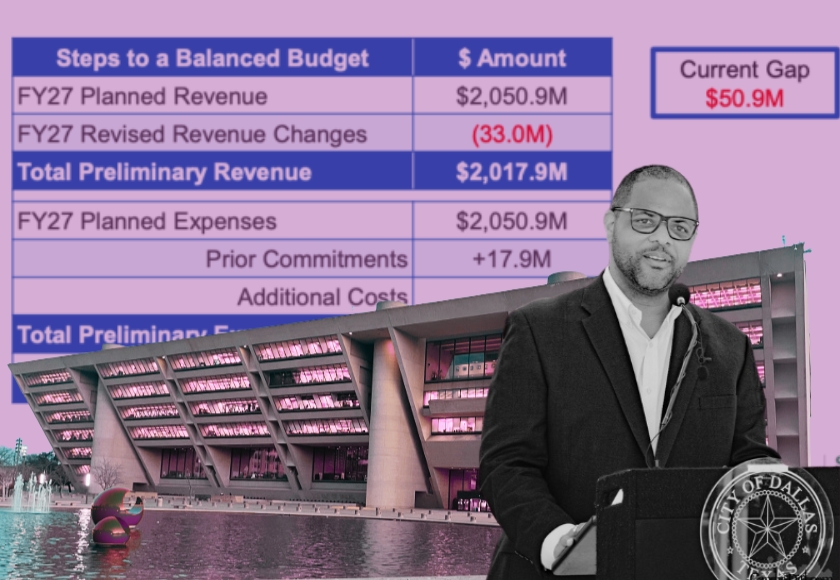
Mayor Eric Johnson outlined his budget priorities on Friday ahead of a critical stretch of weeks in which officials will have to make some hard choices to overcome a significant revenue gap for FY 2026-2027.
In a memo to City Manager Kimberly Tolbert, Johnson argued that Dallas should focus on providing essential services and resist the urge to raise property tax rates despite mounting fiscal pressures.
“At the end of the day, the City’s budget has gotten too big, and while some of this growth has been necessary to efficiently deliver core services, much of it has been growth for the sake of growth or adding new non-core services,” Johnson said. “We are spending people’s hard-earned money, and we should only spend as much of it as is absolutely necessary.”
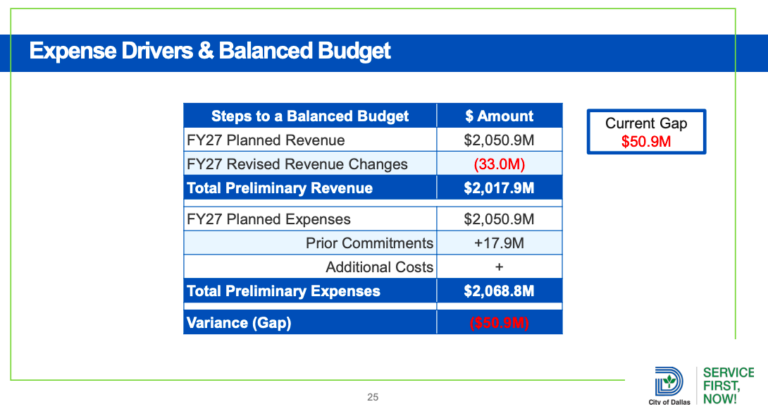
Unreliable sales tax revenue and steep increases in employee healthcare costs and public safety spending already threw the current fiscal year’s budget out of whack, prompting Tolbert to pursue selective spending freezes and mandatory furloughs to close a roughly $30 million gap. Projections from earlier this summer have the upcoming FY 2026-2027 out of balance to the tune of approximately $50 million.
Friday also saw the release of finalized property valuations after protests for Collin, Dallas, Denton, and Rockwall counties, which have homes and businesses located in the city limits. Total taxable value reached $237.7 billion, an increase of $11.3 billion (4.97%) from last year.
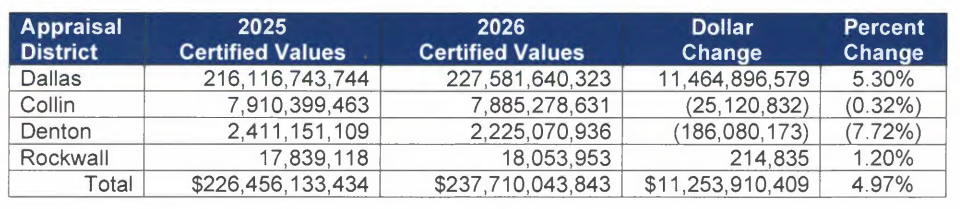
While that continues a years-long trend of rising property values, it falls short of the 5.05% growth staff projected when developing the city’s plan for the FY 2026-2027 budget. The difference is more than $180 million in taxable value.
Johnson said Dallas taxpayers “deserve another reduction” in the city’s property tax rate and warned that raising taxes would hurt the city’s long-term competitiveness. The city has reduced the rate every year for the last 10 years, bringing it down a total of 12.3% over the decade.
A budget survey suggested council members might be hesitant to lower it again, though, given the city’s financial problems. Just over half of the 15 council members said the city should maintain its current tax rate. Two said it should be increased, and four said it should be reduced.
“If we right-size City government, then we can continue to provide essential services efficiently while reducing the burden on taxpayers by lowering our City’s property tax rate as we have done every year I have been in office,” Johnson said. “If we do not act now, the City will eventually run into a far more severe revenue problem and face the grave risk of stalling, or even reversing, the progress we have made in attracting businesses, residents, and investment into our city.”
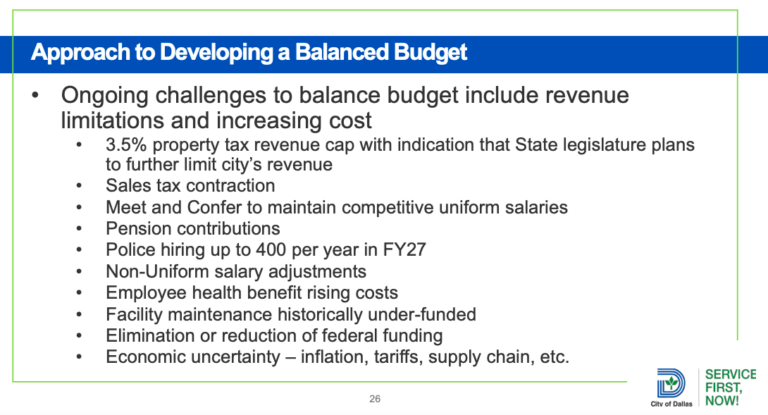
He said City Hall should prioritize certain core responsibilities such as public safety, streets, infrastructure, parks, planning and development, and code compliance, arguing it would be more appropriate for other government agencies or the private sector to handle some programs.
“Each department’s budget must be scrutinized for waste and excess spending. And we must streamline and standardize our internal procurement process for necessities such as software, equipment, and furniture,” Johnson said. “But I am not suggesting arbitrary, across-the-board cuts for their own sake. That type of indiscriminate cutting has severe unintended consequences.”
The mayor also encouraged staff to pursue new revenue sources. He pointed to initiatives undertaken in other cities, like leasing café space in public libraries and implementing commercial loading fees in the city center. He also suggested evaluating existing service fees; expanding public-private partnerships, sponsorships, and concession agreements, particularly within the Park & Recreation Department; and charging higher user fees to non-residents at city-supported attractions and amenities subsidized by residents, like the zoo and Dallas Arboretum.
Other council members will no doubt be coming up with their own budget recommendations, with many having already acknowledged the city’s dire straits and the corrective action that needs to be taken.
Residents will also have multiple opportunities to weigh in. Budget town hall meetings are scheduled across the city from August 11 through August 25. Click here to see the finalized schedule.
Budget workshops and public hearings are on the city council’s calendar, too. Tolbert will have a recommended budget ready for council members to consider on August 11. It’ll be refined by officials in the following weeks, before a final budget and property tax rate get adopted on September 16.