
Dallas Officials Signal Possible Staff Cuts, Policy Changes as Budget Gap Grows
Share News:

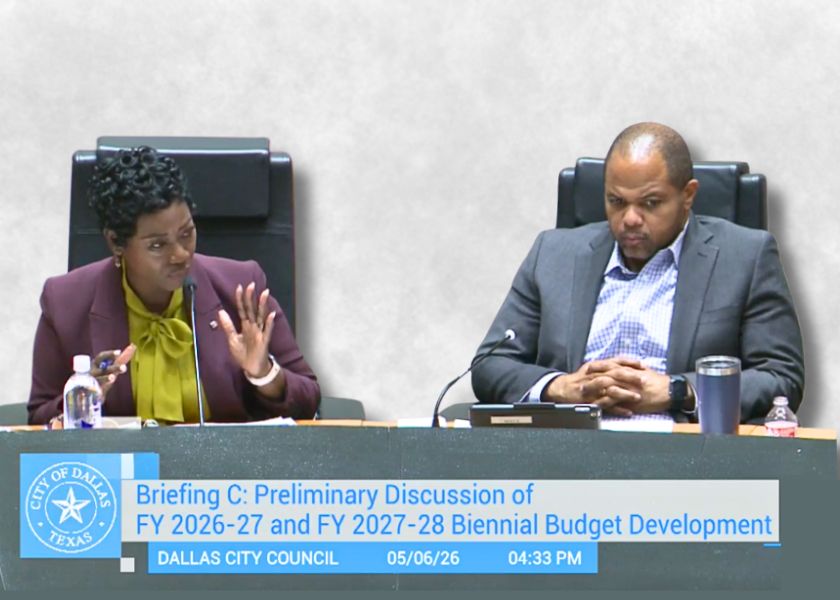
The Dallas City Council is trying to get a handle on the city’s fiscal problems, signaling what measures may need to be taken to arrive at a balanced budget come the fall. And it ain’t going to be pretty.
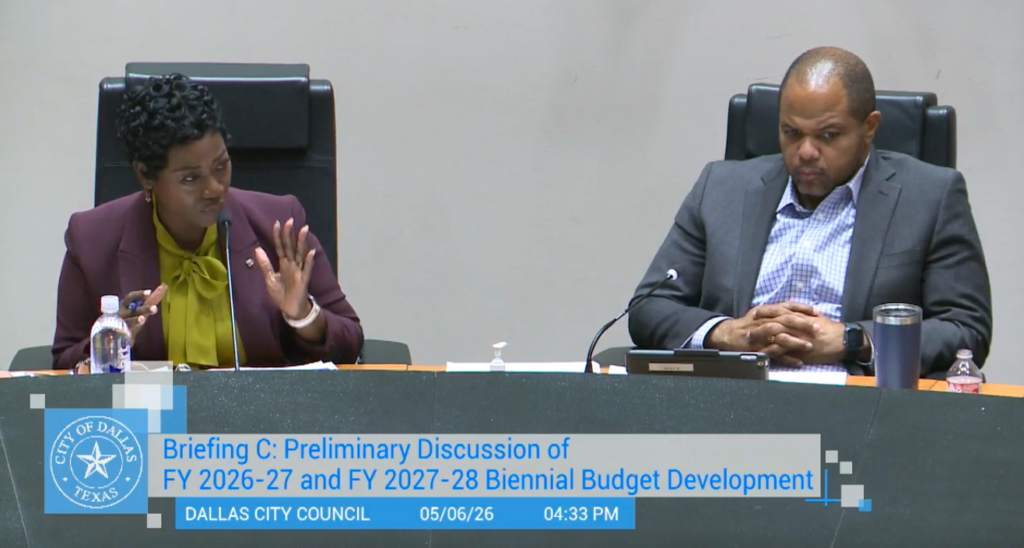
On Wednesday, staff gave council members a briefing on the budget situation, elaborating on the drivers behind the current shortfall and fielding questions about where savings could be found in the proposed budget for FY 2026-2027.
State of Play
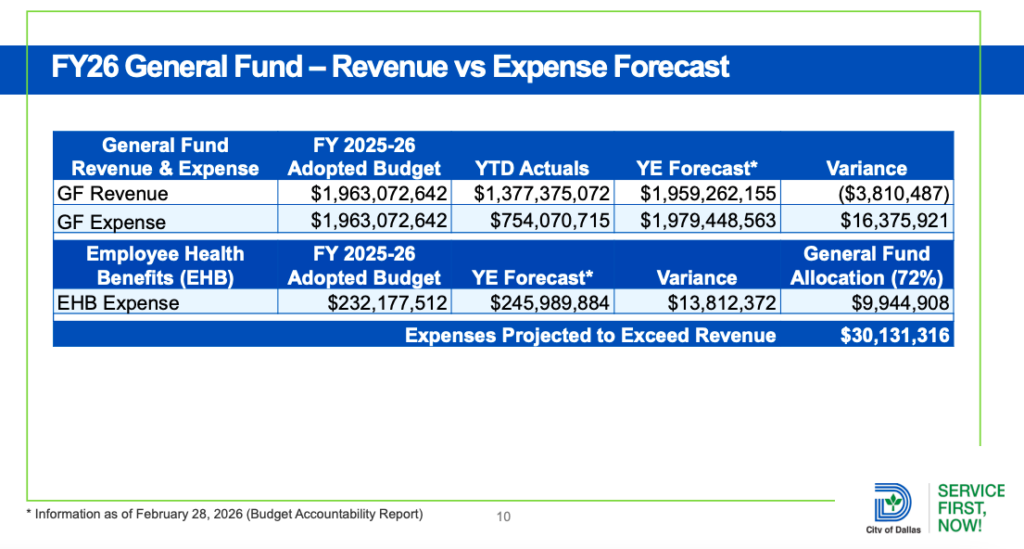
As it stands, sales tax revenues for this fiscal year are projected to be about $6 million short of expected, though increases in service charges are offsetting that by $2.1 million. Meanwhile, increases in police and firefighter overtime and police starting pay and recruitment are set to put public safety operations $14 million over budget. Dallas Park & Recreation and Dallas Animal Services are also spending a few million more than initially projected. And health benefit claims for city employees are coming in nearly $10 million more than expected.
Staff explained that public safety spending was up because of mandatory overtime to maintain minimum staffing levels due to unscheduled leave among firefighters, and that overtime expenditures for police were being impacted by the increase in pay mandated by Proposition U. On the healthcare claims front, staff noted that 116 employees (so far) had medical claims exceeding $100,000, and there’s been a marked spike in pharmacy claims, particularly for specialty medications and GLP-1 drugs.
Emergency spending measures were implemented late last month by City Manager Kimberly Tolbert to offset the spread, but she suggested more could be necessary in July if actual revenues and spending veer further off course and the gap doesn’t close.
Tough Road Ahead
Revised projections for FY 2026-2027 indicate sales tax revenue will decline by $5.1 million compared to what was forecasted last budget season. And service charge and fee revenues are expected to come in $14.7 million under. A revised projection for property tax revenues won’t be developed until after tax protests get sorted out during the summer.
Spending projections have also been updated, with revised expense figures totaling $16.4 million over what was forecasted due to an increase in contracts (crossing guards and custodial at Dallas schools, bridge and street maintenance, and new public safety technology). And that’s just what could be revised up to this point in time. Variances in expected police hiring, meet and confer negotiations with first responders, preventative building maintenance, and other items have yet to be determined.
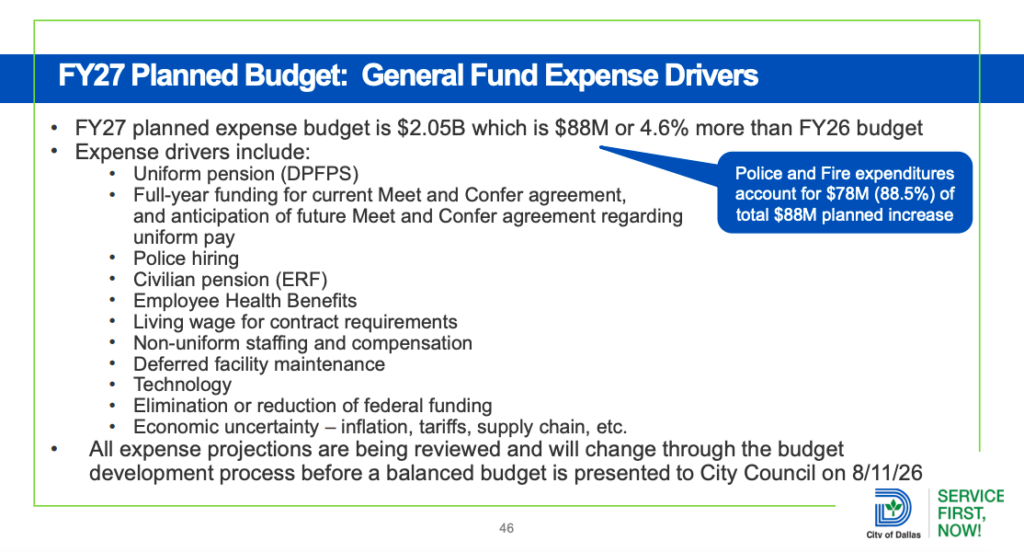
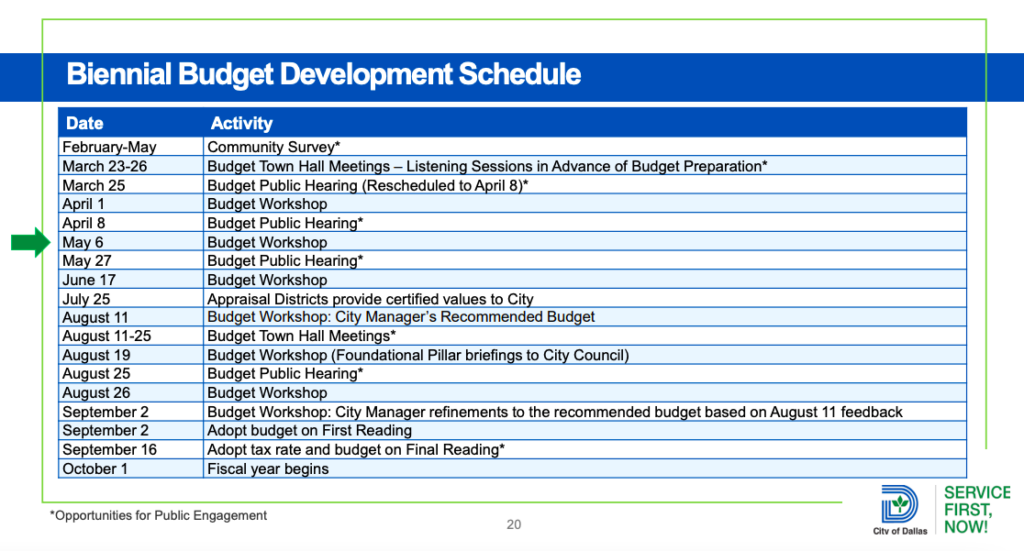
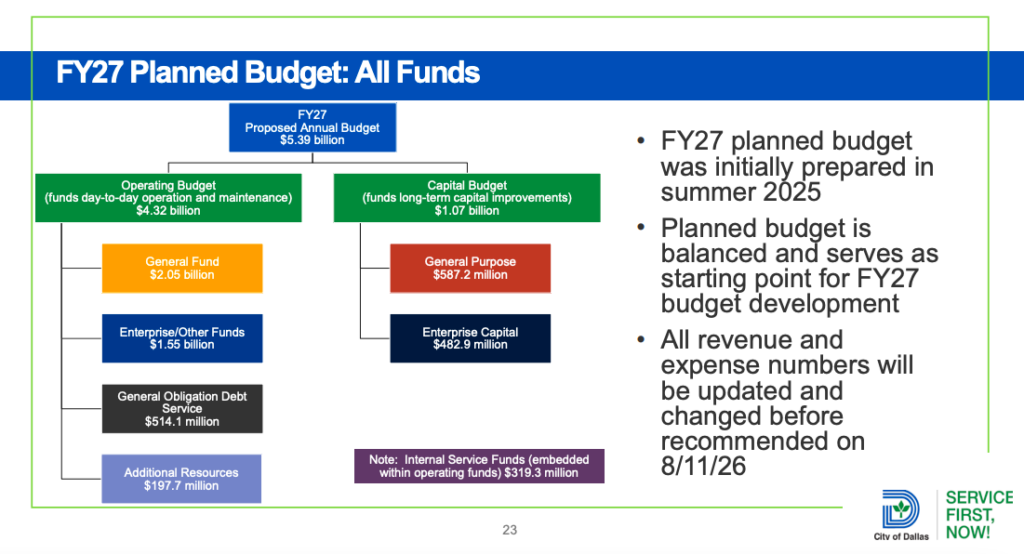
“We know that fiscal year ‘27 is now out of balance, with expenses exceeding revenue by $37.7 million,” said Budget & Management Services Director Janette Weedon. “Revenues are still growing, but they’re growing at a slower pace than historical trends. Expenses continue to rise and outpace revenue growth, and so throughout the budget development process, staff will rebalance fiscal year ‘27 assumptions, and then we will present a balanced budget on August 11.”
Council Survey Says…
Staff polled council members to get a sense of their priorities so that it might be easier to get to a consensus and reduce the number of budget amendments this budget season. However, the survey design was criticized by some at the horseshoe for being overly simplistic and reliant on city branding (the Foundational Pillars). That being said, there were some notable results worth mentioning.
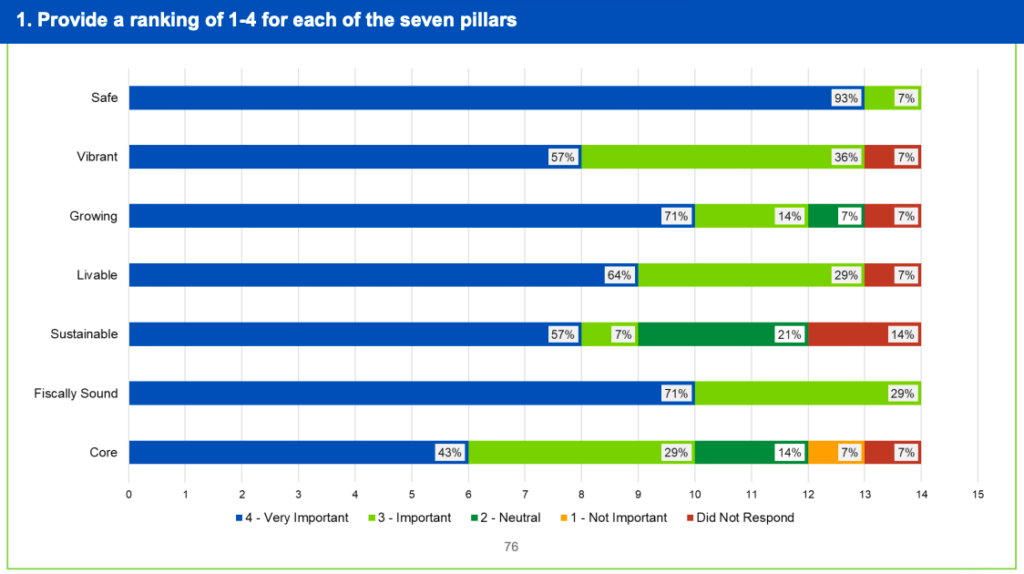
All 15 council members said the “Safe” pillar, which basically represents public safety spending, was very important (14) or important (1). The “Fiscally Sound” pillar also polled high, with 10 saying it was very important and 5 saying it was important. The two were the only pillars not to receive a single “neutral” or “not important” vote. You can read more about the pillars and what they represent in terms of priorities and spending items in this fiscal year’s Budget Book.
Some of the more straightforward questions teased out a majority sentiment. For instance, 57% of council members agreed with the statement that “the city should implement phase-down reduction of funding to partner organizations (including stipends) that have received funding from the city for 5 or more years.” The remainder were neutral. Similarly, 64% agreed that city decision-making should be based on data analytics. Only 7% disagreed, and the rest were neutral.
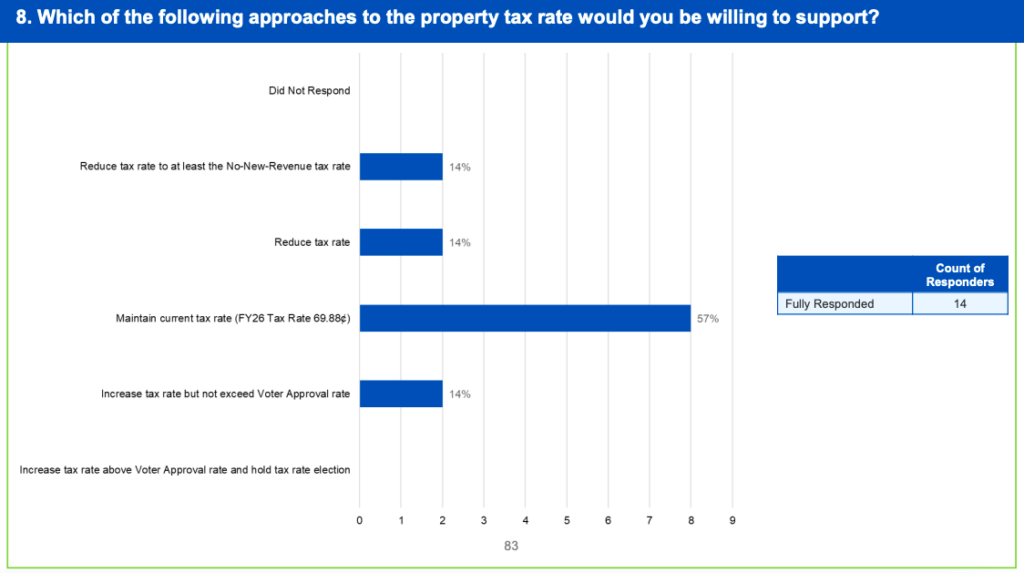
One of the more eyebrow-raising questions gauged council members on what they thought the approach to the property tax rate should be. Eight out of the 14 who responded to the question said the city should maintain the current rate. Four said it should be lowered further, despite disagreeing on how far. Two said it could stand to be hiked, but not enough to trigger a tax rate election.
People Are Costing Too Much
Council members signaled where they’d like to see adjustments made in the budget, forecasting some of the flashpoints we’ll likely see in future budget development hearings this summer.
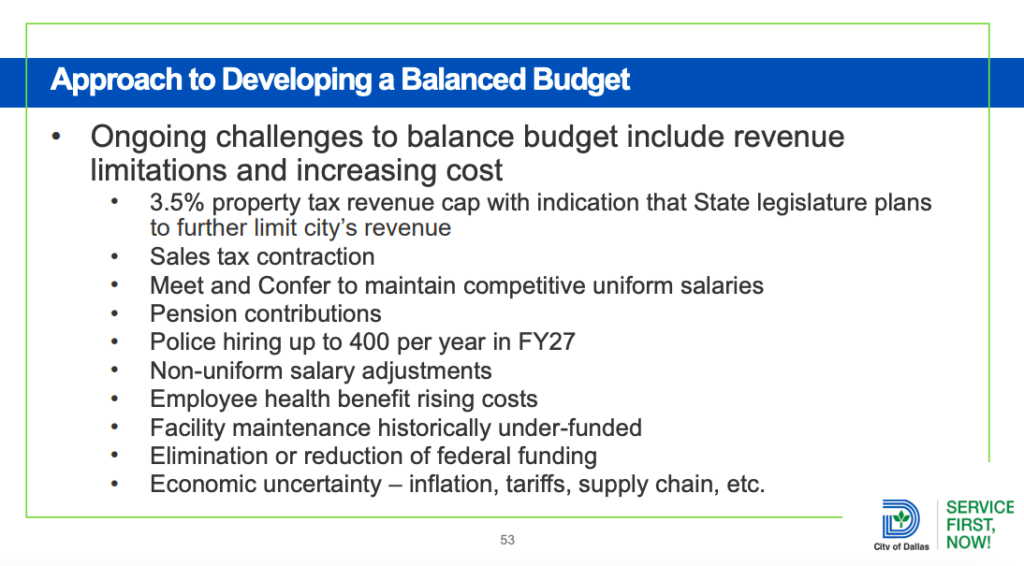
Headcount at the city’s various departments came up a few times, which may portend a reduction in staffing levels. It’s too soon to glean whether that means layoffs or the slashing of vacant positions. City CFO Jack Ireland said there were 15,589 positions at present.
“When I started in 2019, that 15,000-plus number was 13,000,” said Council Member Cara Mendelsohn, who criticized the time-off benefits and incentives city employees get. “Every problem with our budget could be fixed if we get our staffing back on level.”
Ireland said the city has tried not to add any new civilian positions over the last couple of years, instead repurposing vacant positions whenever there was a new need.
“72% of our operating budget is spent on personnel, so I understand that’s where a lot of the expense is, and therefore we have to look at it constantly,” he said.
Council Member Jesse Moreno (District 2) acknowledged it made sense that departments would grow along with increased services — new recreation centers that need park staff, for instance — but suggested cuts should be targeted.
“When we see other departments growing and aren’t seeing the results, those are the areas that I want to be looking at,” he said. “I do want to thank the city manager for cutting from the last budget when we had vacancies, and I think that’s a good start. I think we need to look a little bit deeper there.”
Council Member Gay Donnell Willis (District 13) signaled some agreement, noting that she was against an across-the-board approach to cutting spending.
“It sounds like with the priority-based budgeting that’s the direction we’ve already started going,” she said. “We need to think about the things that we want to sustain and grow that may be possible, but also what we need to reduce or cut. If it’s not going to be effective if we reduce the funding, then we may need to partner or [rehome some programs].”
Outsourcing jobs, transitioning roles to part-time positions, and even privatizing certain services were all brought up at one point or another as ways to shed full-time roles that come with salaries, overtime, health insurance, and pension benefits.
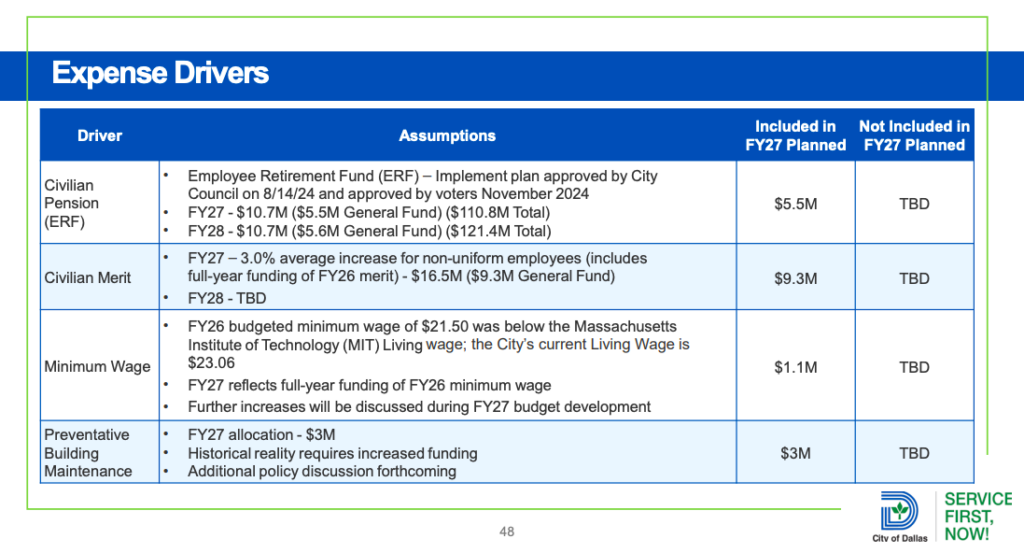
There was also discussion about the city’s current living wage policy, which is based on a formula developed by MIT. The current living wage (the lowest pay) offered by the city to its staff and contractors working on city projects is $23.06 per hour.
“One thing that I think you’re going to see is that there are some cost increases that we’re actually experiencing now due to some of our contracts, contracts that we had before when the living wage was a different amount than what it is today,” said Tolbert. “You’re going to be seeing some of those come to you for approval in the next few weeks.”
Some other cost-saving measures raised included pushing burdens onto partner entities; reducing or cutting partner stipends; evaluating city fleet usage, bike lane usage, and software subscriptions; prioritizing programs that directly or indirectly generate revenue, and leveraging AI.
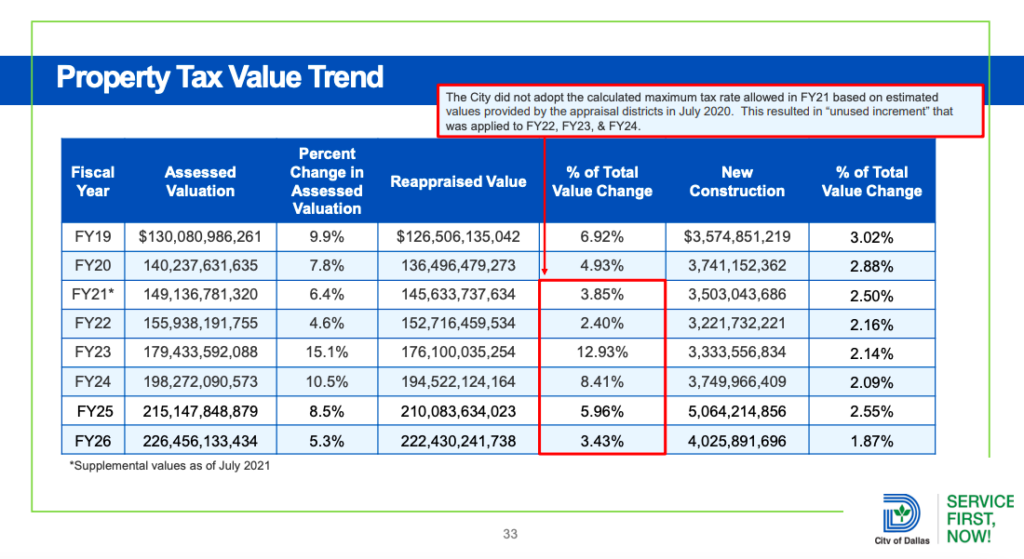
One thing appears completely outside of the city’s control: whether the state legislature decides to once again lower the cap on the annual increase in property tax revenue a city can collect without voter approval. The cap currently sits at 3.5%.
Staff was asked what would happen with the budget.
“I think we’ll start with … we need prayer,” Tolbert said.







My opinion – Police and Fire Fighters are our two most important staff for the City of Dallas. They are a priority. When an emergency strikes, these are the first two you think of to want as soon as possible.
I wonder how they can have a monetary problem when property values (and tax receipts) are up? Just asking….