Dallas Officials Revisit Property Tax Exemptions Amid Budget Crunch
Share News:

Dallas officials are entering budget season facing a difficult balancing act: maintaining property tax relief programs that have long been a priority of the Dallas City Council, while confronting slowing revenue growth and looming budget pressures. Staff is already having to recommend significant cuts, and sales tax projections aren’t looking good, leaving the city short on revenue.
Staff drafted its annual review of property tax exemptions for senior and disabled homeowners, which the Finance Committee will be briefed on Tuesday. The presentation also includes broader property tax collection data from the last 11 years.
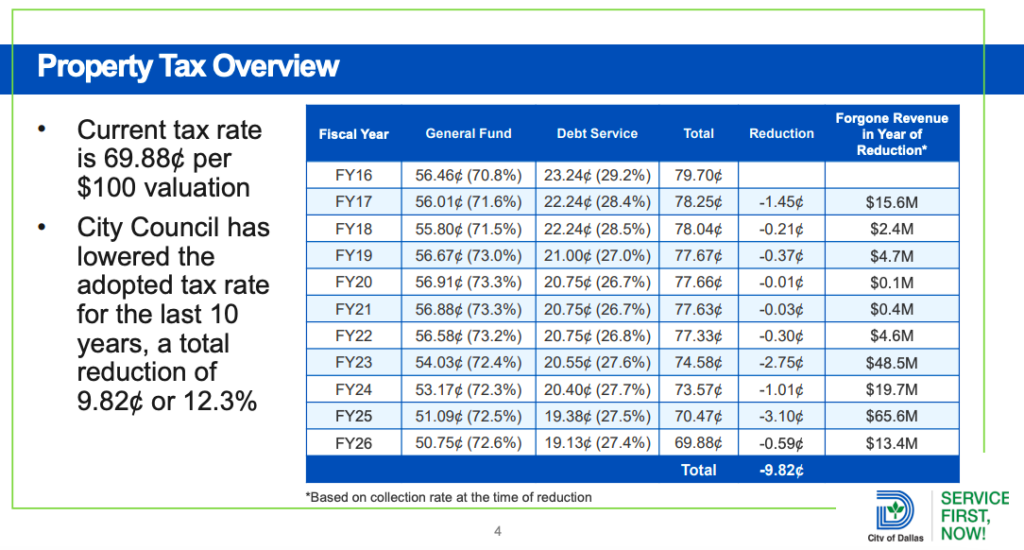
Like it or not, property taxes remain Dallas’ single largest source of revenue, generating around $1.55 billion this fiscal year. Roughly $1.13 billion (73%) is dedicated to the General Fund, while another $424.6 million (27%) goes toward debt service obligations. The current tax rate sits at 69.88 cents per $100 valuation, coming off a cumulative reduction of 9.82 cents (12.3%) over the past decade.
An important factor in the adoption of a tax rate is the Texas Property Tax Reform & Transparency Act of 2019, which caps property tax revenue growth at 3.5% unless authorized by an election. This means officials are sometimes required to lower the tax rate depending on the amount of growth in the city’s tax base. So when property values skyrocketed in the aftermath of the COVID-19 pandemic, the city council opted to lower the tax rate (by quite a lot in FY 2023 and FY 2024) rather than seek voter approval.
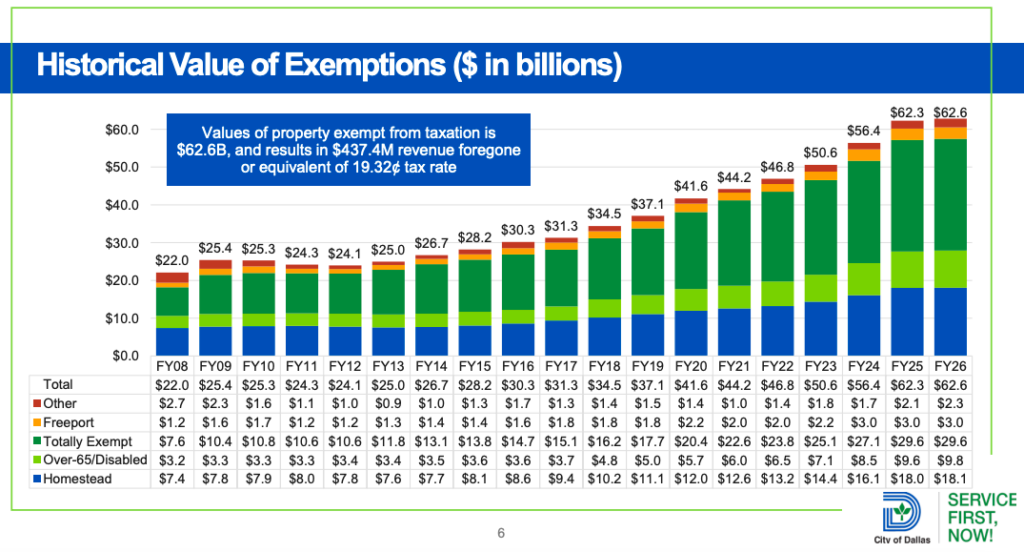
Staff said taxable values citywide total about $226.5 billion for this fiscal year, but approximately $62.6 billion of that value is exempt from taxation, resulting in about $437.4 million in forgone revenue. Among the city’s largest exemptions are the standard homestead exemption and the senior/disabled exemption.
Dallas currently offers the maximum homestead exemption allowed under state law — 20% for owner-occupied homes — which accounts for $18.1 billion in exempted value and roughly $126.2 million in forgone revenue.
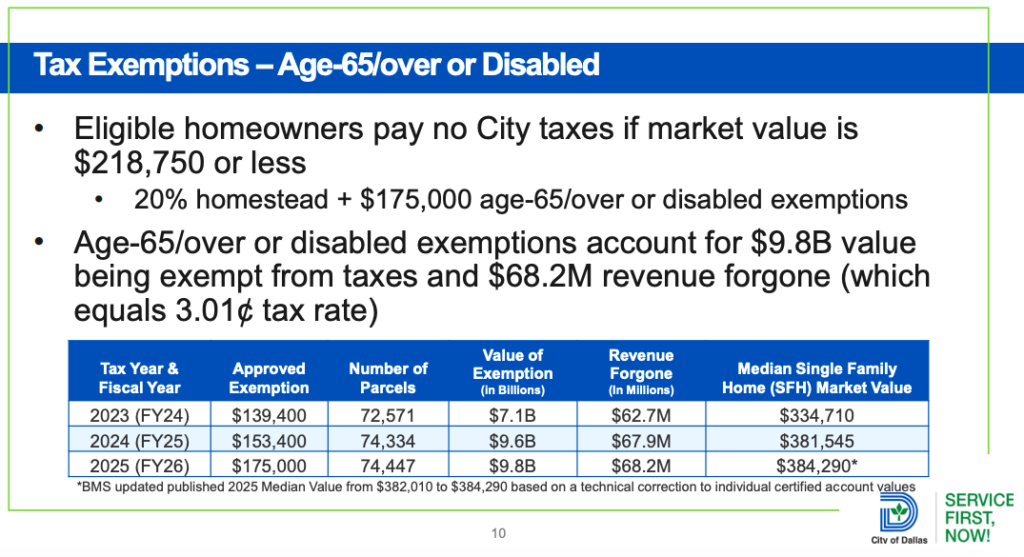
The senior/disabled exemption was first established in 1986, and it’s grown substantially since then. Originally set at $50,000, it is $175,000 this fiscal year, costing an estimated $68.2 million in revenue, according to the presentation. Under the current exemption structure, homeowners who qualify for both pay no city property taxes on homes valued at $218,750 or less.
City policy requires staff to compare the senior-disabled exemption every year against inflation and changes in residential property values before presenting possible modifications to council members.
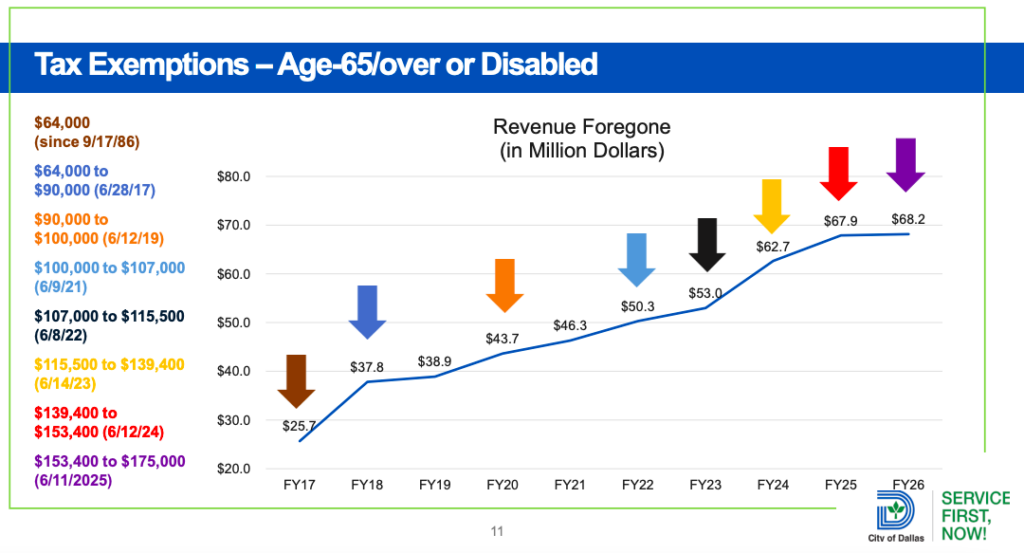
Staff outlined two possible scenarios for consideration based on those factors. One option would raise the exemption to $181,600 based on inflation, while another would increase it to $176,300 based on growth in median home values. The inflation-based increase would result in an additional $3.4 million in forgone revenue, while the smaller increase tied to home values would cost about $700,000, according to the analysis.
Council members haven’t indicated where their heads are at with the senior-disabled exemption, but a budget survey suggested the body might be hesitant to lower the tax rate given the city’s financial problems. Just over half of the 15 council members said the city should maintain its current tax rate. Two said it should be increased, and four said it should be reduced.
At present, staff is planning on an allocation of $1.178 billion in property tax collections to go to the General Fund, with the remainder of whatever is collected going to service debt. That figure is expected to change, though, once property tax protests shake out this summer.