
Homebuyers Getting Cold Feet, Pending Sales Fall Through at Record Rates
Share News:


A record percentage of pending home sales fell through last month in what could either be a bad signal for the housing market or just discerning buyers flexing their renewed clout.
Researchers at the listing website Redfin dug into December’s pending-sale data, and they found that more than 40,000 home purchase agreements were canceled last month nationally — an all-time high for any month. Some 16.31% of pending sales went south, marking a bump from the 14.9% clocked in December 2024.
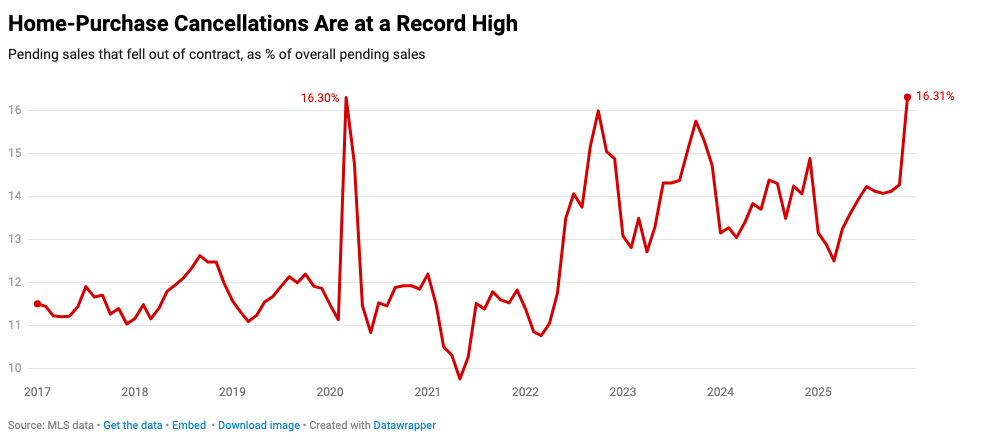
Markets in Dallas and Fort Worth saw even greater shares of pending home sales fall through, logging 18.1% and 18.9%, respectively.
Now, Redfin only started tracking the data in 2017, but the national spike in canceled contracts is still worth noting considering when other similar highs occurred. December 2025 only barely edged out the previous all-time record: March 2020 (16.30%). Everyone remembers what happened that month, right? That was when the United States declared COVID-19 an official pandemic.
Two other notable spikes in canceled home purchase agreements tracked with surging mortgage rates, with one in October 2022 (15.99%) and October 2023 (15.75%). Mortgage rates have been on a pretty steady downward trajectory over the last year. They’re even hovering around the purportedly all-important 6% threshold for the 30-year. So what’s the data trying to tell us now?
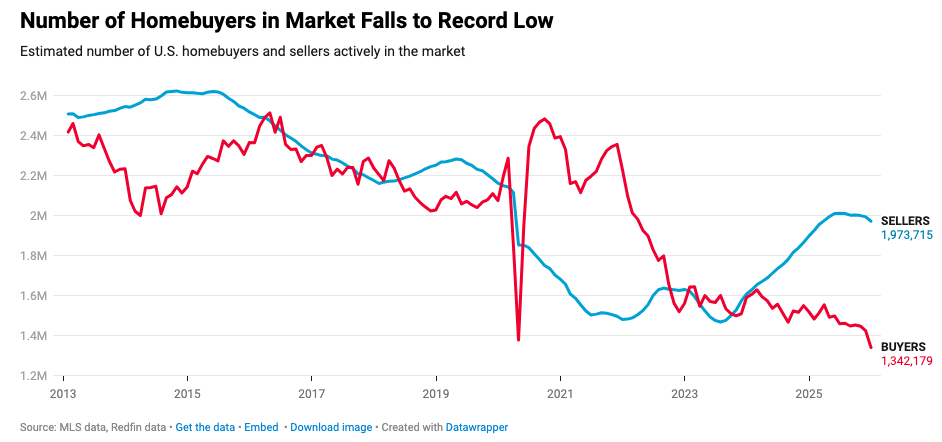
“High housing costs and rising inventory have made homebuyers more selective,” said Redfin’s head of economics research, Chen Zhao. “Home sellers outnumber buyers by a record margin, meaning the buyers who are in the market have options and may walk away if they believe they can find a better or more affordable home.”
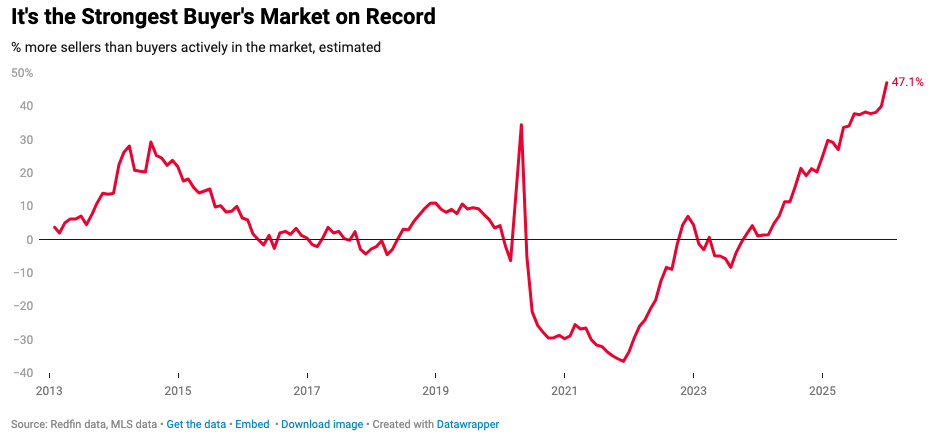
Going by the numbers, that may very well be what’s going on. There were 47.1% more sellers than buyers last month, the high for a single month since 2013. Empowered buyers, though, might not be the only dynamic play. It’s not just that they have way more options; it’s also that there are so few of them entering the market.
Pending home sales also dropped last month to their lowest level since at least 2012, with only around 329,000 homes going under contract. December is slow for residential real estate in any given year, but it’s not encouraging to see the slowest month in more than a decade.
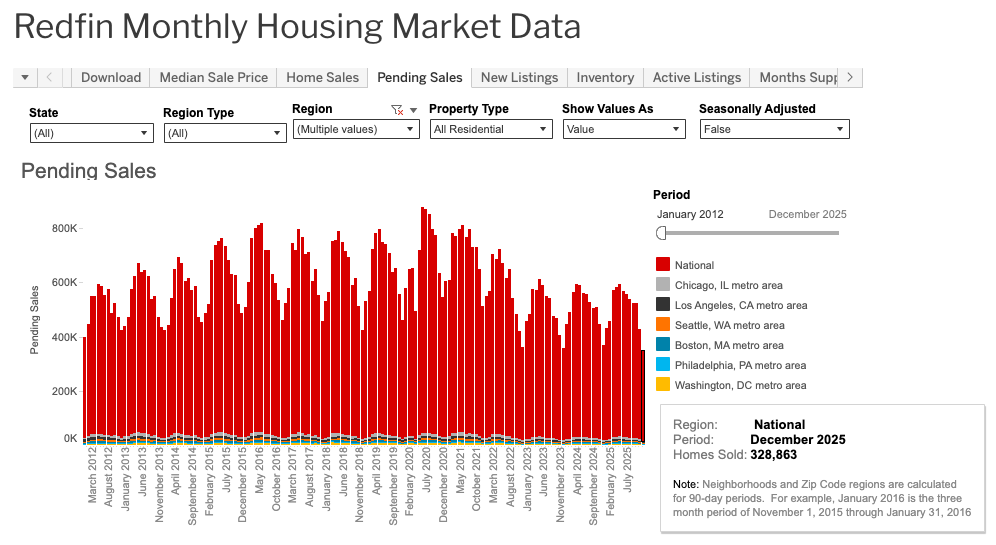
“Homebuyers are skittish due to stubbornly high housing costs, layoffs, and mounting economic and political uncertainty,” a Redfin report reads.
On Wednesday, the Federal Reserve announced it was opting against implementing another benchmark interest rate cut in its first meeting of 2026, despite some even signs from the overall economic picture. Mortgage rates aren’t directly tied to the central bank’s benchmark, but they do tend to head in the same direction, with the Fed setting expectations for investors.
“Available indicators suggest that economic activity has been expanding at a solid pace,” reads the Fed’s post-meeting statement. “Job gains have remained low, and the unemployment rate has shown some signs of stabilization. Inflation remains somewhat elevated.”
Buyers can break a home purchase agreement primarily by invoking contract contingencies built into the deal, most commonly during the inspection, financing, or appraisal periods. If inspections reveal problems, financing falls through, the home appraises below the purchase price, or issues arise with title, surveys, or HOA documents, buyers can usually terminate without penalty as long as they act within required deadlines.