
City Hall Roundup: Clean Zones, Concrete, Less Pavement
Share News:

Another week of City Hall business yielded some transformational updates to the development code, marking another signal achievement of the current Dallas City Council.
Between passing ForwardDallas 2.0 last September and finally accomplishing parking reform this past week, council members are setting the stage for the city’s future growth and development — just not to everyone’s liking.
Here’s some of what went down at City Hall the last several days.
World Cup 2026: No Unauthorized Commercial Activity
The 2026 FIFA World Cup is going to be in Dallas before you know it, and the city’s making preparations to crackdown on any unauthorized marketing and vending.
As part of its contract with FIFA to host tournament games next summer, City Hall agreed to police unsanctioned commercial activity in and around designated locations associated with World Cup activity (downtown, Fan Fest, team lodging, etc). It will do so by establishing “clean zones” at these locations.
Staff briefed the Ad Hoc Committee on Professional Sports Recruitment and Retention on Monday on their plans to amend the city code to beef up enforcement mechanisms that will be used to snuff out unauthorized activity in the clean zones.
“A clean zone is a defined geographical area surrounding a permitted activity footprint or an event venue where temporary restrictions are enforced related to temporary advertising, signage, structures, transient merchants, vendors, or other licensed activities,” explained Jacqueline Justice, assistant director of Convention and Event Services.
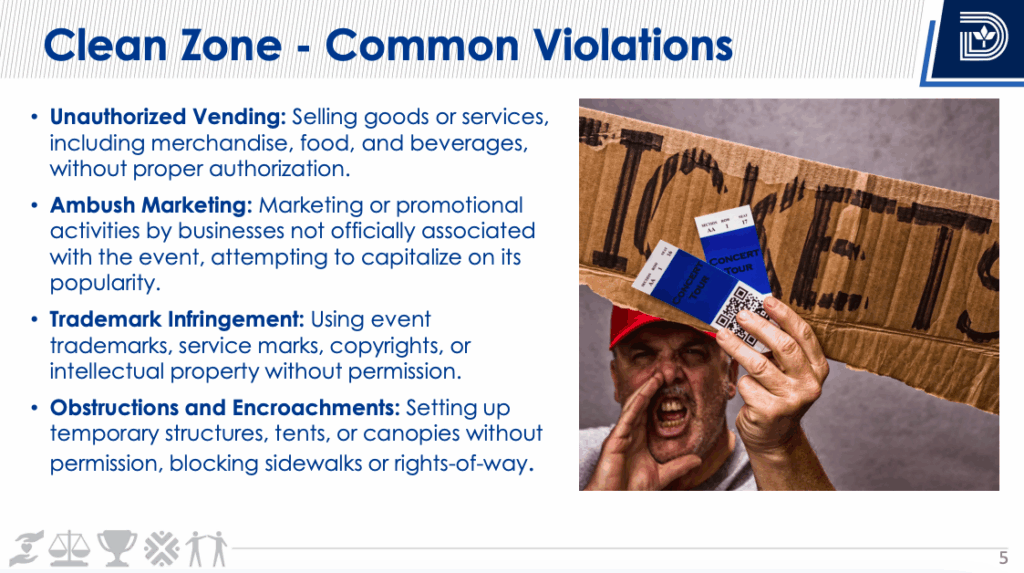
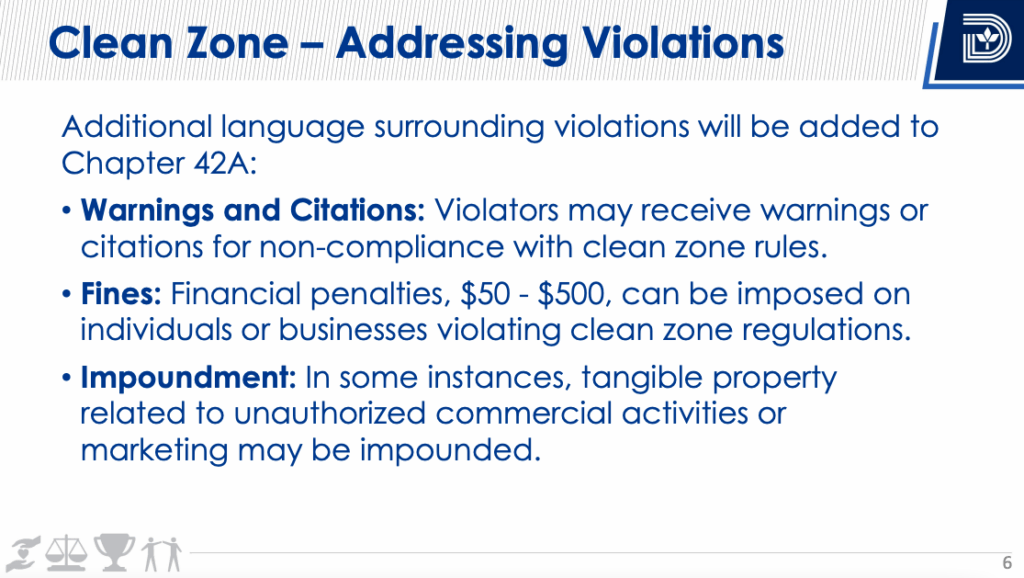
She said clean zones have been deployed by City Hall before and they’re already provided for in the city code to combat a lot of the activity FIFA wants to make sure is prohibited.
“Examples of that would be a food truck that pulls up on the street curb outside of a crowded bar to capitalize on the people there, ambush marketing like an energy drink company pulling up in a branded vehicle and passing out product to passersby but not authorized to do so, or someone selling t-shirts with a FIFA logo while having no affiliation with FIFA,” Justice said.
Council Member Jesse Moreno (District 2) asked staff whether the clean zone ordinance would apply to private property as well. Justice said it would.
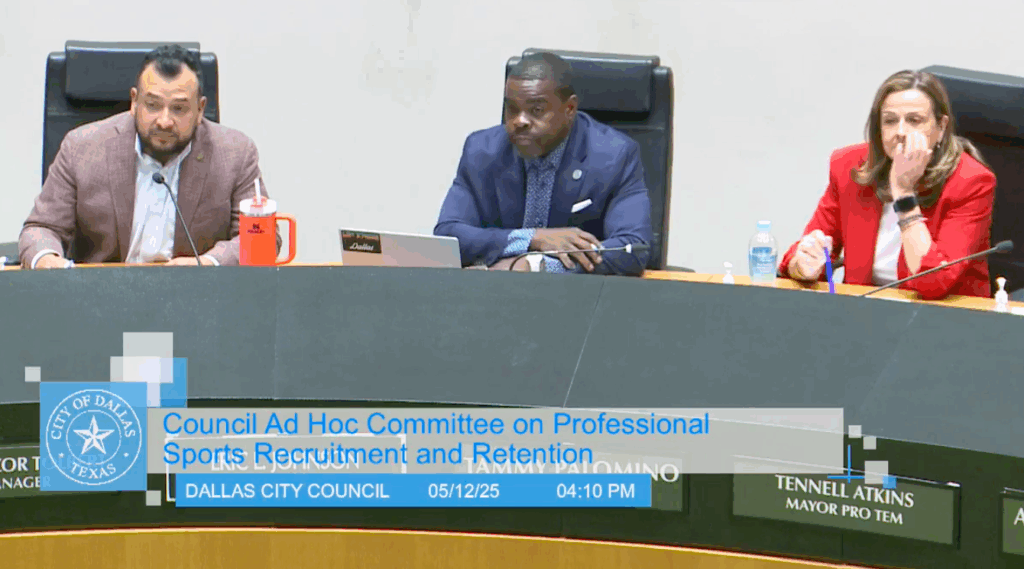
“So we would basically be not allowing a private operator to sell certain merchandise or have an extension of their front door onto their patios? … Well, I definitely have some concern with that,” Moreno said.
Justice said staff will work up some language for the clean zone ordinance and brief the committee via memo before the matter is brought before the full city council. She said they want to have the ordinance sorted out before January.
Dallas Controversies Tend to Come in Batches
So, for those who don’t know, there’s a Dallas park called MoneyGram Soccer Park just west of I-635 and Walnut Hill Lane in District 6’s Elm Fork neighborhood.
The 120-acre soccer complex was built on top of a former landfill and opened in 2014 with 19 fields. While it’s unclear whether this came up at the time, the park was built in relatively close proximity to multiple concrete batch plants and other industrial facilities in a part of town zoned for industrial use.
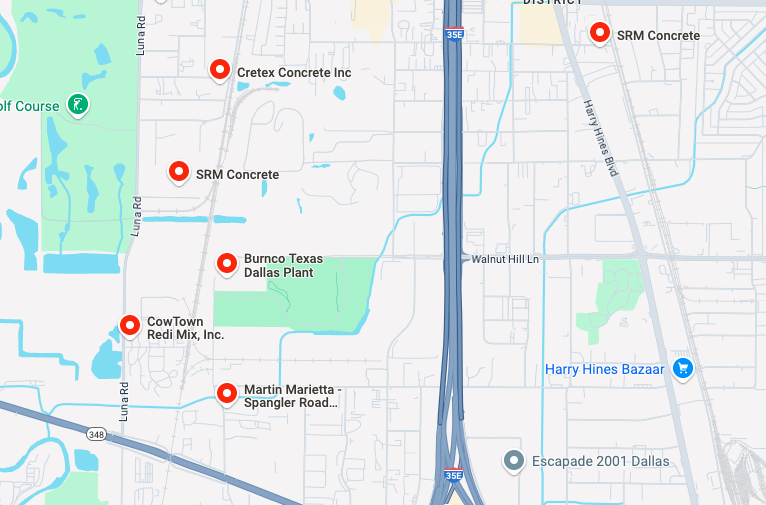
Fast forward a little more than a decade and a small business owner named Brandon Johnson is trying to get a batch plant going at the corner of Manana Drive and Spangler Road, less than 1,500 feet from the closest soccer field.
Environmentalists and concerned residents who utilize the park have been speaking out against Johnson’s special use permit request, pointing to potential health hazards from his proposed operation, never mind that there are already no fewer than half a dozen functional industrial sites within a mile of the soccer complex. Johnson’s batch plant wouldn’t even be the closest one.
The City Plan Commission voted to recommend denying Johnson’s request, and the matter went before Dallas City Council on Wednesday. Council members were perplexed as to why previous officials at City Hall built the park there to begin with, but there was plenty of acknowledgment that Johnson wasn’t being unreasonable in his request.
“Nobody in the community is wrong; everybody’s right,” Council Member Omar Narvaez (District 6) said, according to The Dallas Morning News. “And that’s what really makes this suck for me.”
District 6 has the most industrial real estate out of all the city council districts in Dallas by a pretty wide margin.
“I’m just a small little guy around the corner that just wants to pour some concrete for the city. We just want the same opportunity as they do to operate a business,” Johnson said, referencing the area batch plants purportedly owned by much larger companies, per NBC DFW.
Council members decided to delay their vote on Johnson’s request, opting to pick the matter back up in two weeks.
Parking Reform Rundown
The city finally updated the off-street parking requirements in the development code after more than five years of wrangling. Dallas City Council voted 14-1 on Wednesday to reduce or scrap parking space minimums for a variety of project types, a move critics claim will lead to fewer spaces across the city and more spillover parking in residential neighborhoods.
In a nutshell, City Hall wants developers to have more flexibility in deciding how many parking spaces to build on a project.
Officials hope developers will rightsize parking (which is purportedly underutilized at present) and put Dallas’ limited space to better use. More housing, increased DART usage, and less carbon emission are some of the benefits touted by advocates of the code update.
Here’s a word-for-word breakdown the city sent out explaining the changes:
Parking Reform
- DOES ONLY apply to off-street parking provided on private property.
- DOES NOT regulate or change the on-street parking provisions or regulate the street right-of-way. This is covered by On-Street Parking & Curb Management Policy adopted by Dallas City Council in 2024.
- DOES NOT change existing PDs that have parking lot ratios.
Amendments include some notable updates to the City’s parking requirements including:
- REMOVING:
-parking mandates in downtown and within 1/2-mile of light rail and streetcar stations.
-all mandates for any use located in historically designated/landmarked properties.
-parking mandates for offices and most retail uses.
-parking mandates for industrial and heavy commercial land uses except when next to a single-family home located in single-family zoning.
-mandates for bars and restaurants under 2,500 square feet.
-mandates for institutional and recreation uses. But maintain mandates for places of worship over 20,000 square feet, and senior high schools. - REDUCING:
-parking mandates for residential uses, including a tiered approach for multifamily developments, and a change in ratio from a “per bedroom” to a “per dwelling unit” requirement. Larger developments will be required to provide at last 1 space per dwelling unit, the medium ones will be required to provide at last ½ space per dwelling unit, and smaller developments under 20 dwelling units have no parking mandates. Reserved guest parking for medium and large developments is required, as well as areas for short-term parking for drop-off and pick-up.
-parking mandates for bars, restaurants, and commercial amusement inside uses. - ADDING loading requirements for larger multifamily developments.