
Buckle Up for Dallas’ New Parking Ordinance
Share News:

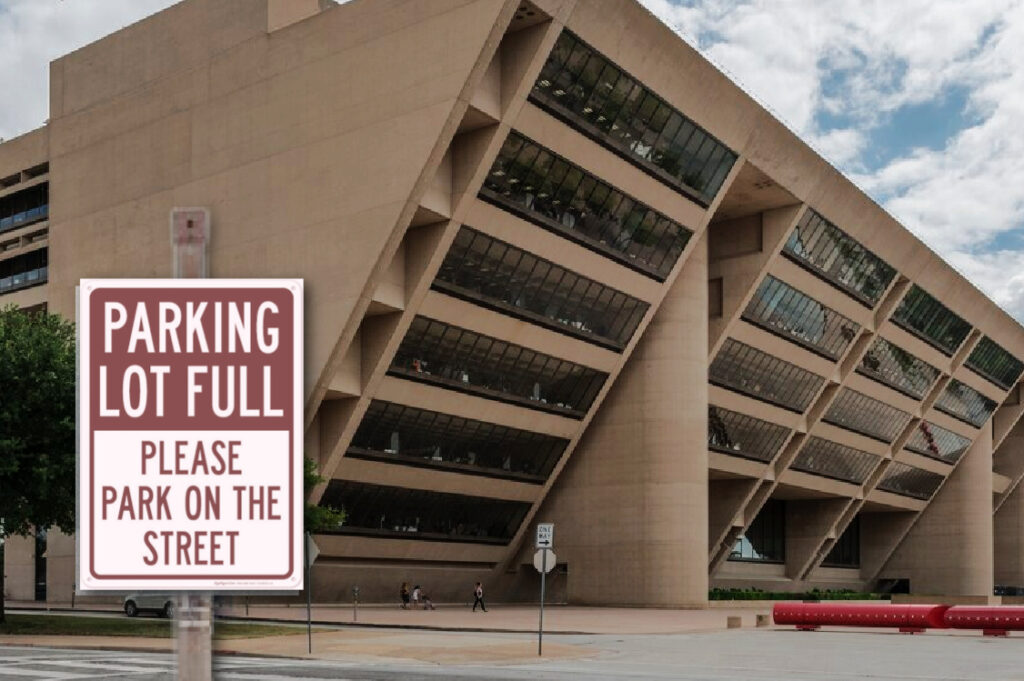
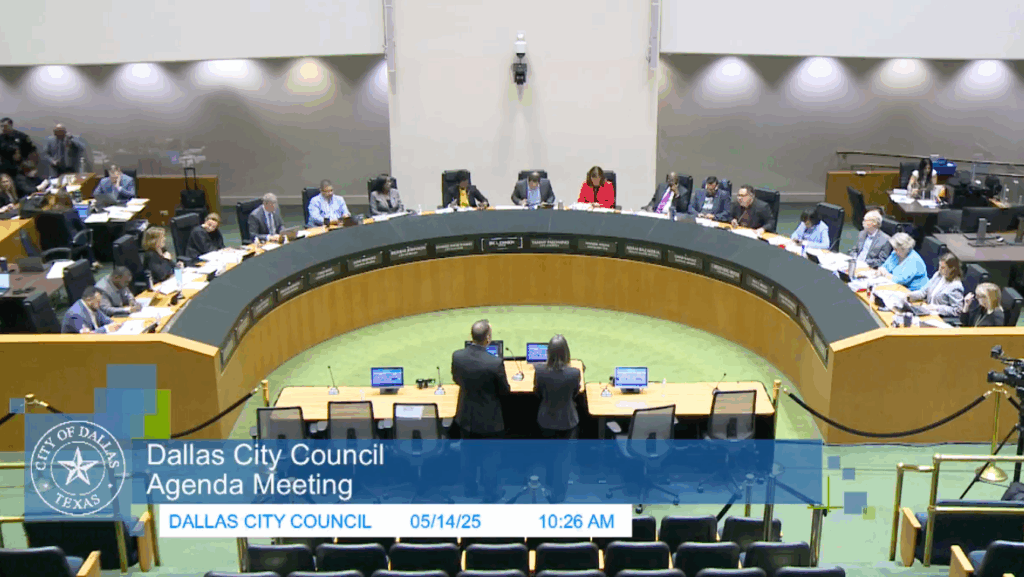
With a 14-1 majority, Dallas City Council members voted to reduce or abolish parking minimums across multiple development types on Wednesday, finally putting parking reform to bed after staff began the effort almost six years ago.
Only Council Member Cara Mendelsohn (District 12) voted against the ordinance, even though others had concerns about the potential impact of a decrease in parking across Dallas.
For years, the city’s development code had required developers to build a minimum number of off-street parking spaces based on project use and square footage. It was basically a ratio system that critics claim was outdated in the age of Uber and Lyft and failed to take into account proximity to public transportation.
Other cities — such as Austin, Birmingham, Sacramento, Seattle, and Minneapolis, among others — have eliminated or reduced parking minimums.
Staff initially proposed abolishing all parking minimums to encourage the production of housing and stimulate economic growth, arguing that a lot of existing parking is underutilized in Dallas and that it would be preferable for the market to rightsize instead of being constrained by purportedly antiquated and arbitrary requirements, as previously reported by CandysDirt.com.
As the proposal was heard by various city commissions and committees, an outright ban was scrapped in favor of a hodge podge of varying minimum reductions and abolition in some cases.
The amended ordinance has been described by supporters as a reasonable compromise that would protect single-family neighborhoods from parking spillover and empower developers to make better use of the city’s limited space.
Unconvinced detractors, however, claim their neighborhoods are already suffering from spillover and less off-street parking will only make things worse. Residents in parts of Dallas that don’t have easy access to public transit also say they won’t benefit from the proposal and already struggle to find parking around town.
Community Members and Stakeholders Shared Their Two Cents
More than two dozen people spoke during the public comment portion of Wednesday’s meeting in a bid to sway council members one way or the other.
There was a lot of institutional support for the proposal, with speakers representing The Real Estate Council (TREC), DART, Dallas Builders Association, Environment Texas, Downtown Dallas Inc., Mothers Against Drunk Driving, Sunrise Movement Dallas, and Dallas Housing Coalition, among others, voicing support for the proposal.
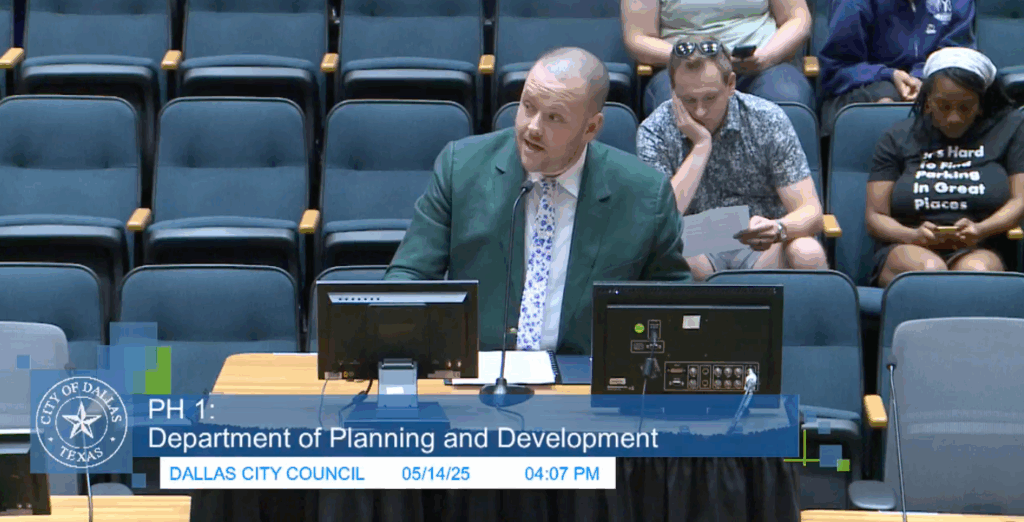
Michael Williams, TREC’s public policy and community relations manager, said that building parking is expensive and space-intensive. On the multifamily housing front, developers pass those costs onto renters.
“This compromise serves permit efficiency, reduces development costs for small and mid-sized projects, and frees land for housing, mixed-use, and transit-oriented development,” he said. “We believe this targeted approach is an important first step to move toward a more walkable, affordable, and economically vibrant Dallas.”
Other purported benefits touted by supporters of the ordinance included reducing drunk driving and car accidents, mitigating greenhouse gas emissions and the urban heat island effect (pavement and dark surfaces absorb and retain heat), and making the city a friendlier place for pedestrians and cyclists.
Local resident Hexel Colorado urged council members to vote in favor of parking reform, claiming fears about parking spaces disappearing across the city are mistaken.
“When you imagine talking to your children or your grandchildren about what you decided to do today and they ask you, you had an opportunity to fix our local climate, did you take that opportunity?” he said. “You had an opportunity to make our communities more walkable and more safe and just better, higher quality places to live. Did you take it?”
Although both sides had plenty of Dallasites advocating for their respective positions, those opposed to reducing or scrapping parking minimums were seemingly made up of individual residents who lived in single-family neighborhoods.
“My concern is that the developers will place greater importance on their ability to build more units for more profit instead of sufficient parking and that our neighborhoods are going to suffer because of all the cars on our narrow streets,” said resident Barbara Page. “This is a problem for weekly trash, for recycling containers, monthly bulk trash, and emergency vehicles to navigate their way through our neighborhoods.”
District 6 resident Debbie Solis said there’s already a shortage of parking in her part of town and that she and her community in West Dallas are underserved by DART.
“We do not have light rail access and we lost many of our DART stops in my community a couple of years ago,” she said, arguing that she and others cannot depend on public transit to offset the potential impact of fewer parking spaces.
Solis and a few others opposed to the proposal also claimed the city didn’t do enough to engage residents in the process or inform them about the coming change, which they feel could be significant.
‘People, Not Cars, Must Be the Priority of Our City’
Most council members celebrated the proposal and thanked staff for their years long work to finally deliver parking reform. They also acknowledged the concerns of residents but argued that change was necessary.
“People, not cars, must be the priority of our city,” said Council Member Jaynie Schultz. “Compromise and efficiency are the key in this case. …Dallas is one of the fastest growing places in America, and the parking situation is simply outdated and archaic. Current parking requirements have created acres of empty parking lots taking up space that could be utilized so much more efficiently.”
“We have a rare opportunity to give the people of Dallas something momentous and meaningful, and further delays will just make things worse,” she added.

Council Member Carolyn King Arnold (District 4) read a letter from a constituent opposed to the ordinance, which in part read, “We already have parking problems, and they’re common. This is not what homeowners signed up for, so this is a bait-and-switch scam.”
While Arnold went on to vote in favor, she advised staff to do better outreach in southern Dallas and also lamented the lack of additional enforcement mechanisms to police street parking.
“Let’s look at the consequences of some of our innovations and creativity,” she said. “We’ve got to make it work and not frustrate people.”
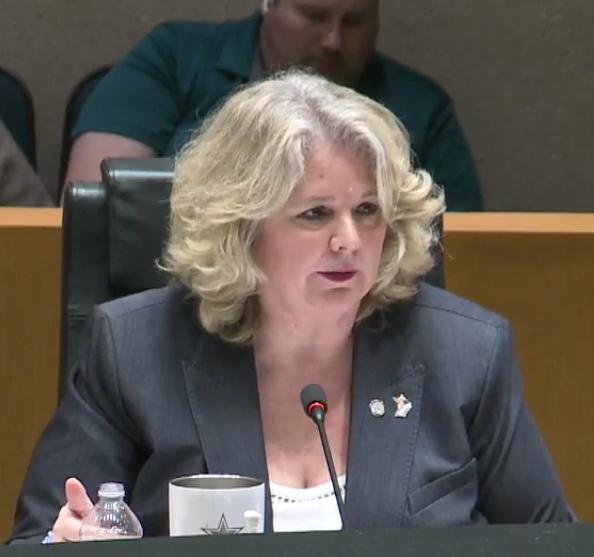
For her part, Mendelsohn decried the proposal and the process that put it before the city council, calling the ordinance “super urbanistic” and out of step with how many neighborhoods in Dallas have developed.
“This policy does not meet the needs of Far North Dallas, and what it’s really doing is shifting parking from off-street to taxpayer-funded streets,” she said. “It’s essentially a giveaway to the developers.”
Mendelsohn also claimed that community meetings with residents were purposefully not held by staff, pointing out that the people “who are saying pause, slow down, it’s not ready, are the residents.”
So How Much Parking Do Developers Have To Build?
Here are some of the highlights of what Dallas City Council passed broken down by development type with the new corresponding parking ratio (or lack thereof):
- Single-family homes and duplexes – 1 space per dwelling unit
- Multifamily housing with 200+ units – 1 space per dwelling unit
- Multifamily housing with 21-199 units – 0.5 spaces per dwelling unit
- Multifamily housing with 20 or fewer units – no parking minimum
- Multifamily housing with affordable units – no parking minimum
- Downtown and within 0.5 miles of light rail or streetcar stations – no parking minimum
- Office and retail – no parking minimum
- Bars, restaurants, and commercial amusement under 2,500 square feet – no parking minimum
- Bars, restaurants, and commercial amusement – 1 space per 200 square feet with exceptions
- Bars in buildings under 2,500 square feet – no parking minimum
- Restaurants – no parking minimum for the first 2,500 square feet
- Places of worship under 25,000 square feet – no parking minimum
CORRECTION: This article was updated at 2:57 p.m. on May 15, 2025, to correct Hexel Colorado’s first name.







Of course Cara Mendelssohn was against this . She wants to keep all these parking lots so the city can continue to look ugly.
One sane voice in the wilderness! And once again it is Cara Mendelsohn.
It’s very disappointing that in the high-density urban zones of Uptown, Lower Greenville Ave and Oaklawn, requiring only 1 space per residence or duplex will definitively result in overflow into our already congested and very limited street parking that is constantly clogged with Uber, Lyft, Amazon, UPS, FedEx, restaurant delivery, and USPS . The City should have at least required developers to make fee-in-lieu payments for these developments to enhance and pay for Parking Enforcement to 18 hours per day, 7 days a week as they already are not responding to 311 notifications about blocked streets and illegal parking in these areas. If the City would just do-its-job and enforce street parking rules, this would not be as much of a concern, but they don’t and they are broke so nothing will change.
And then so few vote… I am so committed to November elections. Democracy dies in darkness but it disintegrates when no one exercises their right to VOTE.
“People, not cars, must be priority.” Seriously? We don’t have wings. Therefore, most people prioritize a safe, affordable place to park their car,
When I moved downtown a decade ago, I paid $75/month for reserved parking. Now, I’m paying $200 for the exact same thing. So let’s have no parking minimums and create another thing that nobody can afford!
They’ve done this in Seattle. The biggest complaint with the fantasy of a city without or fewer cars is, if you live in one of these areas, NO ONE WILL VISIT YOU. Friends have told me how isolated they were, so they moved out of those areas of town with little parking.