
West Dallas’ District 6 Race: Candidates Debate on Housing and Development
Share News:

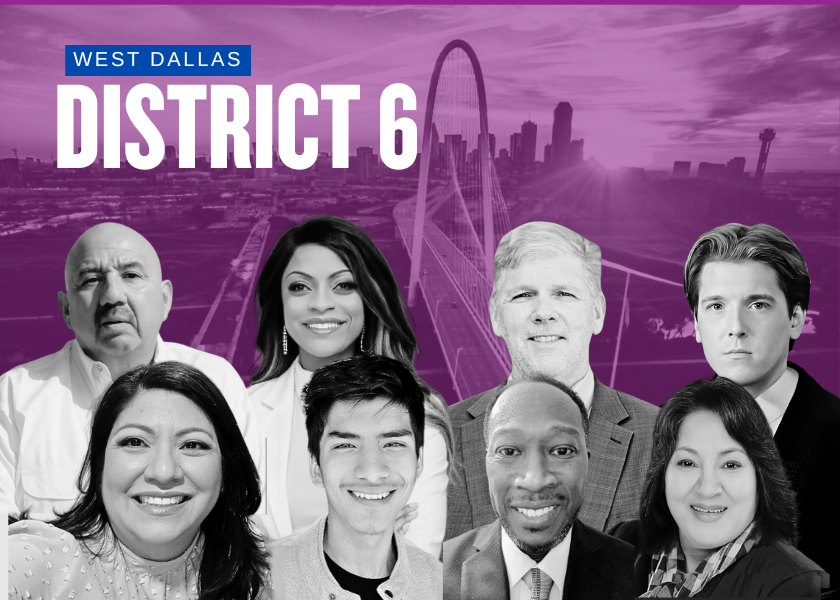
The Dallas City Council race for District 6 in West Dallas is going to be one to watch. With eight candidates vying for Omar Narvaez’s seat, you can almost guarantee there’ll be run-off election for this race.
Incumbent Omar Narvaez is term-limited, but his former Chief of Staff Laura Cadena is seeking to take his place. Also on the ballot are former candidate Tony Carrillo, former District 14 Councilmember David Blewett, photographer Gabriel Kissinger, former candidate Monica R. Alonzo, public speaker Machelle Wells, educator Linus Spiller, and entrepreneur Nicholas Quintanilla.
As West Dallas and the broader city at large continue to grapple with gentrification, rising property taxes, and housing affordability, District 6 city council candidates are offering different visions for the district’s future. While some argue for stronger protections for legacy homeowners and increased city intervention, others advocate for deregulation and market-driven solutions. Short-term rentals and zoning changes under ForwardDallas 2.0 also remain divisive, with candidates split on how to balance development with neighborhood stability. Here’s where they stand:
As a real estate-focused news outlet, CandysDirt.com is asking candidates about the housing issues their district neighborhoods face — and the more difficult question, what can be done as a city council member to improve housing affordability in Dallas.
May 3 Election: If you’re not sure what your city council district is, you can search your address for your city council district on the City of Dallas website. Alternatively, visit the city’s ArcGIS map to search your City of Dallas address.

CandysDirt.com extended these questions to each Dallas City Council candidate, offering them the opportunity to speak directly to our readers and their constituents. Here are unedited and unabridged responses for Linus Spiller, Gabriel Kissinger, Laura Cadena, Machelle Wells, and David Blewett in the order they were received. Monica R. Alonzo, Tony Carrillo, and Nicolas “Nico” Quintanilla did not respond.


Linus Spiller: Affordable housing is one need and capping Dallas County appraisal rates for homeowners is another need, but this issue is more complex than it seems on the surface.
In the NW Dallas/Bachman Lake area of the district, there is a mixture of residential properties and rental units that adequately accommodate population numbers. The issue is code enforcement related to excessive occupancy in single units and environmental issues in those same properties which the city manager’s office has not proactively addressed.
The city council’s reluctance to address this exacerbates the latter in terms of public safety and a NW patrol division that is stretched too thin servicing over 175,000 residents, businesses, and economic engines like the Asian Trade District.
In the West Dallas area of the district, gentrification efforts are ongoing and has created a situation where long-term residents are still losing that have been in their families for generations due to escalating property taxes. The need for affordable housing is critical for residents.
Compounding the affordable housing issue in West Dallas is its socio-economic standing which is one of the most disadvantaged communities in the country. Food deserts and food swamps are present, and crime is high which places a strain on the SW patrol division. Over half of residents live below the federal poverty line, a high percentage of residents live in public housing, and those who are still in rental properties pay roughly $400 a month.
The average apartment rental in Dallas can range from $1,500 – $2,000 so a community focus needs to be placed on education acquisition, including trades and certifications to increase the earning potential of residents to be able to afford housing based on current market rates.
These are all areas I will be a vocal advocate for and build consensus/support for internally and externally after being elected to the Dallas City Council.
Gabriel Kissinger: The most pressing housing need in District 6 is affordability, and the best way to address this is by empowering the market to meet the growing demand without relying on government intervention.
Dallas is experiencing a surge in population, and home values will continue to rise as more people move to the city. National inflation has also contributed to rising costs, including housing. To maintain affordability, significantly lowering property tax rates is essential. By reducing tax rates, homeowners gain more financial flexibility, making home-ownership more attractive. This increased affordability drives up demand for housing.
As demand grows, developers will be incentivized to build more homes to meet the needs of a rapidly expanding population. Cutting red tape and reducing regulations will further facilitate this process, allowing developers to bring new projects to market more easily and ultimately stabilizing prices.
By focusing on lowering tax burdens and eliminating unnecessary regulations, the city can create a more favorable environment for housing growth, helping prevent home prices and rents from spiraling out of reach.
Laura Cadena: Housing availability and affordability is an issue in District 6. Going forward, we must figure out better mechanisms–at the state and local level–to protect legacy homeowners in areas where new development is coming in at a fast and furious pace. To address some of these issues we must also look to public and private partnerships. This includes a mix of tools such as – home repair programs, homestead exemptions and assistance with tangled titles so that residents can stay in their homes if they choose and/or preserve generational wealth. In District 6, areas that were once industrial are now areas were affordable housing and density are occurring without displacing single family residents. The City also created the Housing Finance Corporation and Public Finance Corporation which has had several projects in District 6 to create affordable housing.
Machelle Wells: The most pressing housing need in District 6 is affordable living, which breaks down into three key issues: high property taxes that need to be lowered, the demand for affordable new construction, and the necessity for updated infrastructure. At the council level, solutions include trimming the budget by cutting wasteful spending and underperforming programs, and pressing the City Manager’s Office to make a firm commitment to addressing our infrastructure needs.
David Blewett: We need substantially more workforce housing. On Council we can improve the permitting/zoning process to help developers create more buildable housing lots.

Linus Spiller: The Dallas City Council should vote to reverse/rescind City Ordinance 32473 and all sections/subsections (amending Chapter 27 of the Dallas City Code and Chapter 51 of the Dallas Development Code), including the process of property owners submitting a short-term rental registration application of this ridiculous attempt at public policy.
I understand there are instances where property standards are questionable in certain neighborhoods where short-term rentals exist, events/parties can create excessive noise levels, and criminal actions may result but city ordinances governing those through code enforcement and police intervention already exist. It does not require additional regulation.
There is no need to penalize property owners providing a needed service for those on vacation who desire a place that feels more like home and can accommodate special needs like those who are pet owners.
I am currently in a short-term rental in the Bluffview area of Dallas with my spouse and two (2) pets due to work finally being done because of damage sustained by our home from the Dallas tornado of 2019, including asbestos abatement.
It has been a lengthy process, and we are extremely grateful our home insurance company who is covering the costs was able to connect us with this wonderful property owner and the fact the property is close to our home which allows us to monitor the massive construction repairs taking place.
If the current city council doesn’t reverse or rescind this ordinance, I will identify four (4) additional council members who are in agreement with me either by memorandum, draft resolution, or ordinance to have the mayor include on an agenda a presentation to the entire council why this ordinance is misguided, hinders city tourism, and impacts property owners providing a needed service whether to vacationers or individuals temporarily displaced.
Gabriel Kissinger: Short-term rentals provide homeowners with an opportunity to participate in a growing market, contributing to the local economy and offering affordable accommodations for tourists and visitors. However, we need to ensure that these rentals don’t disrupt the stability of our single-family, residential neighborhoods. I believe in a market-driven approach where property owners have the freedom to rent out their homes as they see fit, with sensible oversight that prevent excessive concentrations of short-term rentals in any one neighborhood.
At the same time, it’s important to give Homeowners Associations (HOAs) the freedom to manage and regulate short-term rentals within their own communities as they see fit. HOAs are in the best position to understand the unique needs and dynamics of their neighborhoods, and they should have the authority to determine whether short-term rentals are appropriate and to set their own guidelines for the area.
Additionally, we must focus on increasing the overall supply of housing through policies that lower property tax rates and reduce unnecessary red tape for developers, which will help keep housing prices affordable in the long run.
Laura Cadena: The matter of short-term rentals is currently working its way through the court system. Until the courts decide on the legality of our current policy, it is difficult to know how to best go forward.
Machelle Wells: I support allowing short-term rentals, as they present an opportunity to bring revenue into Dallas. I favor residents earning income this way, though I acknowledge the challenges that arise for both supporters and opponents. I believe we can find a balance that allows property owners to benefit while ensuring neighborhoods remain safe and stable, and without driving up living costs for renters, who are frequently impacted by these rentals.
David Blewett: We need to regulate “party houses” to prevent disruption in our neighborhoods and make sure short-term rentals are paying the Hotel Occupancy Taxes.

Linus Spiller: I was one of the original Planning Ambassadors for ForwardDallas and volunteered to participate because I was curious how it would not only impact my individual community but affect communities citywide.
While I am a supporter of mixed-use development, that should be a decision made by council members and residents in their district as to how land is zoned whether residential or commercial, the existence of community amenities, and what businesses can operate in each district.
Taking a page out of the NW Dallas/Bachman Lake community, I was part of a small yet vocal movement to remove adult establishments off the Northwest Highway thoroughfare closest to Bachman and push them into an industrially zoned area a few miles down the highway. It was the community’s choice, and I support the will of the people.
Due to that stance, I cannot support ForwardDallas 2.0 in its current form.
Gabriel Kissinger: Yes. ForwardDallas 2.0 does not provide adequate protections for single-family zoned neighborhoods against the possible encroachment of townhomes and duplexes. Without clear safeguards in place, developers could possibly push these high-density housing types into traditionally residential areas, fundamentally changing the character of these neighborhoods.
Instead of benefiting current residents, ForwardDallas 2.0 could drive up housing prices and transform Dallas into a “rent city”, where large developers and corporate investors dominate the market. This would reduce private property ownership, leaving more families dependent on renting rather than owning their homes, eroding the American dream of home-ownership and shifting power away from individual homeowners.
Additionally, it also seems that the city is pushing this plan to increase tax revenue, which they already waste far too much of. The growing influence of out-of-state corporate interests in Dallas’ housing market will make it even harder for working families to own property. This undermines community stability and places more control in the hands of big business and the government, rather than local residents. We need policies that promote private home-ownership, not government-driven growth that forces residents into rental properties.
Ultimately, while ForwardDallas 2.0 claims it emphasizes growth, we must ensure that development does not come at the expense of the values that have made Dallas great—values like strong, vibrant neighborhoods where homeowners can enjoy their properties and live without unnecessary government interference.
Laura Cadena: In District 6, the residents supported Forward Dallas because of the Environmental safeguards that would help protect our neighborhoods. District 6 residents were actively involved in the compromises made to Forward Dallas prior to its passage and met with City staff regularly. With any plan it needs to be reviewed and updated. The plan is required to be reviewed periodically and I am certain that there will be updates moving forward.
One lingering concern is that in general, Forward Dallas 2.0 primarily considered using existing residential neighborhoods to create “missing middle” housing. However, in District 6 we have huge tracts of old commercial and warehouse uses—areas full of parking lots and aging warehouses—within shouting distance of downtown—whose land use declares “no residential.” Long term, we need to look at the possibility redeveloping these areas for missing middle residential. The transportation infrastructure in this area is excellent and could easily handle the increased traffic.
Machelle Wells: My biggest concern with ForwardDallas 2.0 is that not enough attention is being paid to its impact on District 6 communities. While the focus seems to be on new buildings and infrastructure, there’s insufficient discussion about the people affected by these changes. Specifically, I worry about the lack of concern for residents facing rising costs and potential displacement, which could result from this development push.
David Blewett: I live in and support Single Family Neighborhoods. Changing that zoning to Multi-Family designation threatens neighborhood cohesion, delivery of city services, and potential public safety.

Linus Spiller: Related to public safety during this time where Dallas has an interim police chief, the city council should work with the City Manager Kimberly Tolbert and the chief on a multi-year recruiting strategy that doesn’t remove officers off the streets and prioritizes where the 900 additional police officers mandated with the passage of Proposition U will be assigned.
The council’s public safety committee and affiliated city departments should base allocation of officers based on crime statistics as well as types of crimes being committed which the NW and SW patrol division should stand to gain officers based on existing crime data. It is critical for the city council to demonstrate leadership during this process as Moody’s has downgraded our city rating from stable to negative which will have an impact on future bond programs and corporations/businesses decision to relocate to the city.
Regarding infrastructure needs, especially in District 6 with the current and previous representatives not advocating for increased funding for the district during city bond programs, the city council must prioritize where these funds are going to be directed. For the Dallas 2024 Bond Program which has ten (10) proposition totaling $1.25 billion dollars, the lack of prioritization is evident in how the funds were allocated:
Proposition A – $521,200,000 for streets and transportation, Proposition B – $345,270,000 for parks and recreational facilities, Proposition C – $52,100,000 for flood control and storm drainage, Proposition D – $43,530,000 for libraries, Proposition E – $75,200,000 for cultural and performing arts facilities, Proposition F – $90 million for public safety facilities, Proposition G – $72,300,000 for economic development, Proposition H – $26,400,000 for affordable housing and neighborhood revitalization initiatives, Proposition I – $19 million for permanent, supportive, and short-term housing for unsheltered individuals, and Proposition J – $5 million for Dallas’s IT infrastructure.
I was on the Dallas ISD sub-finance committee for its 2020 Bond Program and its $3.7 billion dollar sticker cost. There were five (5) propositions on the ballot, the first two (2) dealing with renovating or replacing campuses and IT purchases and upgrades. The remaining three (3) targeted improving athletic facilities, a new visual and performing arts center, and renovating pool facilities in the district.
Voters passed the first two and rejected the remaining three. While the district did not know how to prioritize, voters did even though we structured the bond program so taxpayers would not face a tax increase. The City of Dallas followed suit with its 2024 bond program and had no tax increase but dropped the ball in terms of needed priorities.
Gabriel Kissinger: Public safety and infrastructure are the top priorities of my campaign, as well as the backbone of a thriving District 6. On public safety, we need to be fully equipping our police force with the resources and training they need to address crime effectively. District 6 has the highest amount of overall crime in Dallas, and we must take immediate action. We should support Proposition U to expand our police force to 4,000 officers, increase starting salaries to attract and retain top talent, and fully fund the police and fire pension plans.
When it comes to homelessness, focus needs to be on a treatment-first policy. Housing should only be provided after individuals undergo treatment to address underlying issues like addiction and mental illness. Those who refuse assistance should be held accountable, for public camping and disorder in our streets can not be tolerated.
On infrastructure, we must fix the basics—repairing roads, potholes, sidewalks, and alleys. Dallas has been ranked among the top ten dirtiest cities in America, and we need to prioritize street cleaning and waste management. Focus also needs to be on revitalizing aging buildings and underdeveloped areas by cutting bureaucratic red tape and encouraging private investment. These efforts will not only enhance the quality of life in District 6 but will create a better environment for business and residential growth.
However, none of this can happen without fiscal responsibility. We need to ensure that funding goes towards these common-sense priorities. It’s time to cut wasteful spending, eliminate non-essential programs, and redirect funds to the necessities that will drive real progress, like public safety, infrastructure, homeless solutions, and sanitation. With projected budget shortfalls over the next three years, it’s crucial that we focus on the essentials and address the $6.9 billion deficit before we can afford to fund non-essential programs and events. Our future depends on making smart, sustainable investments in the well-being of our communities.
Laura Cadena: Public safety is extremely important. My cousin is in law enforcement, and we talk about this issue a lot. There is a national shortage of officers. We need to find ways to help recruit and retain police officers.
In District 6, our Lakewest storefront is a model for community policing. Our officers know community members, attend community meetings, and recently started bike patrols. Bike patrols allow for greater interaction with community members. In fact, some of our local non-profits and businesses donated e-bikes for our officers to use, and we were the first in the city to have e-bikes.
We also need to replace aging fire stations. In District 6, we have been able to access other sources of funding to replace fire stations.
Regarding infrastructure, the city needs to work with partner agencies to address some of our infrastructure needs. For example, District 6 worked with the North Texas Council of Governments to create a Bachman Area plan with community input in multiple languages. In addition, when federal or county programs are announced, the city needs to be ready with shovel-ready projects to access much-needed federal dollars.
We need to find a better way to maintain our streets on an ongoing basis instead of deferring most street maintenance to bond issues. Doing deferred maintenance on streets now gobbles up the majority of our bond money available in every bond issue, thereby reducing our ability to invest in storm drainage, fire stations, libraries, and maintaining our municipal buildings. We may need to look at what other cities are doing.
Machelle Wells: The actions needed to address public safety and infrastructure are as follows:
Public Safety: The City Council must ensure the implementation of Propositions S and U, as voted on by Dallas residents. This will enable us to address community needs, with a strong focus on crime prevention. We need to restore adequate funding, staffing, and equipment to our police department, ensuring they can patrol and protect the areas where they’re most needed. Additionally, I propose increasing police salaries to a competitive level compared to other cities. Officers perform a dangerous job and deserve compensation that reflects their service.
Infrastructure: We should invest in beautification across District 6, including better lighting for well-lit areas, improved roads for safer and smoother driving, and cameras in strategic locations to help reduce crime.
David Blewett: We should prioritize public safety and improving public infrastructure. Budgets are about priorities. The voters are telling us what they want. We should listen.

Linus Spiller: I want voters to know I am a 29-year resident of District 6 and consider myself an anchor in the district. I have worked in both areas of the district as a civic leader/volunteer to address the issues I am running on. I have served as a board member including leadership roles with a high number of area organizations including City of Dallas and Dallas ISD commission and committee appointments.
I do not approach serving on the Dallas City Council as a right, an entitlement to be passed on, or civic service to be taken by force as was the case in 2017 when I made a bid for the seat. Public service, fiduciary responsibility, and policymaking are serious because thousands of lives are affected at the district level and impact at the city level. How council members approach this responsibility has an effect decisions businesses and corporations make to relocate to Dallas which translates into growth for the city, including job opportunities for residents, increased sales tax revenue, and potential decreases in property taxes.
For more information, visit my website at: electlinusspillercampaign.com.
Gabriel Kissinger: I would like voters to know that I’m a fighter and that I plan to serve, not special interest, but the people. My top three priorities are as follows…
District 6 leads Dallas in overall crime, with theft and drug offenses surpassing citywide averages. Rising motor vehicle thefts, the growing fentanyl crisis, and homelessness—bringing encampments and public safety hazards—demand urgent action. My top priority will be ensuring our police and first responders have the resources they need to combat these challenges, and I will fight to fully fund the well-deserved police and fire pension.
At the same time, I will take a strong stance on fiscal responsibility. We can’t afford to waste taxpayer dollars on non-essential programs. I will fight to redirect funding to the services that matter most—public safety, infrastructure, and homelessness solutions—focusing on common-sense priorities that will benefit all residents of District 6.
To improve the quality of life in our community, I will also prioritize infrastructure improvements, including enhancing street cleaning, repairing potholes, and revitalizing aging buildings. I’ll work to streamline redevelopment processes and foster public-private partnerships that will help attract investment, create jobs, and boost economic growth. With these efforts, we’ll build a District 6 that is safer, cleaner, and more prosperous for families and businesses alike.
For more info, visit my website at (www.gabrielfordallas.com).
Laura Cadena: My family has lived in District 6 for over 80 years. I love District 6. It’s where my grandparents lived, where my parents grew up and met in 8th grade and the district that shaped me into who I am.
Prior to working at the city, I was actively involved in the community as a volunteer. When I came to work at the city my intention was to learn as much as I can to help my community. For almost 8 years, the residents of District 6 allowed me to advocate for issues important to them. I plan to continue to be present at community meetings and events throughout our district. I also plan to keep residents, nonprofits and businesses informed. District 6 is on the rise, we are known as showing up to City Hall to provide input, help shape policy and having our voices heard.
Machelle Wells: As your Dallas City Council candidate for District 6, I want every residents to know this: I work for you. Period. I’ve walked in your shoes, lived your struggles, and felt your experiences, I get it. You are seen, you are heard, and I’m here to fight for you with unrelenting determination. Our district shines with potential, yet too many priorities have been neglected for far too long. No more empty promises, it’s time for someone to roll up their sleeves and get to work. That someone is me. With many years of experience serving underrepresented communities, I will be your voice, your advocate, and your problem-solver. I’ll tackle every issue head-on, ensuring no concern is ignored and every resident is valued. I’m here to serve you, fight for you, and deliver REAL results.
David Blewett: I have served on Dallas City Council before (2019-21) and can hit the ground running to help solve the city’s critical issues.




Do any of the candidates on these list want the share the plan to address the out of control prostitution, drugs and crime infested streets by the Asian District [area od 35, 635 and Walnut Hill]?. Our city continues to ignore these extreme and out of control problems!