
Staff Puts Faith in Free Market to Sort Out Dallas Parking Policies
Share News:


City staff got put in the hot seat on Monday during a meeting of the Dallas Economic Development Committee, during which the controversial subject of parking reform was discussed.
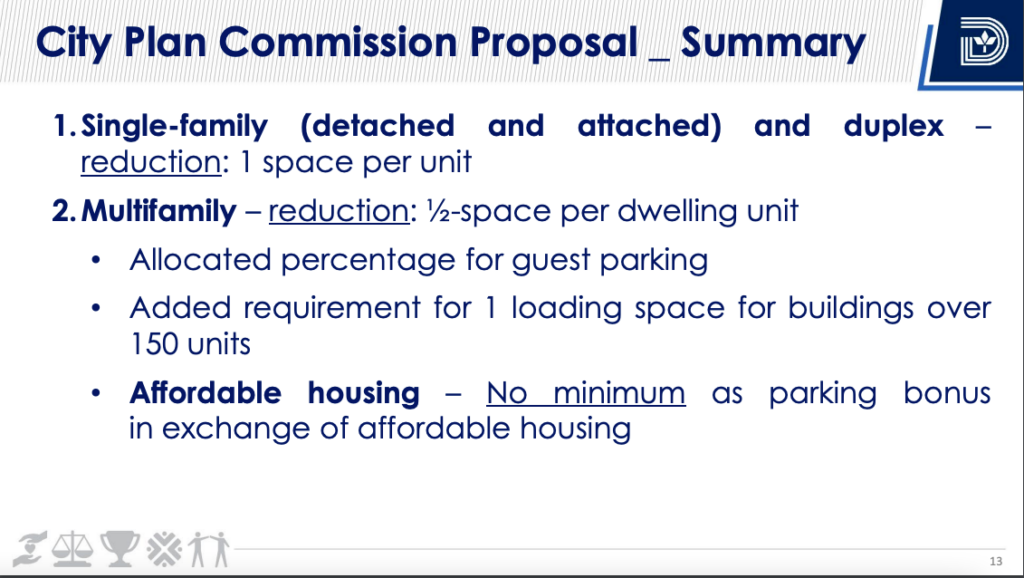
As previously reported by CandysDirt.com, Dallas’s City Plan Commission (CPC) advanced a measure that would eliminate or decrease the minimum parking spaces that developers are required to build for their projects across the city — with caveats.
For example, current policy dictates that multi-family developers provide at least one parking space per bedroom in a unit. While City planners and development staff had initially recommended eliminating a city-mandated number of spaces, CPC’s recommendation included a number of exceptions meant to placate residents of single-family neighborhoods who believe reducing or eliminating minimums would result in more spillover parking on their streets.
Battlelines appeared to take shape during the briefing, with Council Members Chad West (District 1), Omar Narvaez (District 6), and Adam Bazaldua (District 7) more or less expressing support for CPC’s proposal and Council Members Carolyn King Arnold (District 4), Kathy Stewart (District 10), and Paul Ridley (District 14) voicing serious reservations, particularly around the issue of multifamily housing.
‘Let’s Get Out of the Way’

Emily Liu and Andreea Udrea, the director and deputy director of the Planning & Development Department, respectively, walked the committee through CPC’s proposal and made the case for why parking minimums are essentially ineffectual and an impediment to building much-needed housing.
“There are multiple studies that support that the ratios are arbitrary, and they’re a one-size-fits-all,” Udrea said. “They can be accomplished in some parts of the cities, but they cannot in others, and they may hurt. There isn’t any data to support a ratio.”
She said data shows that eliminating parking requirements stimulates development — something staff have been keen on considering the city’s housing shortage.
“The reality of the market, as I said, is that a parking ratio is different … depending on location, depending on proximity to transit, depending on what’s around it,” she said. “So there are a lot more factors, it’s way more location based than a simple ratio: ‘Oh, office needs 1 per 100.’ There is no such ratio.”
Liu said parking minimums have been debated among civil service professionals for years, claiming that she and her colleagues cannot honestly say there’s any validity to this or that recommended ratio. She argued instead that policy should be oriented toward enabling economic development.
“Let’s get out of the way,” she said. “Let the market dictate.”
‘I Don’t Think Anyone’s Going to Think It’s Perfect’
The prospect of renters at apartment complexes regularly parking in single-family neighborhoods seemed to weigh heavy on some council members.
For her part, Stewart said she didn’t trust that market mechanisms would induce developers to build enough parking for their tenants.
“I’d like to believe that they would provide more parking, but what if they don’t?” she said. “What if they’re cutting costs? What if they just don’t?”
If adopted as is, CPC’s parking reform proposal would reduce the city-mandated parking minimum for multifamily housing from one space per bedroom to half a space per dwelling unit.
Arnold asked staff what they would say to a single-family resident about the possible implications of the proposed multifamily parking policy.
“What can they expect in terms of the parking access to their own neighborhoods?” Arnold said. “What are you going to tell them, that parking is going to be provided as the market demands at that location?”
Udrea responded by pointing out that curb parking is allowed for everyone, regardless of their housing situation.
“If we need to create management tools for how to manage the curb, I would say let’s do that but not constrain the supply of housing when we know we need economic development, we know we need housing,” Udrea said.
Noting that he was the only council member living in multifamily housing, Narvaez said his experience lends him to believe existing parking is being underutilized.
West was a bit more forceful in his support of CPC’s proposal.
“I don’t think anyone’s going to think it’s perfect, but that’s what compromises are for, and I hope my colleagues can respect that with minimal changes at best to what CPC worked so hard on,” West said.
Bazaldua proposed some alterations to the ordinance, but the meeting then devolved into a debate on parliamentary procedure.
Somewhat exasperated by the issue, Council Member Tennell Atkins (District 8), the chair of the committee, asked that they all move on to the next agenda item since parking reform was heading to full council regardless — with or without a recommendation from the committee.
“Let’s do the next item. Let’s go, come on. Let’s go home, I’m getting tired. I got 81 days [left],” Atkins said, referring to the days left in his term as a council member. Along with Narvaez and Arnold, Atkins is termed out this election cycle after serving four consecutive two-year terms on the council.







LOOK AT DEEP ELLUM PARKING AND ASK IF THAT IS WHAT YOU WANT. IS MUSK INVOLVED?
Come on City Council wake up. We are not a NYC, DC, Chicago, Portland, etc where you have a light rail or mass transit that gets you blocks away from your final destination. We are a sprawling city and than means we are car-centric and that means we need parking spaces. Maybe cut down to 1 space per 1 bedroom, and no guest parking, but let’s target these changes in a step process and not throw out parking in one fell swoop. It’s stupid and there are no facts to back up your move. I’m an Uptown resident for over 30 years and we still have major parking issues in these urban areas.
The primary goal of parking reform is to enable the development of more housing. We can all agree that the cost of housing has risen beyond what most can afford and or attain.
Past parking ratios do not align with the reality of how and who drives cars to locations where they need to park. All across the city are vast paved and mostly empty parking lots. Yes, there are areas of the city where parking is more scarce and demand is higher. As others have noted, blanket parking ratios being a one size fits all, do not solve the differences in parking demands. But do cause land to be developed into parking that could otherwise be housing and or commercial development.
At the end of the day, we all want a simple, safe place to call home. And if parking reform can help provide opportunity for more housing, then it’s a small price to pay towards this goal.