
Plan Commission Seeks Compromise on Parking Minimums, Will Revisit the Matter on Feb. 13
Share News:

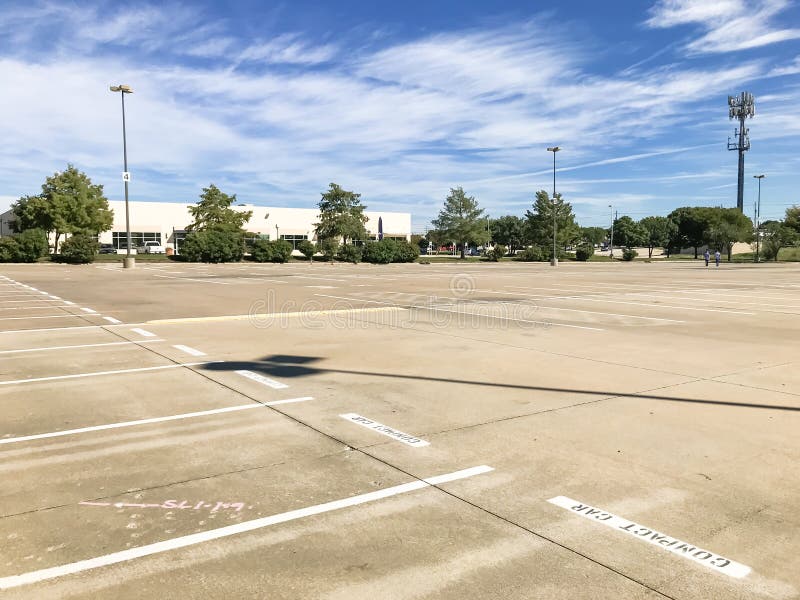
It’s been almost six years since North Oak Cliff Councilman Chad West first floated the idea of eliminating minimum parking requirements for new development. Dallas’ parking requirements are governed by a city code adopted in the 1960s that staff says is outdated and dysfunctional. Business leaders and housing advocates agree and have loudly supported West’s suggestion.
But on Thursday at a special-called City Plan Commission workshop, those who oppose a citywide ordinance showed up and argued that the proposal won’t work as it stands today. The chief concerns are emergency vehicle access and spillover parking into neighborhoods.
Proponents of parking reform say the minimum requirements hinder new business and divert Dallasites from using public transportation or biking or walking. Eliminating minimums doesn’t mean eliminating parking, they say, and the market drives the need for an appropriate amount of parking depending on the land use. Additionally, advocates say more affordable housing could be created in the absence of parking requirements.
The number of parking spaces for offices and restaurants is based on square footage while parking for apartments is based on the number of bedrooms per unit. The Zoning Ordinance Advisory Committee, a subcommittee of the CPC, has gone deep into the weeds of the parking code and recently issued a 72-page revision document.
Plan Commissioner Tip Housewright, who chairs the ZOAC, proposed 14 additional revisions Thursday that will be included in a draft ordinance to be considered at another special-called meeting on Feb. 13.

“I think it’s time to move forward with eliminating minimums wherever possible,” Housewright said. “My motion was an attempt to, first, recognize concerns from our neighborhoods and homeowners while at the same time reaping significant benefits in commercially-zoned areas that do not have an adjacent impact on single-family. I feel strongly that we need to keep this simple.”
Watch the Jan. 16 City Plan Commission meeting, which includes more than six hours of discussion and public hearing speakers, here. All materials and archived meeting videos related to parking reform are posted on the City of Dallas website.
The CPC is a quasi-judicial recommending body and code changes will ultimately have to be approved by the Dallas City Council.
Here’s what happened Thursday.
Plan commissioners asked thoughtful questions Thursday about the possibility of altering parking requirements for particular corridors and in areas away from residential uses. Interim Chief Planner of Code Amendments Michael Wade gave a brief presentation but spent most of the meeting answering questions.
There also appeared to be concerns that some business owners would hear “no minimums” and not provide enough parking, thus creating a hazardous situation or a burden for surrounding development.
Office and multifamily uses tend to be grossly overparked while some other uses — and guest options at multifamily sites — are underparked, said District 9 Commissioner Neal Sleeper, which makes a case for not using a one-size-fits-all approach.

District 4 Commissioner Tom Forsyth questioned why the elimination of parking minimums is being proposed for residential areas when the market hasn’t asked for that. District 11 Commissioner Krista Nightengale asked if there were any tools that could be used to reduce apartment rental rates by reducing the number of required parking spaces. Wade said that tools exist but he’s not familiar with specific outcomes.
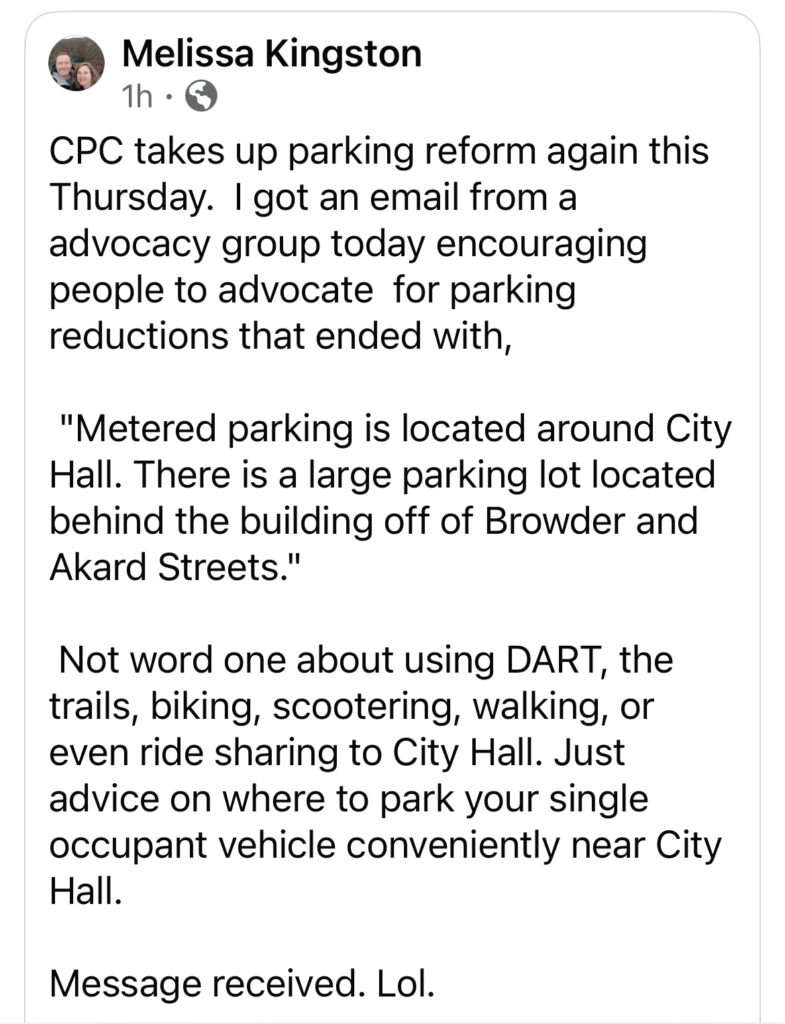
Parking reform advocates have pointed to cities where such changes have been successful, like Minneapolis, but many differences exist between Dallas and Minneapolis, District 14 Commissioner Melissa Kingston pointed out. Additionally, parking changes were made recently in Austin but it’s too soon to gauge their success, Kingston said.
Austin just voted to pay for a light rail system with public funds, while “Dallas just voted to sue ourselves and pay for cops that the police department says we don’t need,” Kingston said, referring to recent charter amendments approved in May.
“So we’re kind of going in a different direction, and we can’t ignore what the voters in this community, what their priorities are,” Kingston said. “Even when we look at the last bond package, every time they got a chance they moved money to streets, away from things like housing.”
The Opposition
Mike Northrup, a civil appellate attorney with Cowles Thompson sent a letter to the CPC saying the parking code needs an update but eliminating minimum requirements is the wrong approach.

“The no-minimums parking model ignores human behavior and shifts the financial burden of parking to those least able to afford it,” he said. “Moreover, the proposal before you ignores best practices for this approach. Ask yourself why we have minimum parking requirements in the first place. History will tell you the answer. You hope that [business operators] will … provide parking even if the city tells them they do no have to. But history tells us that did not happen and that is why parking minimums came about. During the [Zoning Ordinance Advisory Committee] public hearings, some property owners reaffirmed this human behavior by coming forward and representing they favored this approach because they do not intend to provide parking for their intended use for their property.”
Former Plan Commissioner Clare Stanard also weighed in via email, pointing out that prohibiting parking minimums doesn’t change the fact that Dallas continues to be a car-centric city.
“The need for parking is not going away, no matter how much mass transportation is provided,” Stanard said. “Dallas is way behind in providing adequate mass transportation to service the geographic extensiveness of the metroplex, so eliminating parking requirements will provide nothing positive for the City. In fact, with all of the Amazon and FedEx deliveries, there should be a requirement for every multifamily and office building that at least two parking places for deliveries and one for ride-sharing be mandatory.”
Builders of Hope Chief of Community Development and Public Policy Stephanie Champion encouraged city leaders to keep parking requirements as a tool to leverage amenities with housing development.

“Dallas’ parking requirements are abitrary and outdated, causing our city to be overparked, and parking is a significant impediment to project feasibility and affordability,” she said. “But if you eliminate parking minimums altogether and leave it up to the developers to decide how much parking is needed for any particular project, they’re only going to consider one thing in doing so, and that is their bottom line. They’re not going to care about housing affordability. They’re not going to care about neighbohood concerns. They’re not going to care about traffic congestion.”
Eliminating parking minimums essentially waives the City’s power to negotiate community benefits such as deed-restricted affordability, additional greenspace, or walkable infrastucture, Champion explained.
“Keeping parking minimums on the books affords us the opportunity to leverage the reduction of those minimums for any given project, but only in exhange for specific, neighborhood-vetted community benefits,” she said.
Support for Elimination of Parking Minimums
Eliminating parking mandates is supported by the Dallas Builders Association, The Real Estate Council, and the Dallas Housing Coalition. It doesn’t mean no new parking will ever get built, advocates with the DHC have said.
“But it does mean we could lower development and housing costs, stop requiring the over-building of parking, and make better use of Dallas’ land for green space and other forms of transportation besides vehicles including our own two feet,” DHC leaders said in a social media post.

Housing advocates also have pointed out that “removing parking mandates is essential to lower housing costs.”
“In the last three years, we’ve dropped from sixth to eighth to 19th strongest economy in the country,” DHC organizer Bryan Tony said. “Why? Because of our rising houisng costs. The good news is we’ve got an antidote. A 2024 study found that parking reform alone can boost homebuilding by 40 to 70%, more than any other land use change combined, more than [accessory dwelling units] and more than allowing larger multifamily by transit.”
District 14 resident Hexel Colorado said eliminating parking minimums offers a “once-in-a-lifetime chance to build the city that we want, that we deserve, and restore what we have lost.”
“I understand there’s this fear about losing parking spaces,” he said. “If you have a parking lot that’s full and it’s getting absolutely used by employees and customers, don’t worry, it’s not going to go away because that’s privately owned property. They have a choice. That’s the thing we have locked out of the city is giving people that choice.”
Andy Bartels said he’s unable to open a new sporting goods store on Gaston Avenue because of current parking requirements, even though his building offers 18 spaces, which he said is “more than enough.”
“Lifting this parking requirement will allow people like me to open businesses and use existing buildings as they stand,” he said. “Lifting the parking requirement will have an immediate and positive impact on the area from a small business perspective as well as a tax revenue standpoint.”
District 4 resident Nate Hemby said Thursday the current parking mandates are outdated and actively harm the City’s affordability, sustainability, and mobility goals.

“As Dallas continues to grow, we need better transportation solutions than previous generations,” he said. “We can’t simply build bigger roads or build more car parking to get out of our traffic problems. According to the North Central Texas Council of Governments, we don’t have the funding or the space to make our roads any bigger. I don’t have to tell you traffic is already a problem, and we’ve got 2 million more residents that are expected to move here in the next two decades. If that’s going to be the case, we have to change the way people are getting around our city.”
Eliminating parking minimums isn’t a panacea, Hemby added, and it should go hand-in-hand with increasing investment in DART, bike infrastructure, and sidewalks, “so that eventually, slowly over time, transit, biking, and walking become a safe and convenient alternative to driving.”
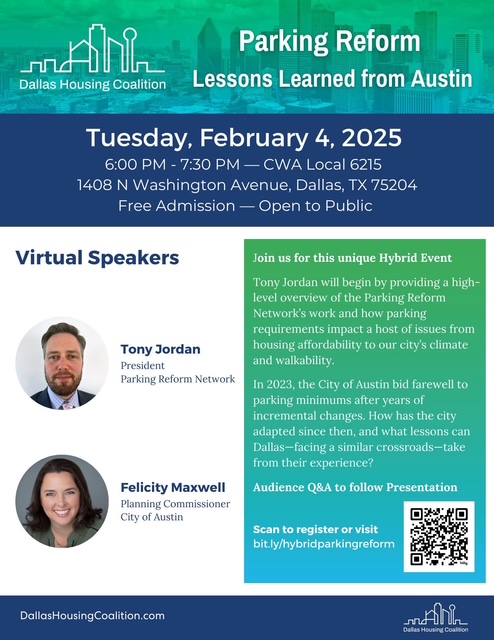
The Dallas Housing Coalition is planning a public event on parking reform in early February to discuss “lessons learned from Austin.” The virtual and in-person hybrid event on Feb. 4 will feature Austin Plan Commissioner Felicity Maxwell and Parking Reform Network president Tony Jordan.







Parking reform is long needed in Dallas. Most will agree that Dallas is car-centric, but its decisions like this that keep us that way.
Parking along Davenport has become a hazard. These people who live in the apartments want to park on the street to avoid parking fees in their own parking lot which has more than enough spaces. Cars are turning right out of the left lane and those exiting the parking lot cannot see around the cars. Same goes with the townhouses on the west side, they have a 2 car garage but decide to keep their junk in the garage instead of caring about those that have to drive Davenport. Cara Mendehlson said that davenport was a major thoroughfare so they why is there parking on the street. Also who gave the ok for the driveway where the cars in front of the house are over the sidewalk and they block Davenport when trying to exit their driveway. This house is on the W side of Davenport close to Campbell.
Now we have another problem, with the daycare at Davenport and Old Preston Pl, not enough space for parents to pick up their kids so now they are in Davenport blocking the lanes.