
Dallas Voters Sent a Message at the Polls But the City’s Next Steps Are Unclear
Share News:

Dallas voters made their stance clear at the polls Tuesday, rejecting proposed salary increases for City Council members while approving two of three controversial charter amendments driven by petition — each of which local elected officials had vocally opposed. But questions remain how and when the amendments will be implemented.
About 57% of Dallas County’s 1.47 million registered voters turned out for this election that featured national, state, and local races on one lengthy ballot. All but two local amendments passed — Proposition C, which would have increased salaries for the Dallas mayor and council members, and Proposition T, which called for the city manager’s pay and employment to be tied to a residential satisfaction survey. Dallas County residents voted down Prop C with 57.46% of the vote and Prop T with 55.21% of the vote.
Measures approved included decriminalization of small (depending on who you ask) amounts of marijuana and the ability to move municipal elections from May, when voter turnout is traditionally lower. View all Dallas County election results here.
How and When Will HERO Amendments Be Implemented?
Leading up to the election, Propositions S, T, and U sparked the most debate. Mayor Eric Johnson and all 14 Dallas City Council members spoke out against the three amendments that appeared at the bottom of the ballot. A contingent of former mayors and a Dallas Police Association joined the fight late last month to educate voters on what the propositions would mean practically for the City of Dallas.
The propositions were introduced by Dallas HERO, a “bipartisan 501c4 organization that seeks to introduce citizen-powered amendments to the Dallas City Charter.” The group circulated petitions and gathered 169,000 signatures of Dallas residents, as certified by the city secretary.
Lawsuits
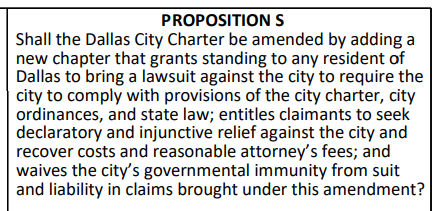
Proposition S, approved with 55.02% of the vote, requires the city to waive its governmental immunity and would allow residents to sue the city if they felt it was not following the city charter, ordinances, or state law. That means, opponents have said, that an individual sanitation worker can be sued for not picking up trash on time.
Dallas Police
Proposition U, one of the most heavily debated amendments, was approved by a slim margin of 50.52% of the vote or 3,217 votes.
According to the proposition language, Dallas will be required to earmark at least half “of annual revenue that exceeds the total annual revenue of the previous year” for the police and fire pension system. Last year, Dallas Police Chief Eddie Garcia said an inability to recruit and retain patrol officers — due in part to a $3 billion unfunded liability in the police pension fund — has resulted in more than 500 officer vacancies at DPD.
Any remaining funds should be used to increase the starting salaries for new police officers, the amendment language says. The current starting salary for Dallas Police is $70,300 depending on skill level and experience.
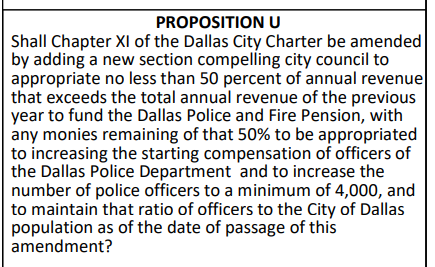
The amendment also mandates that the city maintain a police force of at least 4,000 officers — “and to maintain that ratio of officers to the City of Dallas population as of the date of passage of this amendment.” Dallas HERO Executive Director Pete Marocco told City Council that 4,000 officers represent a ratio of three officers for every 1,000 citizens. Latest census figures estimate the city of Dallas has 1.3 million residents.
The City has estimated it would need to hire at least 900 new police officers, which will create a $175 million budget deficit. Based on current recruitment rates and officer attrition, it would take about 15 years to implement, city leaders have said.
Because the amendment says that it becomes effective upon passage, as a fellow reporter friend pointed out to me, the city may be expected to start hiring police officers immediately after the City Council canvasses votes later this month.
The proposition does not specify in what time period new officers must be hired.
Some supporters of Prop U have said that Dallas may spend five years building its charter-mandated police force of 4,000, citing the full language of the proposition which was not available to voters at the ballot. Others interpret the expectation for hires to be made right away, and when the City fails to do it they’ll be sued (see Prop S).
Questions Remain for Implementation
We reached out to City Hall to get more information. Will there be a City Council briefing? A press release? We have questions on how and when Prop U will be implemented.
Interim City Manager Kimberly Bizor Tolbert replied by email through the City’s Communications staff.
“While we wait for the final, certified results of the election, we will continue to review our options,” Tolbert said.
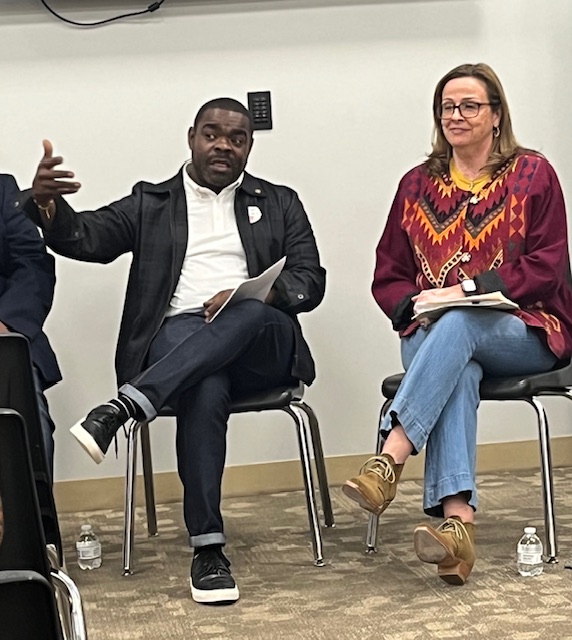
At a public forum on Oct. 21, Councilwoman Paula Blackmon and Councilman Zarin Gracey discussed the proposed amendments candidly with the few citizens in attendence.
Gracey said the actions of the HERO backers beg the question, “What is the motivation behind these propositions?” The proposals are “petty and ridiculous,” and could severely impact city services.

“These amendments are not good for the city and will absolutely bankrupt the city,” he said.
Councilwoman Cara Mendelsohn, who chairs the Council’s Public Safety Committee and publicly pleaded with voters to oppose all charter amendments so the council could go back to the drawing board, did not immediately respond to our request for comment.
District 1 Councilman Chad West addressed the matter in a Thursday newsletter to constituents.

“While most folks focus on the national election, voters passed several ballot measures to amend our City Charter which could have significant impacts on our city,” West wrote. “I have requested that the Interim City Manager and City Attorney brief the Council next week to better understand their fiscal and operational consequences. We must ensure that the 13,000 city staff members, including police officers and firefighters, are protected from frivolous lawsuits so they can continue to do the essential city services we all rely on.”
In the Nov. 5 edition of the Dallas Morning News, columnist Sharon Grigsby suggested that voters got duped.
“Too many Dallas voters fell for the fear-mongering flag of ‘safety and accountability’ and were swept away by a handful of buzzwords,” Grigsby wrote. “The outcome reflects what’s happening elsewhere in politics — campaigns in which voters seemed incapable of appreciating nuance or looking beyond broad strokes. With Prop T’s failure, perhaps potential candidates for the city manager’s job will begin to apply. However, what competent candidate wants to run a city where the top boss’ hands are tied by mandatory police hires and potentially frivolous lawsuits?”
Support for HERO Amendments
Those in support of the HERO amendments have maintained the propositions are about public safety plus checks and balances for those in power.

Betty Culbreath, board chair of the Dallas Housing Authority and former chair of the Dallas City Plan Commission, spoke out in support of S, T, and U in an opinion column published last week in the Dallas Express.
“When you experience the inner workings of politics and city hall like I have, you can easily see the merits of propositions S, T, and U,” Culbreath wrote. “The fact that an opposition of political ‘elites’ has emerged but has no solution, no alternative, just angry voices for a small insular group with incestuous interests, should tell you everything you need to know. But the voice of Dallas residents is stronger.”
The Dallas Express is a website owned by hotelier Monty Bennett and his wife, Sarah Zubiate Bennett, who have publicly and financially supported the HERO amendments. The Bennetts live in Highland Park but headquarter their businesses in Dallas.
Dallas HERO leader Marocco addressed the City Council on Aug. 7 and said that the 169,000 petition signatures represent a broad demand for greater police security, accountability, and enforcement.
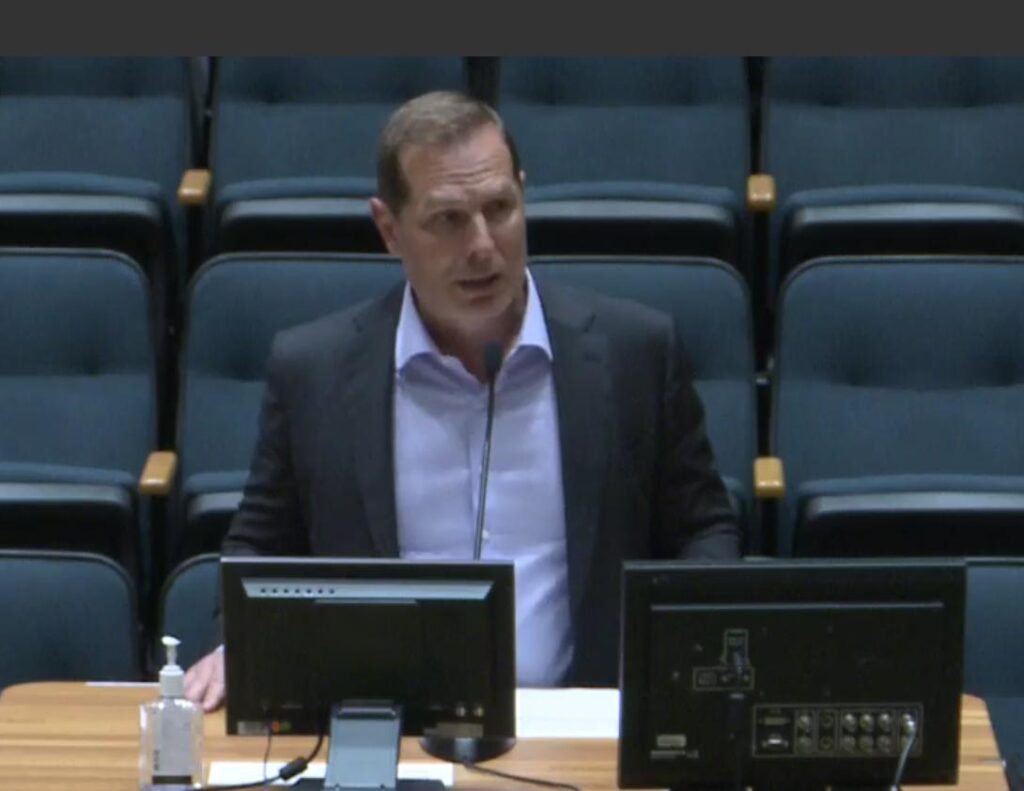
“Violent crime can take hours for police response, if any,” Marocco said. “Property crime is ignored, virtually unrestrained. Businesses and homes are robbed with impunity yet we are insulted with disingenuous word soup that city leaders are waiting at the negotiating table to debate pension details. Meanwhile, our city descends to anarchy. We want a city government where good performance is rewarded and failed leadership is replaced. They’re paid more than the president of the United States with a $4.6 billion budget. Dallas chief executives failed to deliver citizens’ most critical need: security.”
Marijuana and More Money
Propositions S, T, and U garnered the most attention among the charter amendments, but a couple of others also raised eyebrows.
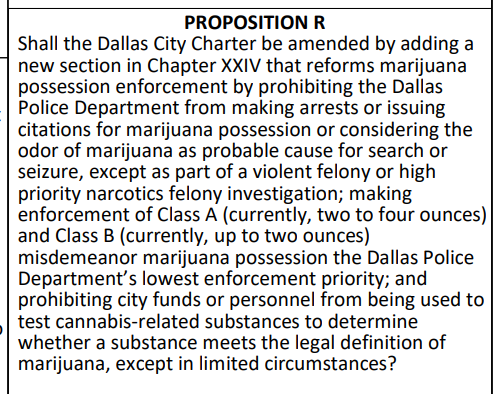
Proposition R, casually referred to as the “weed amendment,” will make enforcement of possession of 2 to 4 ounces of marijuana the lowest enforcement priority for the Dallas Police Department. Voters passed Prop R with 66.9% of the vote.
Former Police Chief Garcia spoke out against it, saying back in August that about 71% of Dallas’ drug-related murders last year involved some amount of marijuana.
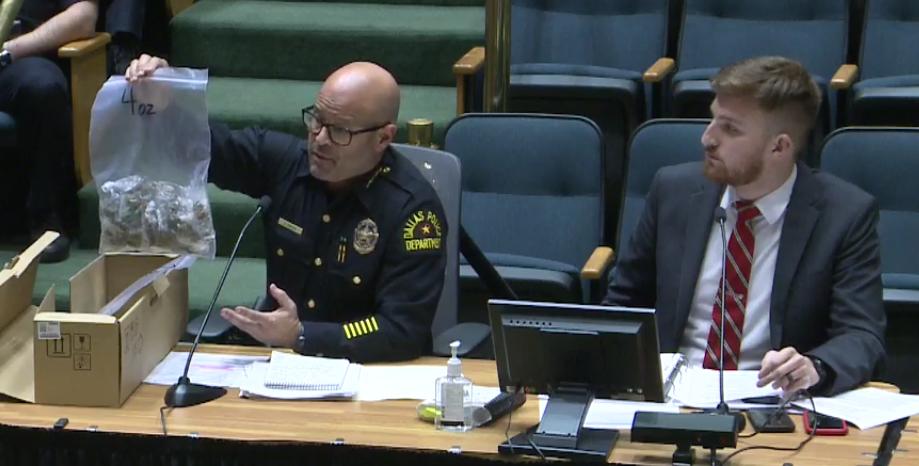
“Four ounces is not a small amount of marijuana and not only will it lead to increased traffic at drug houses in our most vulnerable neighborhoods, but in my 32 years of law enforcement, in my opinion, it could lead to increased illegal sales and deterioration of quality of life in certain areas of our city,” Garcia said at the time.






It’s nice to know that the Dallas Morning News and Sharon Grigsby think Dallas voters are stupid and easily swayed by “buzzwords”.
57% of us! Read CandysDirt.com: free & better City Hall coverage anyhow!