
Mayor Eric Johnson to Business Leaders: Dallas Isn’t Suburbia — and That’s the Point
Share News:

If Dallas is going to stay competitive, it has to lean into its identity as a pro-business urban center to leverage corporate flight from less-hospitable environments and stave off D-FW’s suburban upstarts, according to Mayor Eric Johnson.
Speaking at a Metroplex Civic & Business Association luncheon on Tuesday, Johnson highlighted some of the concrete indicators of the city’s economic momentum since he took office. In addition to the $27 billion in new development that’s been clocked the last several years, he pointed to the upcoming launch of the Texas Stock Exchange, dubbed Y’all Street, as proof of the city’s ability to attract business at a time when coastal politicos are trying to tax them even more.
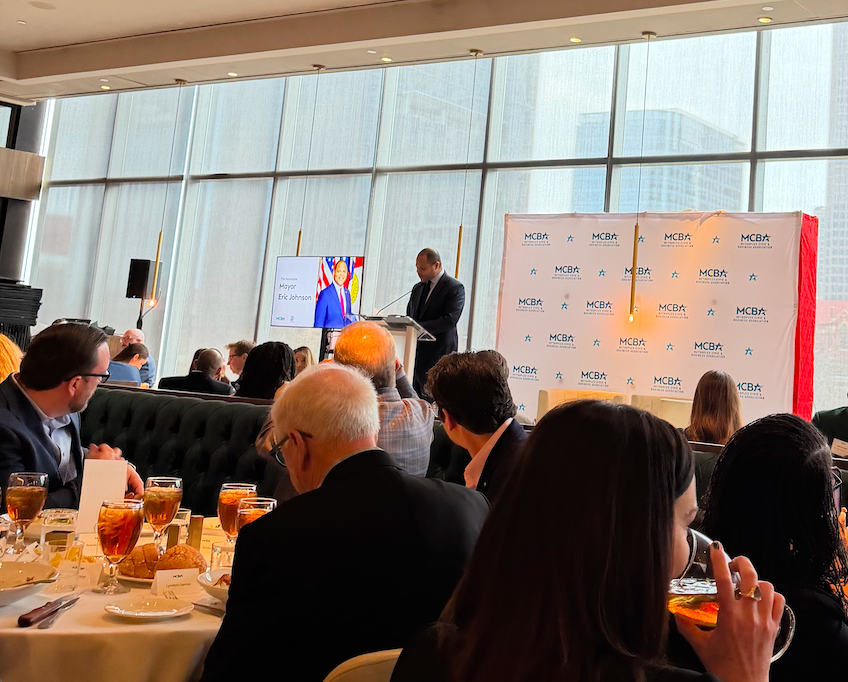
“We’re doing things right, like I said, but it’s also the case that my phone is ringing from financial institutions who say, ‘We are tired of being in places where we are just clearly not appreciated, where we are talked about like we’re the enemy,’” Johnson said.
Corporate Entrances — and Exits
It’s not just corporations relocating. People have been on the move, too. D-FW has been seeing strong growth since even before the COVID-19 pandemic, which spurred even more migration from states like California and New York.
Several consecutive years of property tax rate reductions and a more recent push to increase efficiencies in city operations have positioned Dallas to benefit from that migration. Significant improvements to the park system and reductions in crime won’t hurt either.
“This isn’t all just a coincidence,” the mayor said. “It’s related. It’s all part of the same deal. What we’re doing right and what other places are doing wrong. It’s both.”
Johnson also countered some of the framing seen in the news about Dallas losing out to its suburban competitors. The central business district has lost big-name tenants — not just to booming Uptown but to cities like Plano, Frisco, and Irving. AT&T’s announced departure was a blow, but the mayor cast it as simple incompatibility.
“They want horizontal expansion, to be able to have every single one of their employees in one place … into one corporate campus. That’s what they want,” Johnson said. “That’s not something you can have in this environment. That’s something that you have to have in suburbia, and that’s what they wanted.”
‘… Out There Looking at Olive Gardens’
In contrast, Johnson says Goldman Sachs was seeking exactly what central Dallas has to offer: walkability, density, and access to city amenities. The mayor said the company was pitched on a horizontal campus, and they rejected it.
“They said that’s not our culture, that’s not who we are. We are an urban company,” Johnson said. “The employees that we have, the kind of people that we hire, they don’t want to be in a suburban environment. They don’t want to be out there looking at Olive Gardens, stuff like that. They want to be able to walk out of their office and go to a game, go grab a drink, live some place nearby.”
The Dallas Mavericks, who are searching for space to build a new arena, recently narrowed their choices to two potential locations: downtown Dallas and Valley View Midtown. Dallas is moving forward with a roughly $3 billion rebuild and expansion of the Kay Bailey Hutchinson Convention Center, part of a broader plan to create a mixed-use convention center district. Last summer, Johnson floated the idea of selling Dallas City Hall, which is located less than a mile from the convention center district — though the idea has drawn ire from some residents and preservationists looking out for the architecturally significant Brutalist building.
The Financial Firm Boom
Rather than trying to compete on the same basis as cities like Frisco or Plano, which have become major corporate hubs in the past decade, Johnson said Dallas should embrace its urban layout and character.
“We are not suburbia. We’re Dallas. We are the urban core of this area. That’s the reality,” he said. “There is a type of company that wants to be in an urban core.”
Johnson has made no secret that he’s been trying to recruit such companies away from New York City, which has seen its financial firms dwindle in recent years. Last month, Johnson told the New York Post that he’s ready to welcome a “flood” of Wall Street firms looking to leave the city after Democratic Socialist Zohran Mamdani was elected mayor of New York City.
“It’s a lot of companies. I’ll be in New York next month for a reason. I was in New York last month for a reason. My phone is ringing for a reason. There are people who want this, and we’re going to continue to offer them this,” Johnson said. “And for companies that this is not a great fit for, I like the idea that they’ll be in North Texas versus being in another state, but we are always going to be … the urban core. It’s just the reality, and I’m okay with that reality.”
‘But the Rest of the City Suffers’
The mayor also turned his attention inward, offering some choice words for the business leaders in attendance, arguing they haven’t been doing enough to ensure elected officials were on the same page when it comes to broader policies that attract and sustain commerce.
He suggested that developers have tended to go along to get along, supporting council members who represent areas where they might have a project but care about little else.
“Congratulations on your development deal. I’m really happy you got your permit and you got your development done to build your project, but the rest of the city suffers by having too high of a tax rate and an underfunded police department and fire department or whatever,” Johnson said.
Rightsizing a City
Policy-wise, things have sort of come to a head over the last couple of years. City spending keeps reaching record levels, and a bloated city-owned real estate portfolio has raised eyebrows. Johnson commissioned two new city council committees last year to take up those issues.
Meanwhile, homeowners continue to chafe under swelling valuations and their corresponding taxes, and community surveys indicate residents want greater attention paid to things like public safety and street repairs.
Now, officials are grappling with tough budget choices. Alleyway trash pickup, neighborhood libraries, community pools — plenty is on the table for potential rightsizing. They have less wiggle room, though, than they would have otherwise in light of voters passing the controversial HERO amendment Proposition U, which mandates significant increases in public safety expenditures.
“The business community has got to do more to enforce their values on elected officials year-round, and there needs to be consequences to being a bad policymaker,” Johnson said. “And if you think there’s no such thing as a bad policymaker, then … forget it.”
1 Comment
Leave a Comment







Dallas outgrew the concept of an inside the interstate loop Central Business District forty years ago. Spending billions of tax payer money to perpetuate the same old downtown myth has only made things worse.