
Expert: Migration, Employment Growth Will Keep Texas Among Top Housing Markets
Share News:

The past year was a good one for Dallas home production and 2025 is poised to be even better, a Zonda real estate advisor told members of the Dallas Builders Association last month. Bryan Glasshagel says he’ll be paying attention to migration to Texas and employment growth as home builders head into the first quarter of the new year.
The migration story is multifaceted, Glasshagel explained.

“Do households continue to make Texas a top destination?” he said. “With changes in remote working and return to office requirements, will Texas continue to attract households from the coastal markets at the same levels? International migration is critical to demand as well. Will the incoming administration be as open to migration from key feeder areas like Southeast Asia?”
Everyone agrees that people are still moving to North Texas, and everyone also agrees that we’re running out of affordable homes to put them in. Dallas Area Redevelopment Manager Jasmine Bazley said in a Dec. 10 City Council meeting that an estimated net 68,000 households are expected to move to Dallas by 2033. The City of Dallas and its Housing and Community Development Department can probably support just 32,000 of the new homes through grant funding and existing programs, meaning “the remaining units would need to be supplied by the market or other outside forces,” Bazley said.
“There is a strong call for the city to use its existing land or buildings for affordable housing,” she added. “We should be exploring opportunities to pilot projects on city-owned property and finding ways to fast-track development on these sites.”
While the outlook is good, a crisis still exists. The Dallas Morning News reported in July, “More than 367,000 new homes and 181,000 apartments have been built in the last decade. It hasn’t solved the problem.”
“Dallas-Fort Worth felt the boom, too,” Nick Wooten wrote. “The region built more apartments than any other metro in the country over the past decade to keep pace with the region’s exploding population growth. Between 2010 and 2022, the metro area added 661,000 homes and apartments, according to the U.S. Census Bureau’s American Community Survey. Yet, D-FW added 1.54 million people over that same period. The number of vacant homes dropped by almost 40,000.”
Employment Growth
Employment growth is also something to watch, Glasshagel said in a LinkedIn post.
“The headline numbers look good in all the major Texas markets — positive job growth, low employment rates, businesses moving to Texas, etc.,” he wrote. “One thing to keep an eye on is the quality of the job growth … While there always can be short-term choppiness in demand, both migration and economic/employment growth are long-term tailwinds that will keep Texas among the top housing markets in the nation.”
In case you missed it, here are some of the biggest commercial projects announced in Dallas in 2024, as reported by CandysDirt.com.
The Doughnuts Are Expanding
Zonda’s analysis of residential development in all markets shows that home start activity looks like a doughnut in every market.
In D-FW, it “was amazing how quickly growth moved from Frisco to Prosper to Celina, [and] now we are talking about Gunter in Grayson County,” Glasshagel said.
The Dallas metropolitan area emerged as the nation’s largest and fastest-growing market for new home construction, according to Zonda’s Local Leaders list, released in July.
The U.S. News reported in October that the “Dallas-Fort Worth-Arlington real estate market is much like Texas weather: steady and predictable – except when it isn’t.”
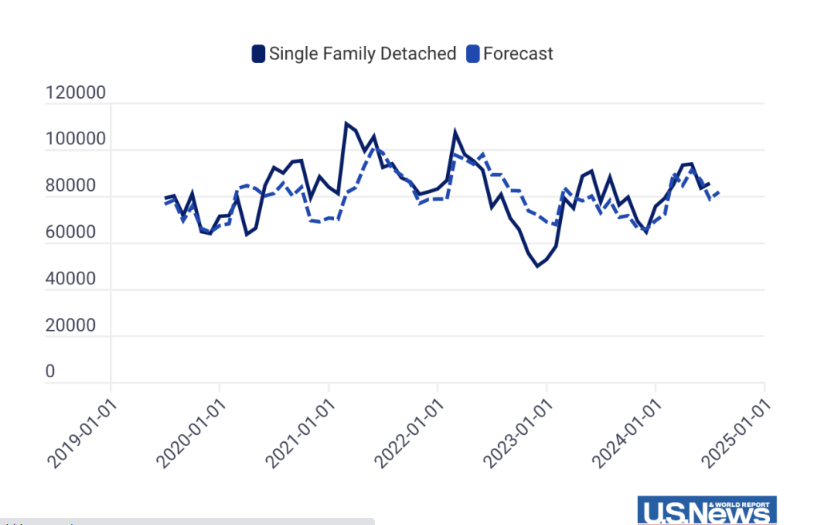
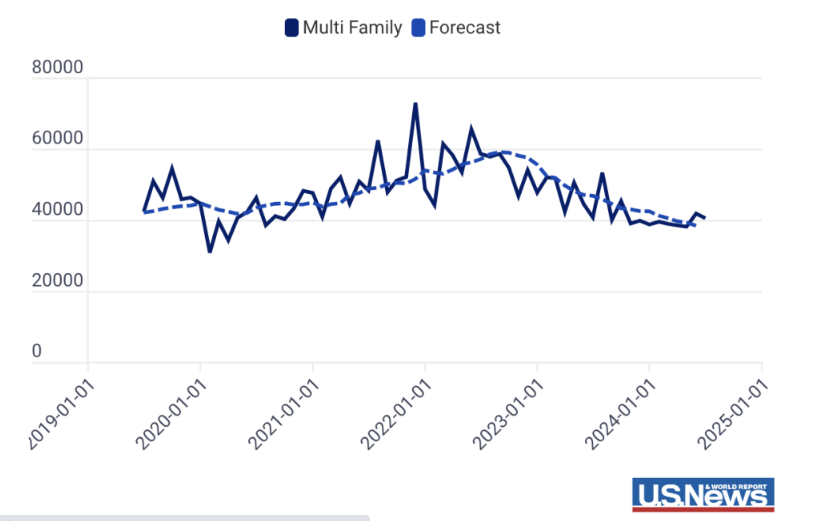
Newly approved construction permits for single-family and multifamily houses (those with two or more housing units) saw slow but steady growth in 2024, according to the U.S. News Housing Market Index. In July 2024, the most recent data available, there were 4,246 newly approved construction permits for single-family homes compared with 3,532 at the same time in 2023, a 20% increase year over year.
Permits for single-family homes for the year steadily increased from 3,516 in January 2024 through July. Permits for multifamily homes for the year declined slightly from 2,454 in January to 2,238 in July, the most recent data available. Year over year, multifamily permits declined nearly 8%.
“The Dallas-Fort Worth-Arlington area is interesting because its suburbs have some of the fastest-growing cities in the country, and select cities such as Princeton have temporarily banned residential development to let its infrastructure catch up,” said Todd Luong, a real estate agent with RE/MAX DFW Associates, in the U.S. News article. “In September, the Princeton City Council voted to stop approving new permits for residential development for four months because rapid growth was overwhelming the city’s infrastructure.”
So the key takeaway is that nothing is certain but death and taxes — but it looks like we’ll see more home construction in 2025 expanding outside the Dallas-Fort Worth-Arlington doughnut. Let’s hope it’s enough to accommodate the influx of new residents.



This is so interesting. I spent some time in Grayson County last week, and residents tell me the place is loaded with Gen X and young 30 and 40 somethings moving there! I never would have considered a quieter town in my 30’s! But increasingly, people do seek that. Grayson used to be like one big senior citizen home. I still cannot quite figure out the call more for housing in DALLAS when we are losing population. The strong growth is well outside, as these experts prove.