
Don’t Let Dallas’ New Convention Center Destroy Its Southern Gateways
Share News:

I’ve been closely watching the action over at Dallas City Hall as of late — and there’s been a lot of action — but one upcoming action item has me particularly concerned.
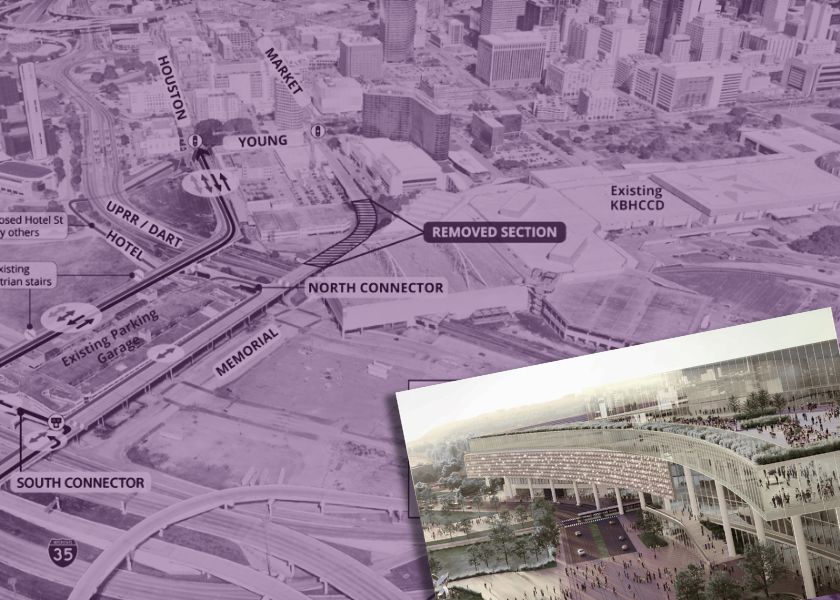
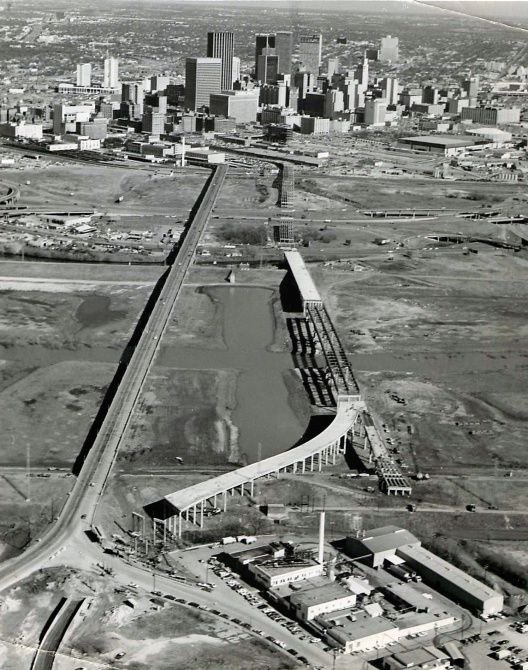
On Wednesday, the Dallas City Council will vote on whether to raise the expanded convention center design back to its originally planned height to avoid disrupting two major historic arteries connecting downtown to the southern part of the city: the Jefferson Boulevard and Houston Street Viaducts.
This is the right move, and not just because of traffic considerations. It would actually be doing right by the communities south of the central business district, something many council members often claim they’re interested in.
The city’s Transportation Committee recommended reverting to the original design, but a fresh memo from City Manager Kim Tolbert is advising against the change. In other words, she is in favor of cutting those arteries and tying them up into a knot.
People who commute from downtown to Oak Cliff or Kessler Park and back are worried their daily commutes are about to become a living hell. They should be worried. People with real estate holdings south of downtown and local business owners in neighborhoods like Bishop Arts are afraid that the city is backtracking on its promises of increased connectivity. They should be afraid.
All Because of the New Convention Center
Seems to me like Tolbert and her predecessor, T.C. Broadnax, should have been paying more attention. Tolbert was Broadnax’s deputy and chief of staff at the time when the convention center redevelopment was estimated to cost $1.9 billion. Voters approved Proposition A to support the project in 2022, with city debt issuance authorized up to $2.1 billion. Now, the price tag is coming in at a staggering cost of $3.7–3.8 billion.
Under the original design, the building would be raised to accommodate Jefferson Viaduct traffic under it. However, last year, when cost overruns were reported to be in the $1.8 billion range, Dallas City Council wasn’t too pleased. Who would be? In a bid to trim costs by $500 million, staff figured they could lower the design by two stories.
But that value engineering basically screwed Oak Cliff and Kessler Park and virtually anyone else who might use the bridges on a regular basis.
Last month, city staff proposed a “fix” that left a lot of stakeholders dumbfounded. When they presented it at a short-notice community meeting, many residents and business owners were furious. When it came back before the Transportation Committee, two-thirds of the entire City Council showed up to the briefing. No one was impressed with what staff came up with, to say the least.
The real irony is that boosters of the convention center redevelopment sold it as a way to better connect downtown to southern Dallas.
“This opportunity to redesign the convention center advances DDI’s strategic goals to advance urban mobility, build complete neighborhoods, and promote great placemaking,” said Downtown Dallas Inc. CEO Jennifer Scripps. “It will do all of those things, and it will leverage great private-planned developments and connect neighborhoods. This opportunity is so important to improve connectivity, pedestrian access, open space, transit connections, strategic infill, and, of course, grow cultural tourism.”
“This is a once-in-a-lifetime opportunity,” said Councilman Adam Bazaldua (District 7). “The convention center is going to be an enormous opportunity for us to be able to bring in more economic growth and connect neighborhoods. To be able to leverage an opportunity like this with growth in the south is extremely innovative and well past due.”
Jefferson Boulevard Is Literally at the Center of an Actual Design Dispute Right Now
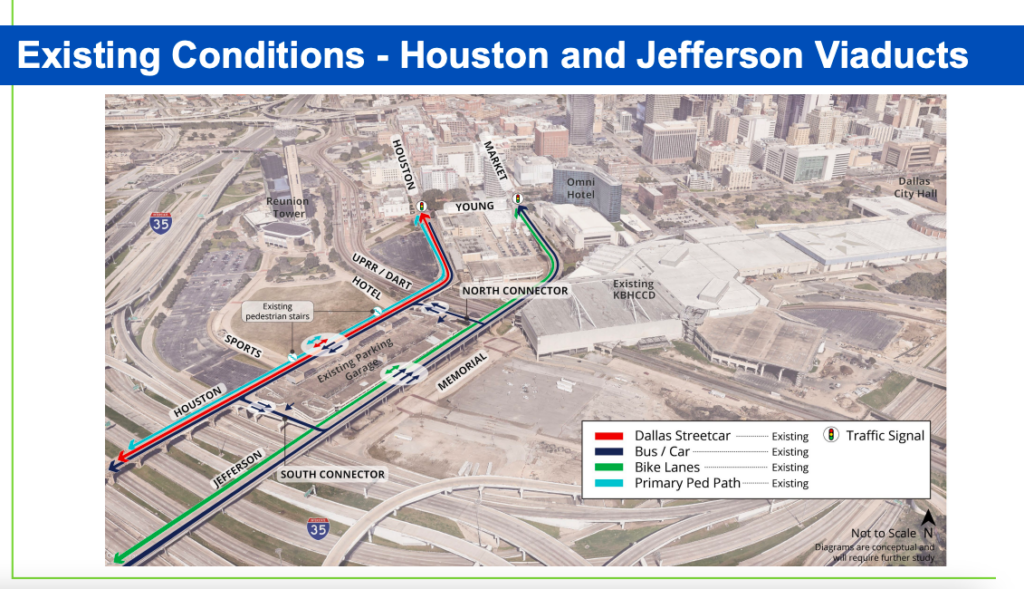
Right now, Houston Street runs southbound over the Trinity River, and Jefferson Boulevard runs northbound directly into downtown. One bridge going in and one going out for a total of five lanes of vehicular traffic. But to accommodate the lowered convention center, they’ll need to remove a section of Jefferson just north of the railroad, cutting off a straight shot from Oak Cliff right onto Market Street.
Under staff’s most recently floated plan, three lanes of northbound Jefferson traffic would be funneled onto Houston Street, which would be reduced to just one lane in each direction from the Sports Street parking garage to Young Street. This would be for the duration of convention center construction.
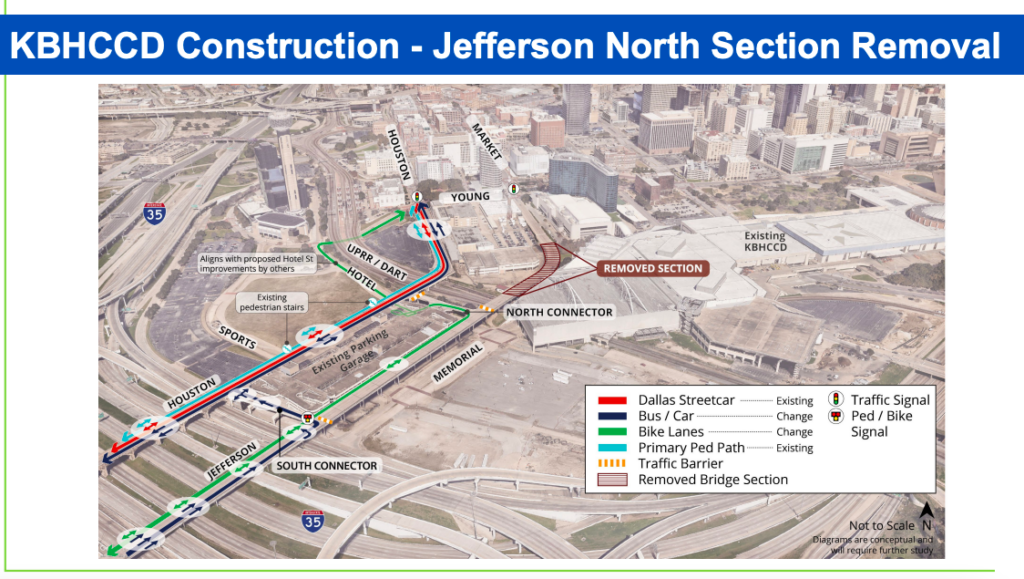
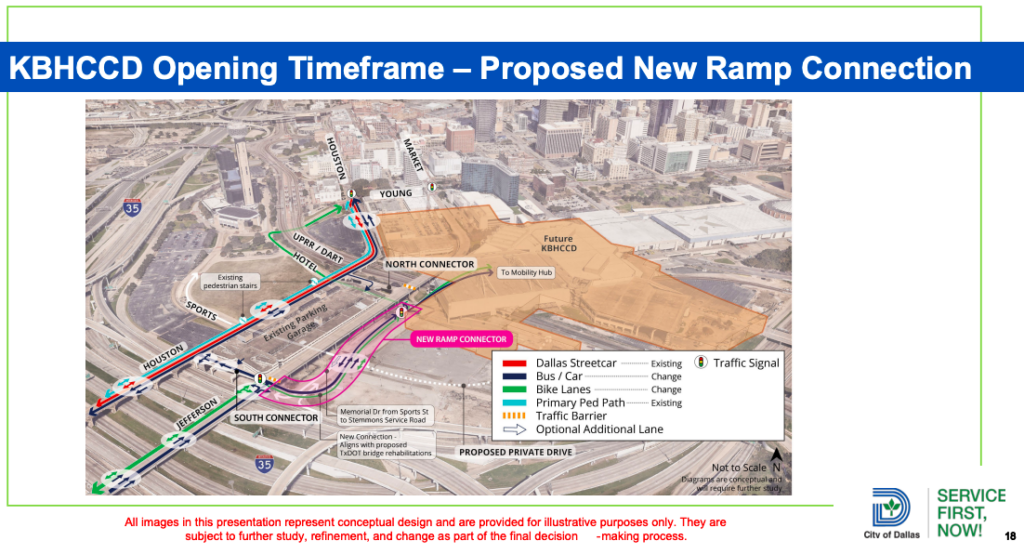
They then promise a ramp from Jefferson directly to the convention center’s mobility hub (gee, thanks). When all is said and done, though, a new flyover would connect Jefferson and Houston north of the parking garage. The Houston bridge would be reserved for everything but vehicular traffic, and Jefferson would turn into a two-way road with four lanes, none of which take you directly into the heart of downtown.
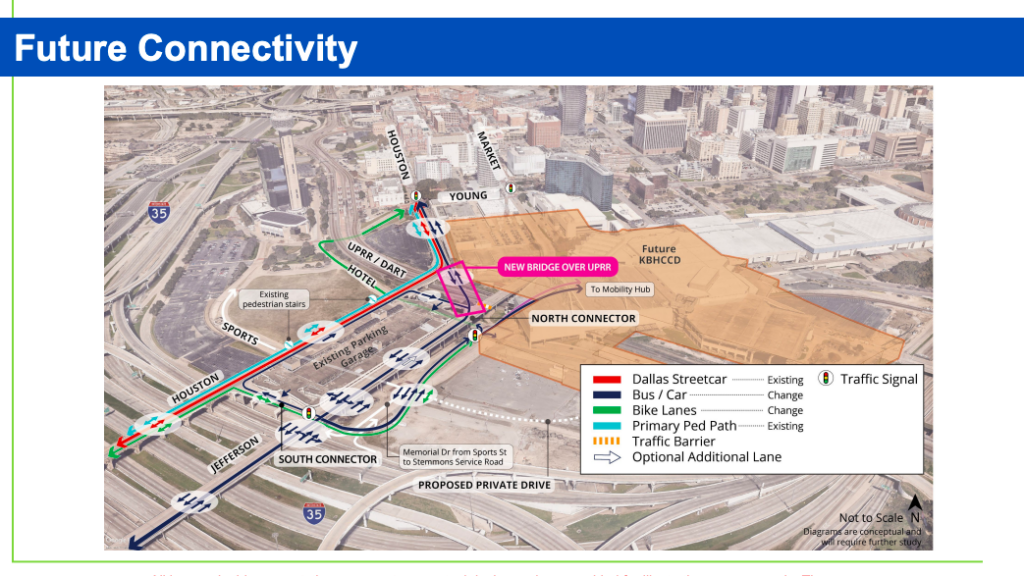
It’s worth noting that none of this traffic redesign is currently funded. Our suddenly budget-conscious city manager says these “roadway improvements” are estimated to cost around $97.3 million. Her memo holds that up against the now projected $597 million to raise the convention center back up and the estimated $1.4 million per month in lost revenue that would be sustained across the additional year that raising the building would add to the construction timeline.
But as Councilwoman Cara Mendelsohn (District 12) put it a couple of months ago:
“You’re going to forever change the traffic, which is going to be a nightmare for people. The truth is, if it’s going to take another $500 million to get it right, I’d rather spend that and have it done properly.”
So What About the Taxpayers?
A lot of stakeholders want the city to calculate the potential economic impact on area homeowners and businesses in Oak Cliff, like the currently thriving businesses in Bishop Arts that would suffer from a disruption of existing traffic patterns should things start grinding to a crawl just north of the river. They should look at housing costs, too — rents and home values.
Area residents say there had been little to no city outreach about staff’s plans to fundamentally change the viaduct traffic before attorney and resident John Barr began rallying the neighborhood. Since then, a public awareness campaign has taken shape, and there are a lot of engaged voters south of the Trinity watching the issue.
Bottom line: go to City Hall this Wednesday (June 24) and tell the city council to direct staff to go back to their planners and engineers and tell them to preserve those viaducts AND get the convention center built.
Residents who want their elected representatives to hear what they have to say need to sign up to speak. The deadline for registering to speak in-person or virtually is 5 p.m. on Tuesday (June 23). To sign up, click here.
Is the Convention Business Robust? Sure
The convention market took a huge hit during the pandemic, but it is coming back. Overall industry revenue has actually declined at a compound annual growth rate of 1.2% over the past five years, reflecting the pandemic hangover. However, private investment is expected to fix that.
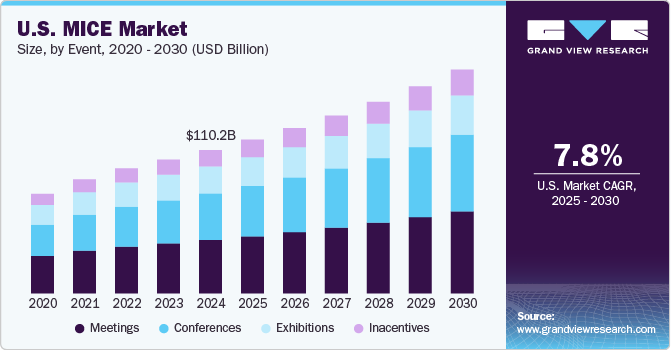
The U.S. MICE (Meetings, Incentives, Conventions, and Exhibitions) market was valued at $110.24 billion in 2024 and was projected to expand at 7.8% annually through 2030, when, by the way, the convention center was expected to be finished. It might take a little more time, but regardless, the market will push over $170 billion by then if the MICE projection holds. And Texas remains one of the top states in the industry. Meanwhile, Visit Dallas says the city will lose around $1.4 million per month in hotel tax revenue while the convention center gets redeveloped.
All that’s to say, Tolbert might have the data to show that having a shiny new convention center come 2030 or 2031 is a good idea — the market is there and growing — but the cost of construction is exorbitant, and the lack of foresight in the last design change is threatening the very neighborhoods the city is duty-bound to support. That the city would so thoughtlessly ram a plan through without significant neighborhood input and support sounds like the refrain of the last five years: get Dallas vertical as quickly as possible cause it will ostensibly increase the tax base.
But who is thinking about the current taxpaying residents? There are growing, attractive housing opportunities north, south, east, and west of the city. Dallas has a current population of about 1,302,753 and is experiencing a slight population decline at an annual rate of 0.01%. Since the 2020 census, which recorded 1,303,212 residents, the population has fallen by about 0.04%. Essentially flat, but technically trending down.
People are moving to the suburbs. Our Metroplex is booming, but Dallas isn’t. City officials don’t need to give our residents any more reasons to look for greener pastures.
Don’t forget to sign up to speak at Wednesday’s meeting. SIGN UP BY TUESDAY AT 5 P.M.


Good article really. I agree that the city is backing away in a sense from promises to connect south dallas, and completely understand the sentiment and frustration of Oak Cliff residents. My issue comes with what you said at the end “ Our Metroplex is booming, but Dallas isn’t. City officials don’t need to give our residents any more reasons to look for greener pastures.” I feel like this statement is the reason why we don’t move forward in this city. Everyone, council and citizens alike, are all too afraid of change and the growing pains that come with it to let the city grow and become something more, not even for tourists but for ourselves. Arlington took the risk of developing their city in ways that many residents didn’t like at first, and now they’re booming. I’m not commenting to say those viaducts should go, I’m just saying the ideology I’ve seen from citizens regarding issues like the convention center, city hall, and others is showing that we don’t even want to risk losing anything even if it means something greater.
Very thoughtful, thank you!
You know one thing for sure when you work for the city and when something changes, there’s 12 people that are gonna wanna know why. They’re called a Jury. Mr. Mathews, and Miss Tolbert get ready. I’m beyond suspicious of your relationship this deal’s gonna break open like a dozen of eggs hit by a freight train. Every single southern sector council person has said they’ll vote against this deal if it cuts off their community. I had a guy work for me, Don Hill who lied to the public and lied to me. It’s the last time that I’ll stand down and wait to see what happens. Southern sector you’ve spoken on camera that you would not vote to cut off the community. The questions gonna be why if you change that position.
Miss Tolbert you’re not gonna have anyone answer the questions for you because the subpoena is going to be directed straight to you. This thing called the convention center had cost overruns and I don’t intend til allow you to balance the balance sheet on the back of these poor people in the southern sector. I’m angry. I’ve got all the time in the world and enough money to get to the bottom of this truth/lie. My name is John Barr and I live in the southern sector and I’m proud of it, and your names are on the top of the list.