
Critics Say Viaduct Plans Could Cut Oak Cliff Off From Downtown
Share News:

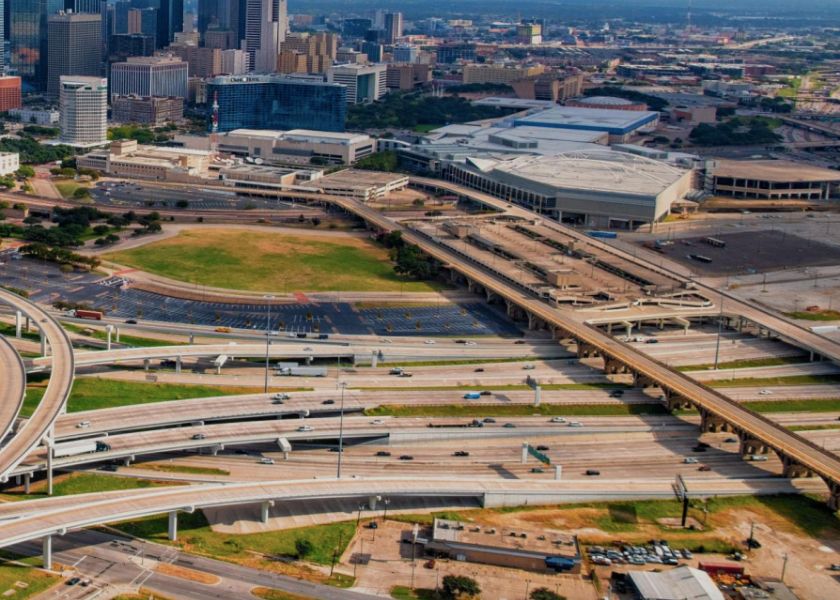
A lot of things in Dallas seem up in the air these days, and now you can add connectivity to Oak Cliff to the list.
Plans to reconfigure the Jefferson Boulevard and Houston Street Viaducts that link North Oak Cliff to downtown are in the works, prompting concerns that the city is going to disrupt established traffic flows that commuters and the neighborhood have depended on for decades.
Jefferson and Houston Viaducts are one-way roads sending cars in opposite directions, running parallel over the Trinity River. The Jefferson Viaduct takes traffic from Jefferson Boulevard, Zang Boulevard, and Marsalis Avenue in Oak Cliff and sends it directly onto Market Street downtown. Meanwhile, westbound traffic in the central business district can hang a left on Houston Street before the stack interchange and ride it south over the river and onto Zang or Marsalis.
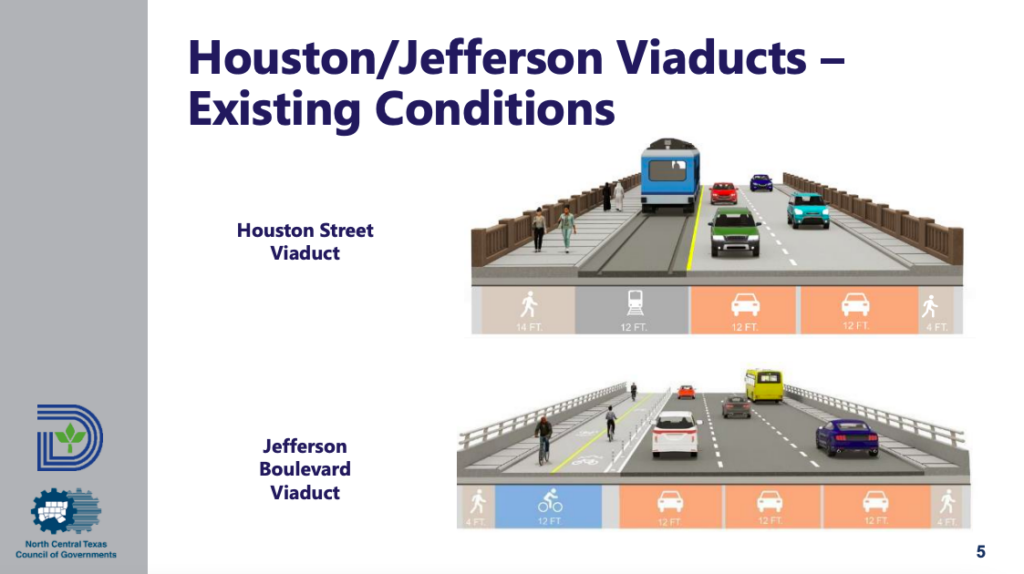
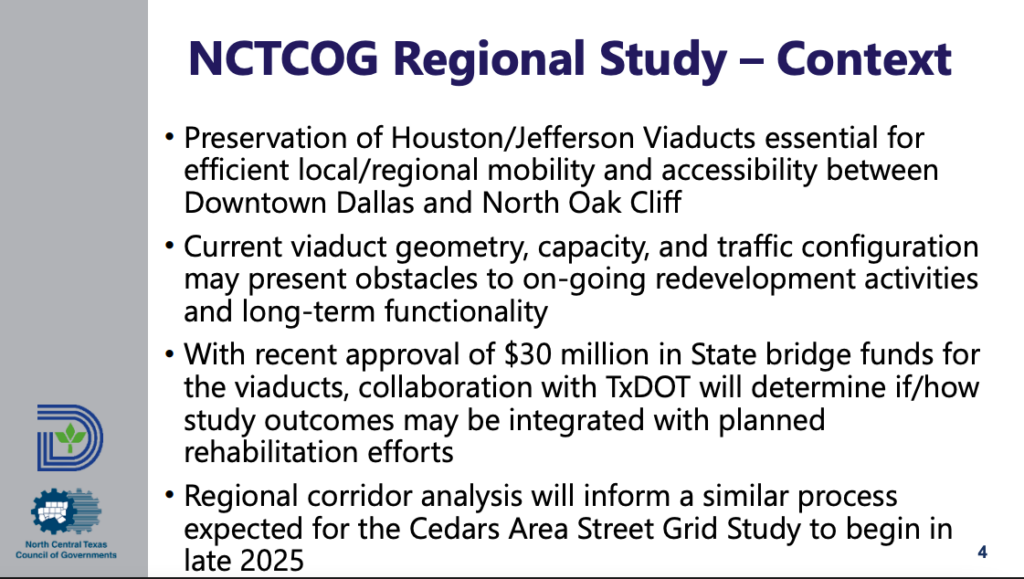
As things stand, officials are eyeing the conversion of the Houston Viaduct into a pedestrian, bike, and public streetcar only bridge, per the recommendations of the Oak Farms Transportation Corridor Study, which seeks to increase the viaduct’s longevity by offloading vehicular traffic. An inspection report from 10 years ago reportedly rated the 114-year-old bridge’s condition as poor and in need of replacement.
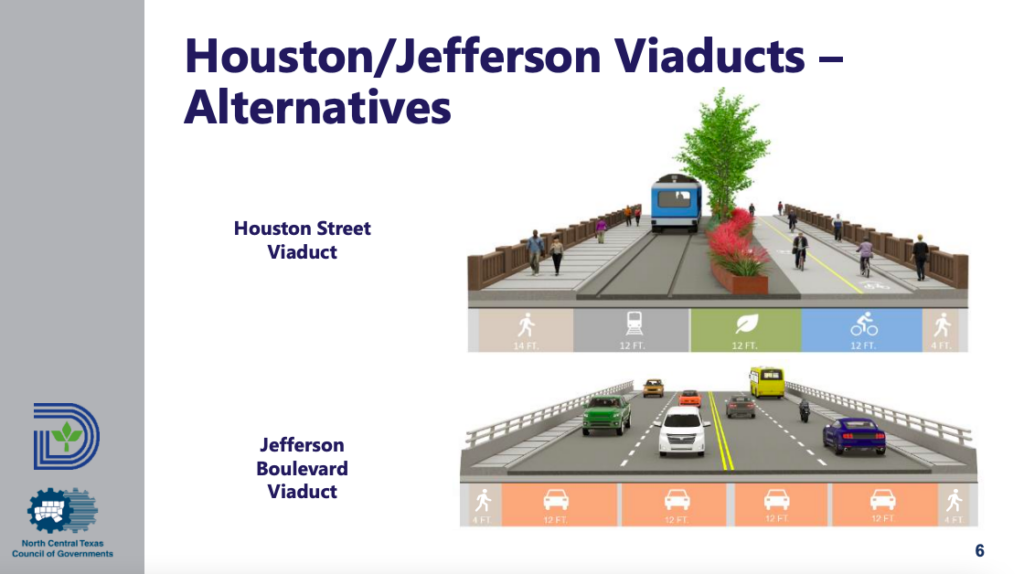
The study was conducted in collaboration with the North Central Texas Council of Governments, and some $30 million in state funds are being allocated for necessary repairs to the two viaducts. Conceptual plans call for making the Jefferson Viaduct a two-way thoroughfare to make up for the discontinuation of Houston as downtown’s vehicular gateway into North Oak Cliff and Bishop Arts District. It would be a huge shakeup all around, and while the now-completed study has been years in the making, it has yet to be adopted by the Dallas City Council.
Recently, media strategist and former Dallas reporter Brett Shipp dropped a couple of videos urging residents to turn out to an upcoming special called meeting of the Transportation & Infrastructure Committee on May 19. Committee members will be briefed on staff’s latest efforts to accommodate the Kay Bailey Hutchison Convention Center redevelopment design by rerouting Jefferson Viaduct traffic.
That particular issue emerged back in March when staff said an earlier plan to run Jefferson traffic under the convention center was scrapped following a project redesign to save money. Instead, staff floated having Jefferson terminate at Hotel Street, which could then be taken in either direction around the convention center footprint and vice versa.
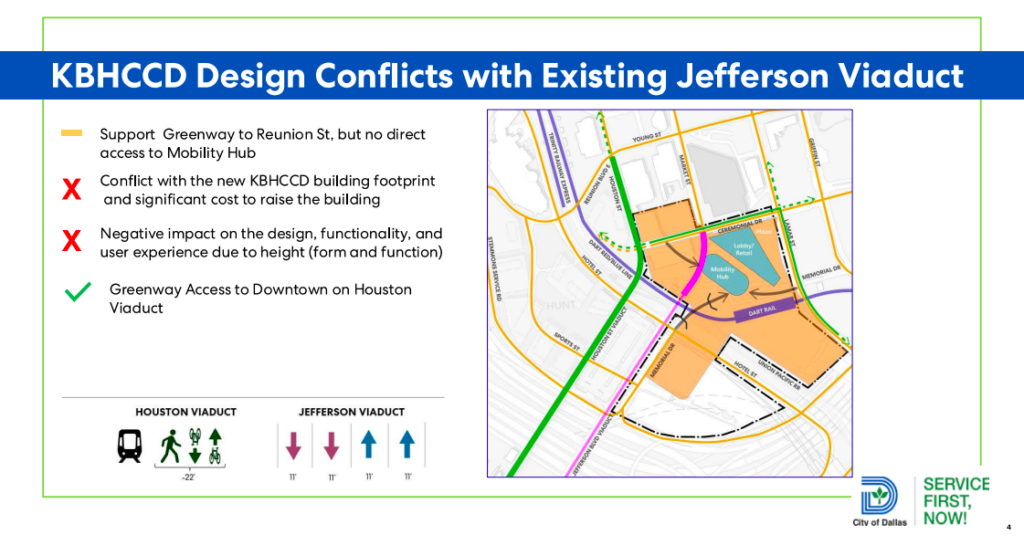
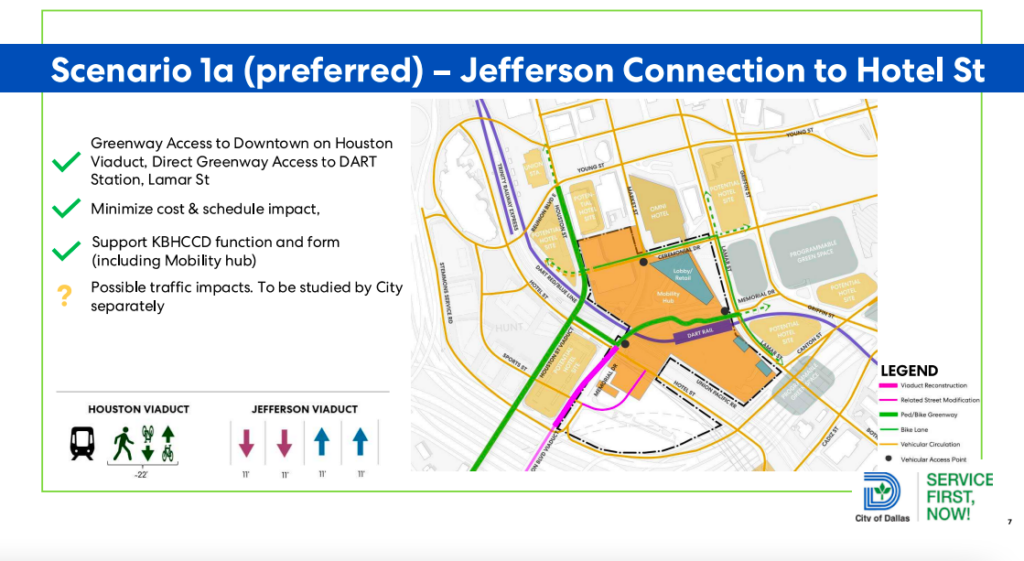
Committee members seemed to treat that particular plan as a non-starter, sending staff back to the drawing board to figure out another way to run Jefferson Viaduct traffic. All seemed to more or less accept plans for the Houston Viaduct as a given, despite its lack of full council approval and the rerouting of Jefferson.
Michael Morris, the longtime director of transportation at NCTCOG before he was terminated from the position late last month and subsequently reinstated by a court pending litigation, said his agency wasn’t consulted by city officials about the Jefferson Viaduct having to be rerouted to accommodate the convention center.
“If Jefferson is going to Hotel Street, then I don’t know what’s next,” Morris told The Dallas Morning News in April. “Are we back to redoing the whole Oak Farms study again? Because you can’t convert Houston to two ways.”
Since nothing is set in stone, it seems like critics of the viaduct plans are taking the opportunity to get mobilized and weigh in before the city permanently reconfigures the roadways connecting downtown and North Oak Cliff.
“What they’ve become is essential for traffic, and we’ve got people coming to our building wearing these buttons that say ‘Connect the Core,’ and what this is actually doing is disconnecting the core,” Council Member Cara Mendelsohn (District 12) said back in March.
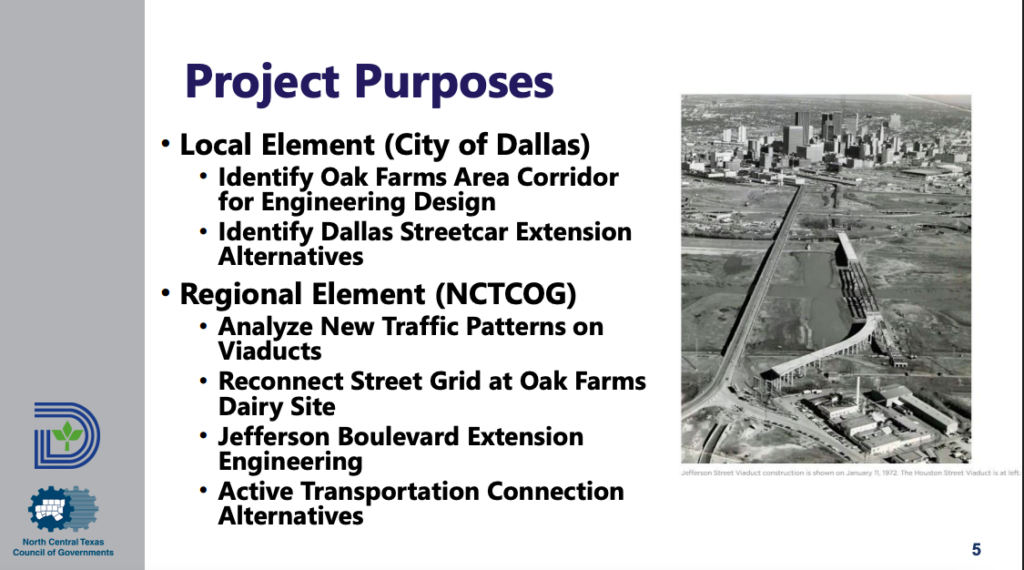
It could be an uphill climb to preserve car traffic on both viaducts. During an April 8 meeting between city staff, the convention center master plan team, the project manager for the Oak Farms Transportation Corridor study, and a traffic consultant, it was agreed that staff would seek “written confirmation, as verbal has already been provided, that no options interfere with or are in opposition to the Oak Farms Transportation Corridor Study.”
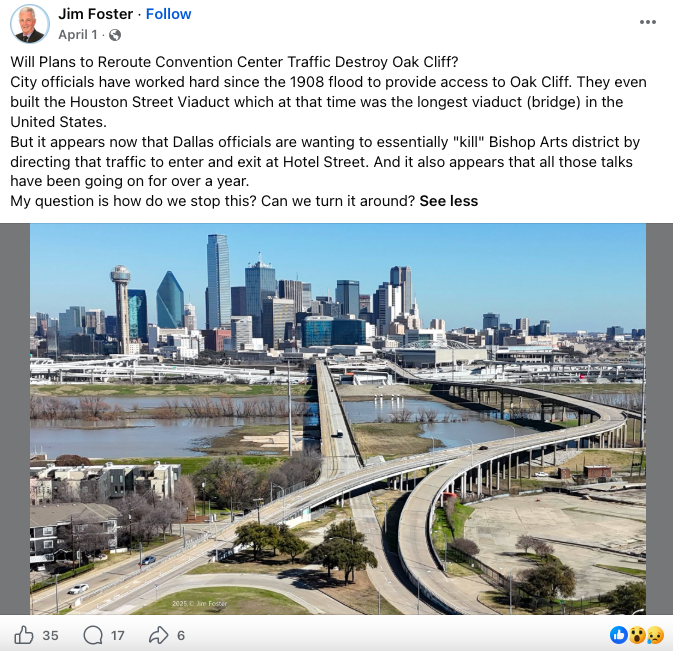
Officials could conceivably turn back the clock, but it could mean unwinding a lot of the work put into the study, which extends beyond how the viaducts would be used.
The special called Transportation & Infrastructure Committee meeting is scheduled for 9 a.m. on May 19.




I think the original Oak Farms recommendation makes sense. I use these bridges a lot, they’re hardly at capacity and could accommodate traffic flowing both ways on Jefferson. But that also hinges on how it currently connects to downtown — very convenient, very nice. It’s beyond frustrating that everything is being bent in service of this convention center boondoggle. Soon they’ll demand your first-born son be placed at the altar of the KBHCCD!
Cars from downtown come to Oak Liff on Houston St., viaduct. It allows two choices on the Oak Cliff side, Marsalis or Zang. Why is that important? Because it’s the gateway to Oak Cliff. When you cross that bridge, you see Parks you see brand new $60 million high-rise Class A apartments and you have a thoroughfare that can handle the traffic and take it straight up through the corridor back to IH 35. It adjoins Bishop Arts. It runs right past Davis Street, two of DALLAS‘s top 20 restaurants are on Davis. In addition, it drops into Oak Cliff right at the area where there’s 18 acres zoned MU 20. If somebody builds at large building or Methodist Hospital expands we need to get the people to work and back from work.
North Oak Cliff has been designated by our city, and the federal government is an economic opportunity zone. That allows capital gains that someone has to be invested and not taxed on those capital gains to help us elevate the economics and to improve jobs. If the investor’s capital gains remains invested & holds for 20 years;They never have to pay that tax. Dallas sites , you’ll remember what used to be known as State Thomas area, that was transformed into uptown after the federal reserve bank built on the north east corner of Woodal Rodgers and Pearl. That transformation can occur here, our tax space can increase and help the rest of the city.We ask for your help.
The other bridge, Jefferson, is what carries the cars from OC & south west to downtown betweenWFAA-TV and the OMNI Hotel at Young and Market’s street. The important factor is that it has three feeders for Major arteries in Oak Cliff, Jefferson Boulevard, Marsalis Boulevard, and Zang Blvd. We found when there’s a crash or heavy traffic on interstate 35 going across the river that motorist from Duncanville Cedar Hill, De Soto and South Oak Cliff use these three streets is alternatives to get to work or to enter the central business district. We agree that bicycles should have protected entrance and they can have that if we leave the Bridges alone.
The most important thing is, we’re not asking for any money from anybody to do this. We’re just asking that they not build the convention center pursuant to the change suggested in March, which is to put the convention center on grade in the middle of our bridge entrance to downtown.
Dallas seems to love cutting off neighborhoods, separating itself from parts of the city. Great areas have to be hunted down.
Leave the bridge as is with repairs.