City Hall Roundup: Officials Play Hooky, KBHCC Showdown, Community Park
Share News:

We’re another week closer to “summer break” at Dallas City Hall, with council members set to take July off from official public business at the horseshoe.
No doubt there will still be some surprises and City Hall news next month, but nothing regular with budget hearings and ostensibly further 1500 Marilla St. relocation drama kicked down the road to August.
For now, though, here’s some stories you might’ve missed this past week:
Who Wouldn’t Put Down Work for a World Cup Match?
On Wednesday, council members were supposed to get a budget development briefing. However, it seems the separate special called meeting that same day to consider authorizing due diligence for City Hall relocation took up too much time. Or rather, too many council members had other obligations scheduled in the afternoon.
What could be so important, you might ask? FIFA World Cup 2026 tickets, apparently.
The missed briefing quickly became noticed after reports surfaced that some council members and staff attended the England vs. Croatia match at AT&T Stadium while the meeting was supposed to be underway. Quorum was not met, though, and the briefing was reduced to a subsequent memo without explanation.
Council Members Maxie Johnson (District 4), Laura Cadena (District 6), Kathy Stewart (District 10), Bill Roth (District 11), Cara Mendelsohn (District 12), Gay Donnell Willis (District 13), and Paul Ridley (District 14) were reportedly at City Hall and ready to work. Council Member Chad West (District 1) tuned in virtually from the World Cup match. But nine is the magic number for quorum, whether in-person or virtual, and the city council came up short.
It’s unclear who else attended the match, but City Manager Kimberly Tolbert and Mayor Eric Johnson were photographed at the venue.
As for the budget briefing, there were definitely some important highlights, like the nearly $51 million estimated General Fund shortfall the city will need to close the gap on for FY 2026-2027.
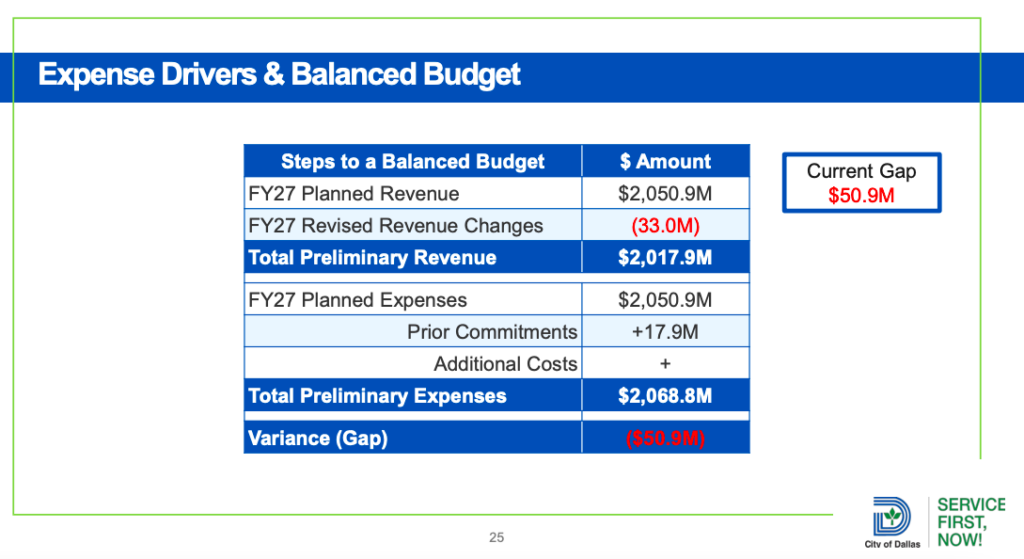
On the revenue front, preliminary appraisal data show taxable property values reaching $256.1 billion, well above earlier projections of $237.9 billion. However, officials expect values to decline as property owners challenge appraisals. The largest revenue concern stems from sales taxes, which city staff say continue to soften amid slower consumer spending and a cooling labor market. Updated forecasts reduce expected sales tax collections by $18.3 million.
As for the spending side, the city continues to face pressure from rising pension obligations, employee health care costs, technology investments, and plans to hire 400 police officers. While many of those expenses were already incorporated into the financial plan, officials identified an additional $8.9 million in costs tied to public safety technology upgrades and contract increases.
Steep cuts are anticipated across all non-public safety departments, with Dallas Park & Recreation already being asked to figure out a roughly 15% year-over-year budget reduction.
Staff Argue Against Convention Center Design Reconsideration
City Manager Kimberly Tolbert is urging the Dallas City Council to reject a proposal that would require restoring the Kay Bailey Hutchison Convention Center design to its original elevation to preserve existing traffic on the Jefferson Boulevard and Houston Street Viaducts.
In a Thursday memo, Tolbert pushed back on the recommendation from the Transportation & Infrastructure Committee to raise the building, pointing to the estimated $600 million price tag for the redesign and further potential revenue losses from any consequent delays to the project. Staff attributed the alleged price increase to additional structural requirements, higher steel tonnage, labor expenses, and construction cost escalation caused by project delays.
“Staff remains strongly committed to community engagement and believes firmly that both the continuation of the convention center expansion project and an equitable continued entryway into downtown can be accomplished in tandem,” Tolbert wrote, pointing to a viaduct reconfiguration plan presented in May.
Residents who wish to speak out against Tolbert’s memo and address City Council directly should sign up to speak at Wednesday’s meeting (June 24), say neighborhood activists who fear a tremendous loss of both traffic and real estate values for Oak Cliff and Kessler Park. The deadline for registering to speak in-person or virtually for the meeting is 5 p.m. on the Tuesday before (June 23). To sign up, click here.
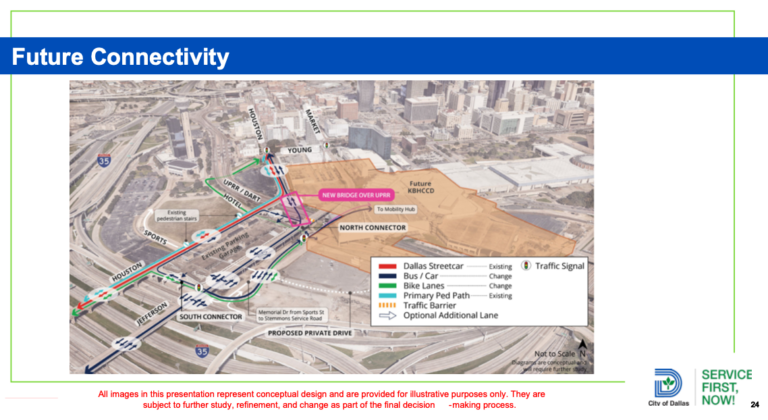
That plan received a cool reception from members of the Transportation & Infrastructure Committee, as well as other council members and community activists who claim messing with the viaducts would upend longstanding connectivity between downtown and southern Dallas.
Beyond construction costs, Tolbert warned that postponing completion of the expansion beyond 2030 could trigger economic consequences. Staff estimated that the city already faces approximately $271.3 million in known losses from conventions being redirected to competing cities, with losses expected to grow by roughly $1.4 million per month if uncertainty surrounding the project continues.
Convention & Event Services officials have reportedly begun discussions with some clients about relocating events scheduled for 2030 as concerns mount over whether the expanded facility will be available on time.
The memo also cites potential declines in hotel occupancy tax collections, Project Financing Zone revenues, and other tourism-related funding streams that support arts, cultural, and economic development initiatives. More than 6,000 tourism and hospitality jobs could remain in limbo as construction timelines stretch further, according to staff.
Council members will consider raising the convention center design on Wednesday, June 24.
Health and Wellness Grant Gives Community Park a Boost
Dallas’ planned Community Park at Fair Park got some financial help this past week after the McKesson Foundation announced a $2.5 million grant to support health and wellness programming at the long-awaited project.
The planned park will transform more than 10 acres of what is currently Fair Park surface parking into green space for nearby residents. Supporters have long argued that the project will provide much-needed recreational space for people who live in the area.
“McKesson Foundation recognized that this project is about far more than building a park,” said Jason Brown, board chair of Fair Park First, which was contracted to design and build the park within the next two years. “It is about creating opportunities, improving quality of life, strengthening community health, and ensuring that the neighborhoods surrounding Fair Park benefit directly from one of the most significant public investments underway in Dallas.”
The funding will support the creation of McKesson Market Grove, a dedicated area within the park designed for community gatherings, fitness activities, nutrition education and other wellness-focused initiatives.
Council Member Adam Bazaldua (District 7), who represents the area, described the grant as a direct investment in South Dallas residents, noting that philanthropic organizations have historically underinvested in such neighborhoods.
“When we talk about building stronger communities, we’re talking about more than roads, buildings or infrastructure,” he said, according to The Dallas Morning News. “We’re talking about creating places where families can gather, where children can play, where neighbors can connect and where people have access to opportunities and resources that they need to live healthy, successful lives.”
The Community Park is expected to cost roughly $40 million. Prior to the McKesson grant, Fair Park First had secured approximately $34 million toward that goal. Project leaders say the new funding brings them closer to closing the remaining gap and keeping construction plans on track.