
Rising Mortgage Rates Follow Escalating Iran War, Fed Holds Steady
Share News:


Mortgage rates are responding to the escalating war in Iran, jumping again for the second week in a row to reach a three-month high on the 30-year.
Freddie Mac put the average at 6.22% for the week ending on Thursday, marking another disappointing development for prospective homebuyers standing on the sidelines waiting for rates to get more affordable.
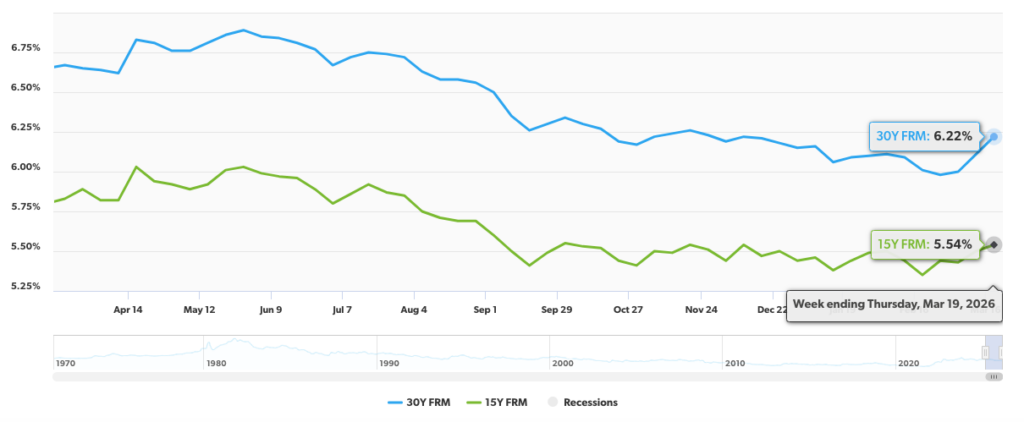
Those who can afford it, though, are in a better position than they were a year ago, with rates still about half a percentage point lower.
“Potential homebuyers are poised for a more affordable spring homebuying season than last with the market experiencing improvements in purchase applications and pending home sales,” said Freddie Mac chief economist Sam Khater.
It’s definitely a more favorable environment than in recent years. Inventory is up, prices are coming down in some markets, and buyers are starting to see more wiggle room as sellers start coming down to Earth. The prospect of a prolonged war in the Middle East, though, could put a damper on housing activity.
Lawrence Yun, chief economist for the National Association of REALTORS, said higher oil prices could lead to fewer buyers entering the market if mortgage rates continue to tick up.
On Wednesday, policymakers at the Federal Reserve decided to hold benchmark interest rates steady. It was an expected decision considering the central bank has been projecting only a single rate cut this year, but investors are now betting that we might not even see that.
“The combination of war and Fed news triggered a taper tantrum in the stock market as investors concluded that monetary policy may be limited in its ability to address the war’s economic consequences,” wrote economist Ed Yardeni.
“Indeed, Fed Chair Jerome Powell barely mentioned the war. Notably, he opined that the economy and labor markets are in good shape and that core inflation is likely to moderate in the coming months, implying the Fed will remain on pause for the foreseeable future,” he added.
The latest heart attack on the war front came from attacks on energy infrastructure, adding to the oil shocks already reverberating from Iran’s selective closure of the Strait of Hormuz. Oil being a critical input in the production and distribution of most goods worldwide means consumers could really start to feel it beyond the gas pump.
“The thing I really want to emphasize is that nobody knows,” Powell said on Wednesday. “The economic effects could be bigger, they could be smaller, they could be much smaller or much bigger. We just don’t know.”
Last week, the growing refinance demand lenders have been enjoying at the start of the year saw some significant slowdown, with total mortgage application volume sliding down by 10.9% compared to the previous week, according to the Mortgage Bankers Association.
“Mortgage rates continued to move higher, driven by increasing Treasury yields as the conflict in the Middle East kept oil prices elevated, along with the risk of a broader inflationary shock,” said Joel Kan, MBA’s vice president and deputy chief economist, speaking about the week ending on March 13. “Mortgage rates increased across the board, with the 30-year fixed rate rising to 6.3%, the highest rate since December 2025.”
Conventional refinance applications dropped by 27% over the week, Kan said.