
Dallas City Hall Repairs Pegged at $1B — But Is That the Real Cost?
Share News:

Around $1 billion to repair Dallas City Hall — that’s the figure staff have come up with with the help of consultants, but the estimate has come under fire from critics who want 1500 Marilla St. to remain the seat of municipal government.
Today, the city council’s Economic Development Committee will meet at 1 p.m. to hear from the public on the Finance Committee’s recommendation to pursue relocation. Committee members will also get an opportunity to give feedback to staff on next steps related to redeveloping the site. Two days later, the full city council will consider the Finance Committee’s recommendation and possibly initiate the process of moving City Hall functions out of the Brutalist building designed by I.M., where they’ve been based since the iconic structure was completed in 1978.
Of course, the cost-benefit of offloading 1500 Marilla St. for some kind of project will have to be weighed against the price of fixing the building (unless it really is all about keeping the Dallas Mavericks downtown at all costs). But what is everyone supposed to make of the numbers produced by staff?
What Does Staff Say?
For starters, the roughly $1 billion figure is what relocation would cost across a 20-year period. Rehabbing City Hall would only take five years if all repairs were done concurrently, according to staff, but the 20-year framework exists because the estimate assumes financing the project at 5% annual interest across 20 years. Borrowing will cost $299-360 million, about a third of the grand total.
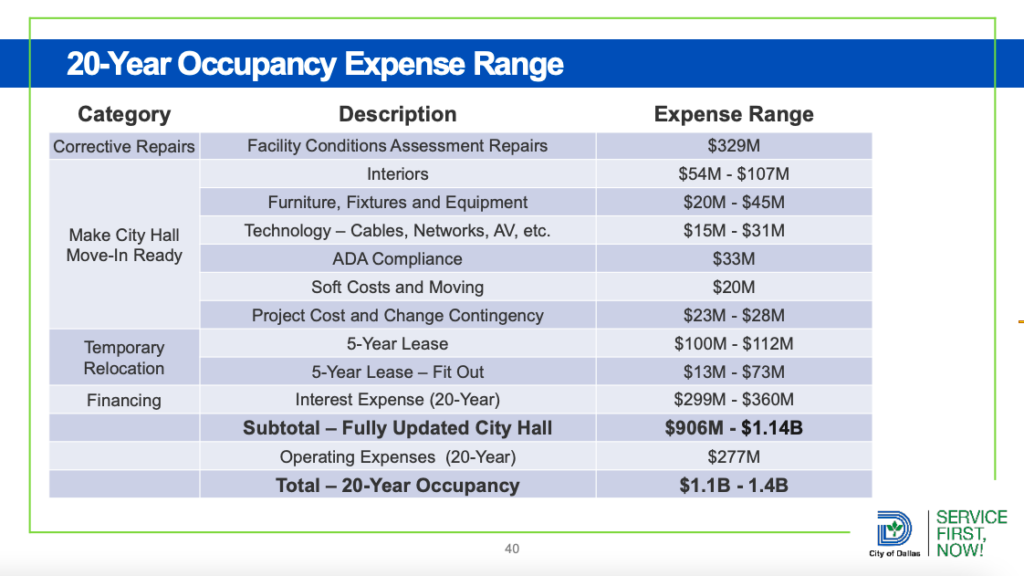
Everyone who works at City Hall would have to be relocated for five years under this scenario, which means temporary office space for up to 2,200 employees. Leasing and fitting out the space would cost $113-185 million. At last week’s Finance Committee meeting, staff said a phased approach to renovations was ruled out as too costly and dangerous because of asbestos-containing materials throughout the building.
Making City Hall move-in ready will purportedly run $165-264 million, and there’s quite a lot to that. The biggest component of that is work on the interiors, coming in at $54-107 million. This includes office fit-out, modernization, and workplace improvements. Then, furniture, fixtures, and equipment at $20-45 million, followed by getting the building ADA-compliant for $33 million. Outfitting a restored 1500 Marilla St. with necessary technology — which includes things like more AV equipment, surveillance and security systems, emergency dispatch consoles, etc — is estimated to cost $15-31 million. Soft costs, moving, and change contingency would be $43-48 million.
As for the actual repairs, staff said they would cost around $329 million. While plenty of work needs to be done, the overall structural integrity of 1500 Marilla St. appears to be sound, at least according to the limited sight surveys conducted. Water intrusion is pretty widespread, though.
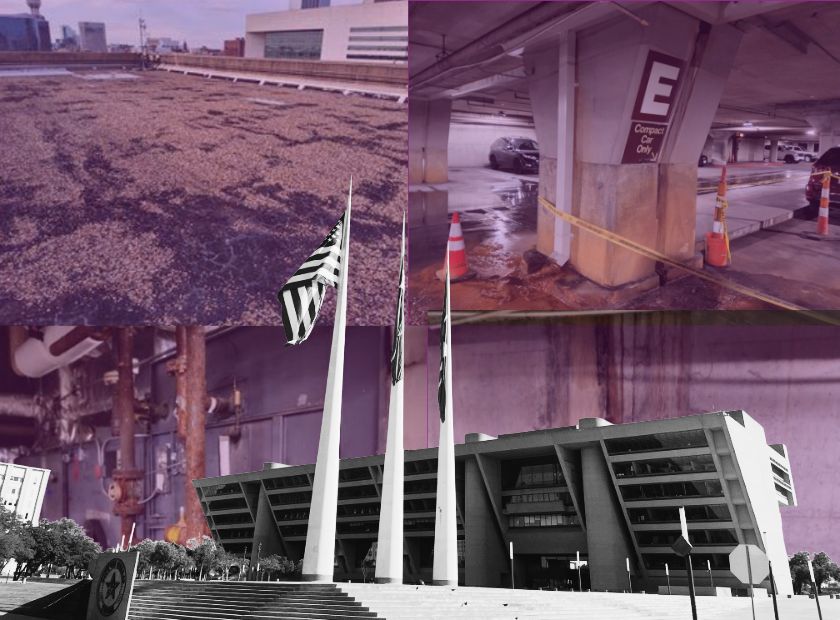
In a Friday memo, staff described water intrusion as a longstanding, systemic issue that dates back to the building’s original construction. While repairs could improve conditions, staff cautioned that fully eliminating water intrusion may not be possible, and renovations could uncover additional hidden damage.
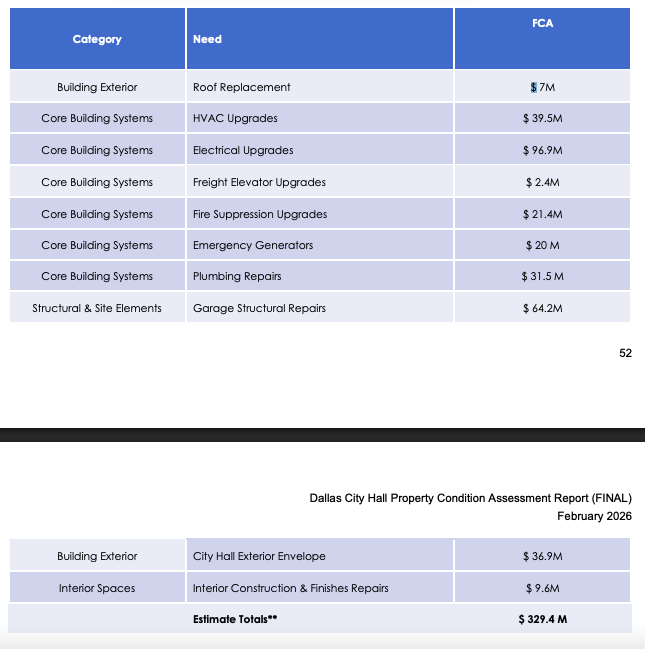
Exterior repairs recommended include a full roof replacement and fixes to the exterior walls and envelope that will combat water infiltration. That adds up to roughly $46.9 million. Interior work that needs doing is estimated at $9.6 million. Repairs related to the parking garage total $61.5 million. This mainly comprises localized issues with the concrete and structural interfaces.
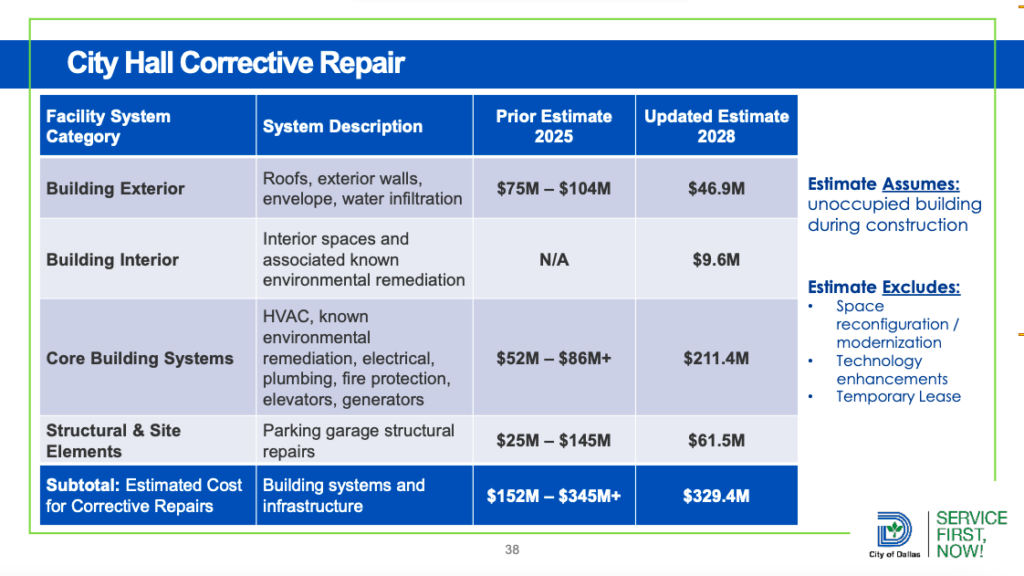
Core building systems like HVAC, electrical, plumbing, fire protection, elevators, and generators add up to $211.4 million — easily the biggest repair expense altogether. Most of these, though, are recommended replacements and upgrades rather than repairs.
According to staff’s memo, the emergency power system, water intrusion, and the roof are “the most critical failures identified.”
“Multiple firms collaborated [on the assessment]. AECOM provided the cost estimates based on industry standardized methodology. The cost estimating was within their scope of work. The other firms were not tasked with cost estimating,” the memo reads.
It’s worth pointing out that the city doesn’t want to get a second opinion on the property condition assessment it commissioned through the Dallas Economic Development Corporation. A lack of an official second look has contributed to suspicion among critics of relocation, some of whom think staff has inflated estimates and exaggerated structural deficiencies so council members could justify selling the site.
Such claims have been denied by city officials.
“No one on the city staff has had any influence at all or has made any comments candidly about what the future of City Hall will be,” EDC President Linda McMahon said last week. “The goal and the charge has always been that we want independent, verifiable, professional work done, and that is what we strive to do, and I feel like we’ve delivered on that.”
What Are Critics Saying?
Now, there’s been a ton of sticker shock out there. Many have probably seen a graphic circulating that compares the City Hall estimate with the purported costs of renovating some even more historic landmarks. WFAA ran with its own version, including some new major builds in the D-FW. Most of them came in under what staff is projecting.
Last month, a group of former American Institute of Architects Dallas presidents known as the Ten Presidents released a report calling the city’s estimate into question. The report claims the historical record doesn’t support the $1 billion figure.
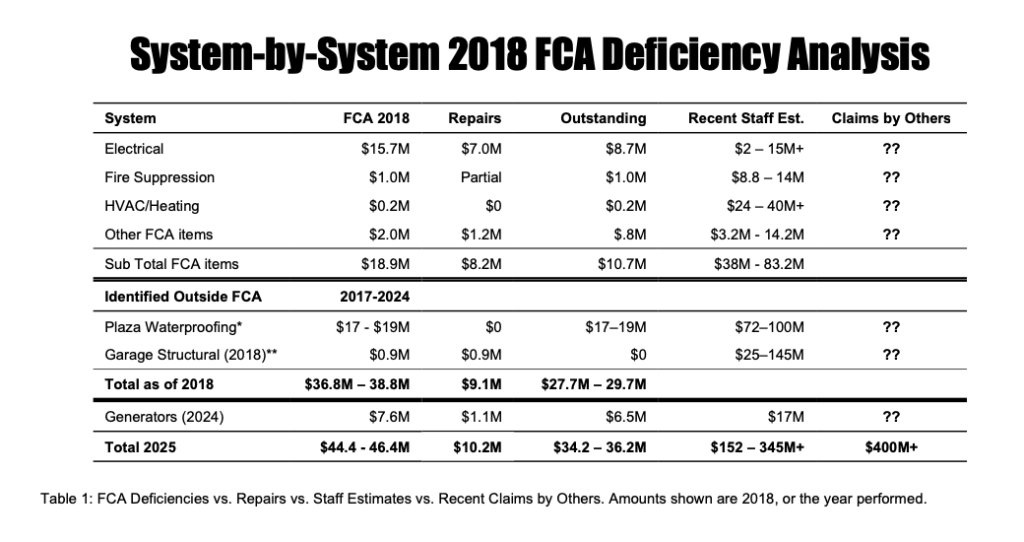
According to the most recent comprehensive Facility Condition Assessment from 2018 (the product of a two-year study), only $37-39 million in needed repairs were identified. Granted, that’s from eight years ago, but the architects argue that staff’s estimate is conflating actual needed repairs with modernization upgrades, full system replacements, and plaza enhancements — not to mention the hundreds of millions of dollars that stem from a 20-year loan and five-year temporary relocation.
The architects argue that the estimate also fails to factor in older investments and modernization and that the relatively short sight survey conducted by the consultants was nowhere near comprehensive enough to base such a significant decision on.
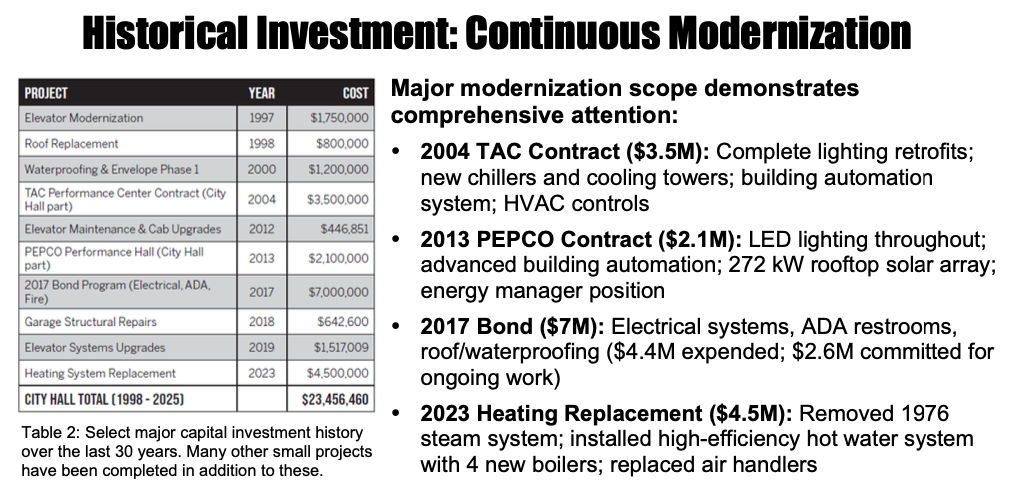
“Put plainly, there is no evidence in the FCA record, the project history, or prior engineering studies to support the idea that City Hall has accumulated 400M+ in true deferred maintenance,” their report reads. “The magnitude of the cost gap indicates that independent validation and a full 12-month FCA following industry standards would provide more reliable cost projections before irreversible decisions about relocation or disposition are made.”
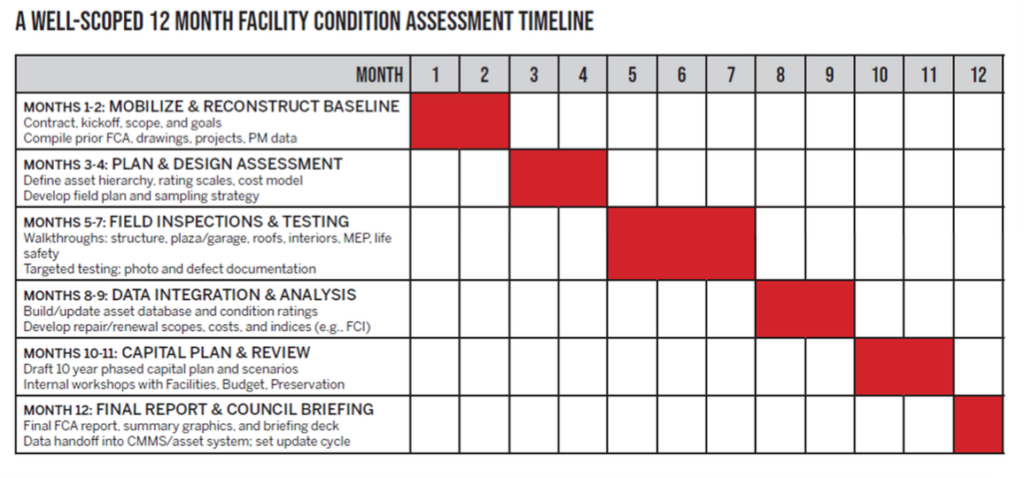
Characterizing the building as a “functional asset, not a failing structure,” the Ten Presidents claim that continued phased investment — rather than an all-at-once replacement program — would better serve taxpayers as city leaders weigh renovation against relocation.
Another report recently emerged that was received by Dallas City Council. The memo line says it was sent by “Independent Fiscal & Facilities Analysis – Dallas Taxpayer Advocacy.” The report was created with the assistance of the Claude AI chatbot, according to Council Member Cara Mendelsohn (District 12).
The report claims that AECOM’s estimate was based on “upgrading every system to luxury Class-A commercial office standards.”
“Let us be direct: the actual critical repairs needed to maintain Dallas City Hall as a functional, safe, B-class government facility are estimated at $60 to $90 million — a figure consistent with standard government facilities benchmarks for a 490,000-square-foot building of similar age,” the report reads. “The EDC report arrives at 12-to-15 times that figure by layering on unnecessary modernization upgrades, full-building relocation costs, 20-year financing interest, and a gold-plated fit-out more appropriate for a Goldman Sachs trading floor than a city permit office.”
Here’s a breakdown of cost estimates from the report:
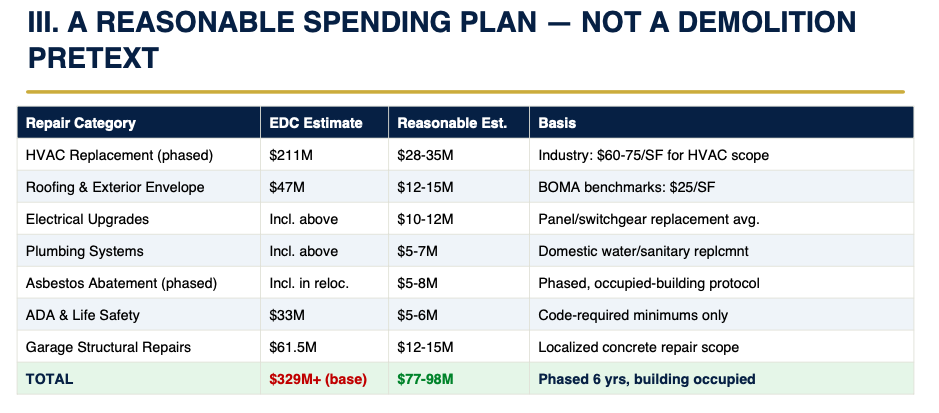
“A responsible plan would phase these repairs over six years while keeping the building occupied, eliminating the $113 million relocation cost entirely. The $299–360 million in financing interest disappears if the City funds repairs through its existing capital improvement budget — as it should. The $165 million ‘make-ready’ fit-out is simply unnecessary for a government office building,” the report reads.
Here’s the thing, together, these two reports do not constitute one side of a fair apples-to-apples comparison with the city’s property condition assessment and consequent estimate. But they are alternative analyses in the absence of a thorough second opinion — something staff said is not necessary.
Nothing is set in stone yet, but the Finance Committee voted unanimously to recommend relocation. That’s seven out of the 15 elected officials who sit on the city council, for what that’s worth.