
Finance Committee Recommends Exploring Dallas City Hall Relocation
Share News:

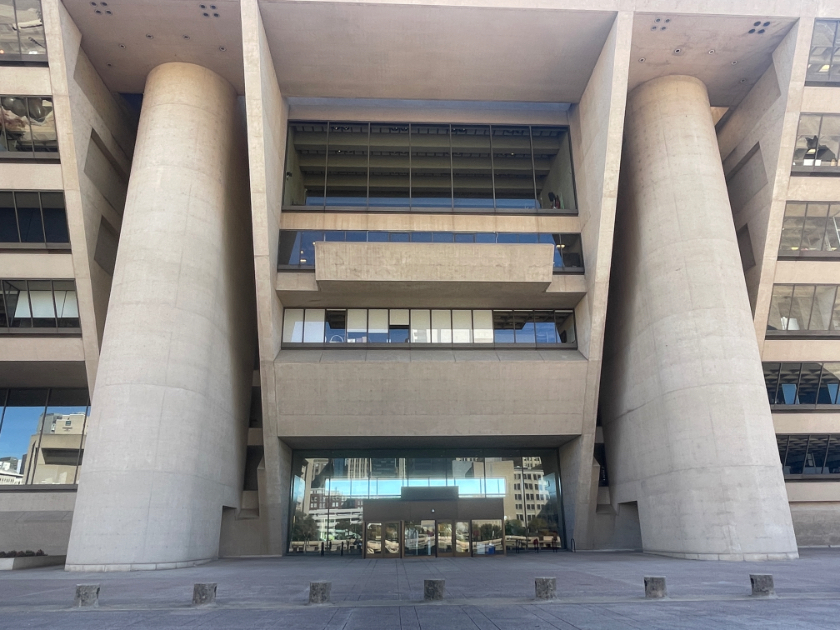
The City Council’s Finance Committee voted unanimously Monday to recommend that the city begin exploring relocation options for City Hall functions currently housed at 1500 Marilla St.
The property condition assessment and recommendation renewed speculation on social media that officials were laying the groundwork for redevelopment of the site, possibly to accommodate a new Dallas Mavericks arena. The City Hall Condition Assessment Report can be found in Dallas City Hall documents available online.
At issue is the roughly $1 billion estimate to repair and update the aging building over 20 years— a figure that has drawn sharp skepticism from some critics who believe staff and consultants are exaggerating its deficiencies and inflating projected costs.
Some council members not on the committee echoed similar concerns as they grilled staff about the integrity of the report, which was spearheaded by the Dallas Economic Development Corporation.

Linda McMahon, president of the EDC, defended the qualifications of the companies and specialists who conducted the assessment and claimed there was no pressure coming from above to arrive at a certain conclusion.
“No one on the city staff has had any influence at all or has made any comments candidly about what the future of City Hall will be,” she said. “The goal and the charge has always been that we want independent, verifiable, professional work done, and that is what we strive to do, and I feel like we’ve delivered on that.”
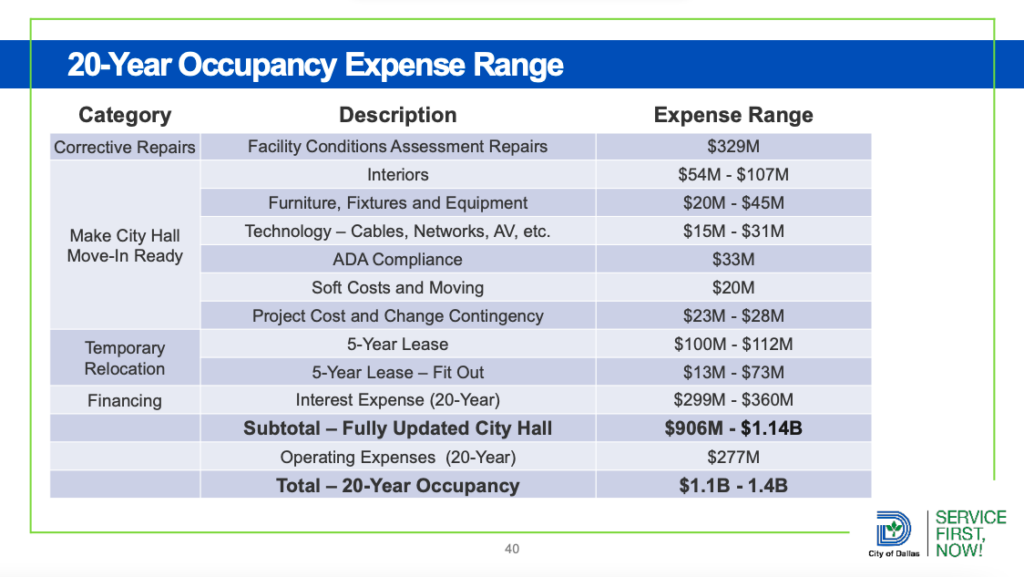
Still, questions were raised about the projected costs being based on the assumption that all the repairs would be done concurrently with the building completely vacated. Temporary relocation was estimated to cost between $100 million and $200 million — roughly a fifth of the total estimate range. Additionally, it was revealed that the building assessment itself had a margin of error of 25%, with corrective repairs pegged at $329 million.
A phased approach model to repairing City Hall was not included in the report, according to staff, because industry professionals involved said it would significantly increase both costs and the construction timeline.
“I would like to have a second opinion on this $1 billion by disinterested parties,” said Council Member Cara Mendelsohn (District 12). “I think there have been any number of highly qualified folks that would actually do this for free because they cannot believe what is being said to us.”
She expressed her preference for a phased approach, saying there were city facilities with excess capacity that could absorb temporarily-relocated City Hall employees, many of whom, she suggested, were already working remotely.
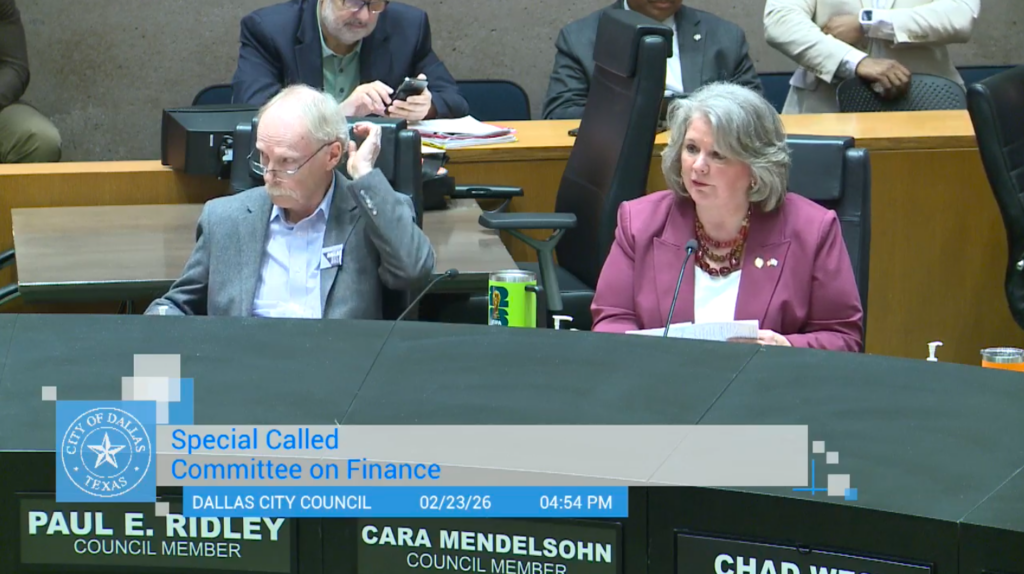
“I would love for there to be a fire alarm that was a test and see how many people exit this building because I guarantee you it’s not anywhere close to [around 2,200],” she said.
Staff and some of the third-party specialists countered that widespread asbestos-containing materials found throughout the building would pose significant challenges to a phased approach, not just in terms of cost but health risks to city employees.
Council Member Paul Ridley (District 14) suggested the assessment was rushed, which could have led to inflated estimates and an inclination to replace entire building systems rather than identifying and trying to fix particular issues.
“I also believe that we need a second opinion before we make such a momentous decision, an expensive decision — someone who is not going to be financially interested in the outcome and who can at least review the results of these consultants,” he said.

Assistant City Manager Donzell Gipson said he was confident in the work that was done by the team assembled by the EDC and that there was no need for an independent third-party review.
“I wouldn’t have brought this briefing today if I didn’t feel so,” he said. “All these folks are industry leaders.”
Council Member Adam Bazaldua (District 7) asked staff if they engaged with any consultants who did not stand to benefit from a sale of 1500 Marilla St.
“Not that I’m aware of,” McMahon responded.
Bazaldua questioned how offloading 1500 Marilla St. would improve city services for residents and suggested that the assessment was not sufficiently unbiased.
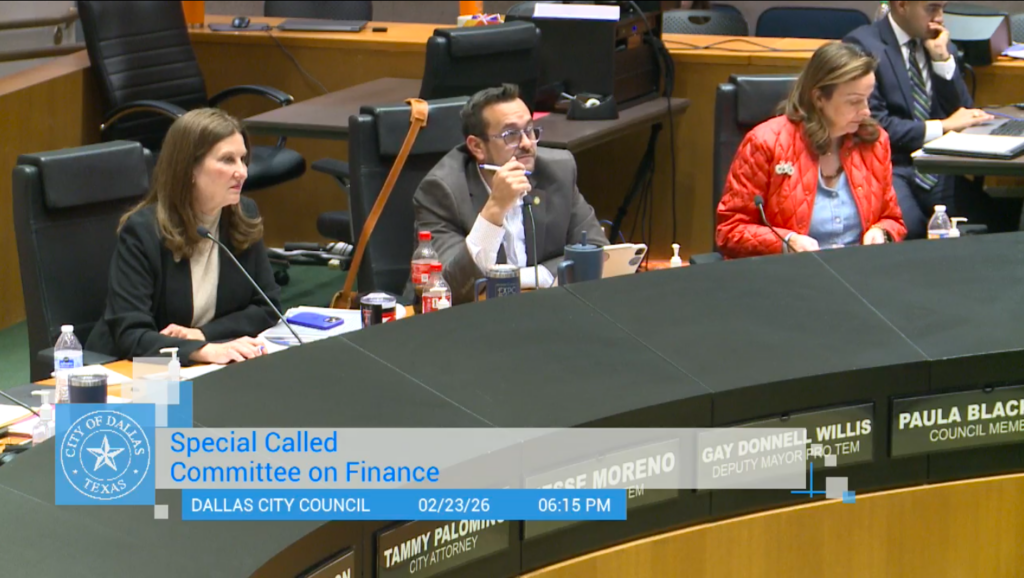
“Our obligation is not to facilitate a real estate transaction or to pad the pockets of billionaires in our city,” he said. “Our obligation is to protect the public’s trust and their tax dollars. Before we abandon a public asset, we owe Dallas residents independent validation, refined numbers, and a truly comparable long-term financial analysis.”
Sitting members of the Finance Committee, on the other hand, took a more measured approach in their questioning. All expressed sympathy with what the historic building means to many in the city and stressed that transparency was important. But being practical and appreciating the costs of years of accumulated deferred maintenance, they said, had to be considered, too. And most were against pursuing a phased approach to repairs.
“Regardless of where we ultimately land on City Hall itself, I believe it’s prudent for the city to continue engaging the market,” said Council Member Jaime Resendez (District 5). “Understanding what opportunities exist and what the private sector is realistically willing to offer informs our decision-making. Market engagement does not commit us to a particular outcome. It equips us with information.”
Council Member Chad West (District 1), who chairs the Finance Committee, said at the beginning of the discussion that continuing down the path of deferred maintenance should not be an option and officials need to decide to either commit to repairing City Hall or relocate. He noted that he and his colleagues at the horseshoe have been hearing from all manner of constituents on both sides of the issue.
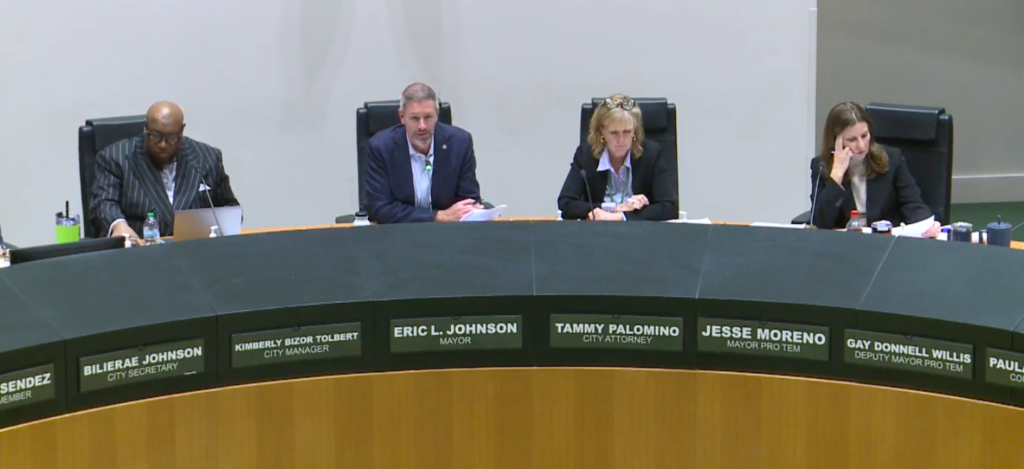
“Everyone, including city staff, has an agenda,” West said. “At the end of the day, we have a fiscal and fiduciary duty to our residents to look past emotions and past the personal interests and choose a path forward that is fact-based and will give our city and downtown the best shot for a successful future.”
In addition to recommending to City Council that it pursue relocation options for City Hall functions from 1500 Marilla St. and explore redevelopment options for the site, the Finance Committee also recommended that emergency operations and 911 and 311 dispatch be moved out of City Hall as soon as possible.
The Finance Committee was created by Mayor Eric Johnson last fall. He tasked it with determining “whether Dallas City Hall and other municipal facilities effectively support City operations and best serve the citizens of Dallas; Consider all potential options and identify the most fiscally responsible course to address the mounting deferred maintenance and carrying costs of Dallas City Hall.”
He made West chair of the committee. Other council members appointed to the body were Council Members Kathy Stewart (District 10), Zarin Gracey (District 3), Maxie Johnson (District 4), Jesse Moreno (District 2), Jaime Resendez (District 5), and Gay Donnell Willis (District 13).
A hearing by the Economic Development Committee — which will allow for public comments — is scheduled for March 2. Two days later, the full Dallas City Council will receive a briefing.







This is only one set of numbers. We do not have a comparative analysis from others on this set of assumptions, much less a varied set of assumptions on, say, four or five examples of leased space and what that cost would be. Seems to me the City Council is not ready to make a responsible decision at this time and needs to do more homework.
Should we raze City Hall, a splendid monument to Brutalist architecture, and replace it with a sports arena? “We will probably be judged not by the monuments we build but by those we have destroyed.” Ada Louise Huxtable
I just can’t see that it’s “fiduciarily responsible” to move out of City Hall to some facility that is probably old and woudl require substantial work to make it fit the functions of the City deparments. The sheer cost of renting/leasing would be enormous and are unavoidable continuing cost. Then there is not only the cost of moving, but the cost of disruption to City services.
This is not like trading in a car – the City gets nothing back from a move – costs only increase. The Council needs to look at moving the emergency services (911, 311, EMCR, etc) to a new facility and using that space for internal space swaps during renovation.
Beyond the question of moving – what happens if the City vacates? Will a new arena come at taxpayer expense? Sports magnates are well know for wheedling costs for stadiums from the public trough – will our grandkids be paying for an arena in the 2030s???