
The MLK Legacy That’s Not Talked About Enough: Fair Housing
Share News:

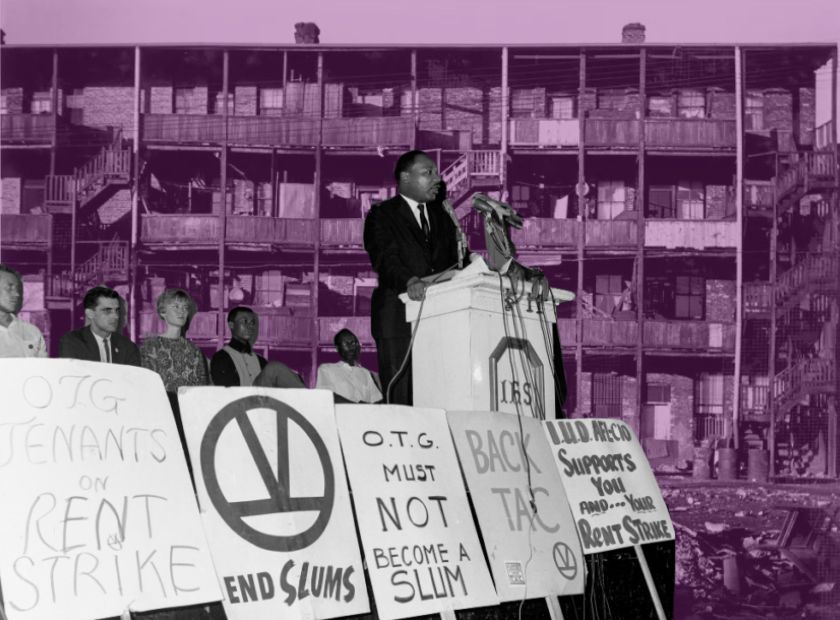
As the nation observes Martin Luther King, Jr. Day, there will be plenty of reflections on the man’s fight for racial justice — many focused on the historic struggles in the South. But often less appreciated is the campaign he waged up north for fair housing. What better part of his legacy for CandysDirt.com to highlight?
Challenging Jim Crow in the segregated South made King a national name, but his vision for equal treatment under the law took him to northern states as well. Black families in northern cities were facing de facto segregation across a number of critical aspects of their lives.
In 1966, King accepted an invitation to co-chair the Chicago Freedom Movement, a coalition of civil rights groups who wanted to expose and confront systemic discrimination in education, employment, and housing.
That January, King and his family made a symbolic move: they packed up and relocated to a rundown apartment on Chicago’s West Side to put a spotlight on what African Americans were facing there, which included overcrowded, poorly maintained housing for higher rents and being denied access to mortgages and neighborhoods redlined for white residents.
“I can see no more dangerous trend in our country than the constant developing of predominantly Negro central cities ringed by white suburbs,” King said in a speech that year, describing “rat-infested slums” black families had to overpay for. “This is only inviting social disaster. And the only way this problem will be solved is by the nation taking a strong stand, and by state governments taking a strong stand, against housing segregation and against discrimination in all of these areas.”
That summer, thousands marched from Chicago’s Soldier Field to City Hall, carrying a list of demands that included an end to discrimination in housing and accountability for banks and realty firms that denied equal treatment. As they passed through white neighborhoods, the marchers encountered violence from hostile residents who threw bricks and bottles at them. King himself was hit in the head.
The Chicago campaign secured limited commitments from the city, like the promise to expand public housing and work with lenders to broad access across the color line. And the Leadership Council for Metropolitan Open Communities was established to promote fair housing practices. For many in the fight, including King, it was understood to be the beginning of a longer struggle.
King was assassinated less than two years later in 1968 in Memphis. That same year, though (just a week later, actually), the Fair Housing Act was enacted. Tragic as it was, King’s murder spurred legislative action as unrest spread in cities all over the country. Still, it was ultimately the work of King and thousands of other dedicated activists like him who made the issue a national priority in the face of fierce resistance.
The law made it illegal to discriminate in the sale, rental, or financing of housing based on race, religion, or national origin. It was later expanded to include sex, disability, and family status as protected categories. The Fair Housing Act was a huge legislative milestone, putting the force of law behind the notion that Americans of all stripes should have the right to choose where to live free from discrimination.
Many believe, however, that the promise of fair housing remains unfulfilled to this day. Inequities in homeownership, ongoing patterns of segregation (arguably uncoerced), and resurging challenges in enforcement suggest King’s project is still a work in progress.
Regardless, as much as there is any national holiday with a housing dimension to it, it’s got to be Martin Luther King, Jr. Day.