
Startup Looks to Turn Idle Apartment Laundry Rooms Into Resident Perks, Gig Economy Jobs
Share News:


A new laundry service platform is looking to grow its presence in Texas, leveraging underutilized washers and dryers to enter the D-FW laundering market.
NoScrubs is an app-based, on-demand laundry service that relies on gig workers to pick up, clean, and return customers’ clothes and linens within just a few hours. The company got its start in Austin a little over a year ago and just this month went live in Dallas and Fort Worth.
“The basic premise is there’s never been a truly same day laundry delivery service,” said NoScrubs CEO and co-founder Matt O’Connor, speaking with CandysDirt.com. “That’s a key component because most people have access to a laundry machine but would rather not be using it. So if that’s really what you’re competing against, the three-hour turnaround that we offer is vital.”
The Gigification of Laundry Service
No stranger to the startup game, O’Connor previously launched the out-of-home ad buying platform AdQuick. He was also one of the first two dozen or so people to work at Instacart, an experience he says has informed his latest venture.
He explained how his platform, like Instacart, utilizes existing infrastructure to unlock last-mile delivery for his customers by connecting gig workers with partner laundromats in service zones.

“Once a customer schedules the pickup, ‘scrubbers’ will pick up the order and go to the closest laundry location that’s in our network — right now it’s predominantly laundromats, but we’re moving into using multifamily housing common laundry rooms, which are effectively off-market laundry rooms,” O’Connor said (more on that last bit later).
He said his company’s partner laundry locations are well distributed across the service areas.
“One of the core lessons of Instacart that we’re applying here is that last mile. The distance you travel, it’s absolutely vital to minimize it so that your end cost to the consumer can be low and the people doing the orders can make good money,” he said.
According to O’Connor, Scrubbers can make about $15 per hour, which is more than many Uber or DoorDash drivers may make after accounting for gas and vehicle wear-and-tear.
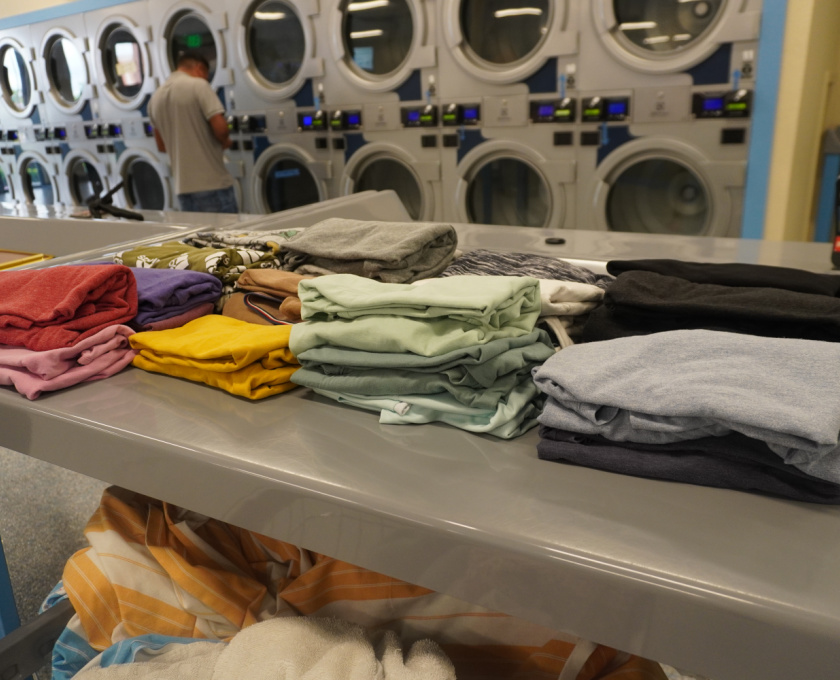
“We feel like we’re very competitive there, not to mention the other kind of qualitative benefits of not having different food or people in your car,” he said. “And a lot of the time, when you’re doing the orders waiting for the cycles to complete, it can be qualitatively peaceful to a lot of people, so it’s pretty differentiated in the overall gig economy with slightly superior average earnings.”
NoScrubs isn’t the only game in town, though. A similar platform called hampr launched in 2021, however, it is geared more toward servicing proprietors like short-term rental owners, medspas, and wellness brands.
“We focus on high-volume operators … who need reliability at scale, not just convenience,” hampr CEO and founder Laurel Hess told CandysDirt.com. “That’s why we built a platform that pairs local, vetted ‘washrs’ with tech that’s designed to grow alongside our clients.”
No In-Unit Laundry? No Problem
Coming back to those “off-market laundry rooms” mentioned earlier, multifamily housing poses an interesting opportunity for a company like NoScrubs. Many properties maintain common laundry spaces with multiple underutilized washers and dryers.
“I lived in an apartment building with a common laundry room, and I noticed that basically nobody was ever in there,” O’Connor said. “If we could leverage these completely idle machines that are basically everywhere, we would be able to minimize the last mile and have this three-hour turnaround.”
He said a lot of the properties NoScrubs is looking at were built before 2000, before in-unit laundry was made more widely available in the multifamily sector.
“For them it can be a revenue driver because they’ll make money when those machines are being used,” he said, arguing that deploying the platform at multifamily properties is a win-win relationship for stakeholders.
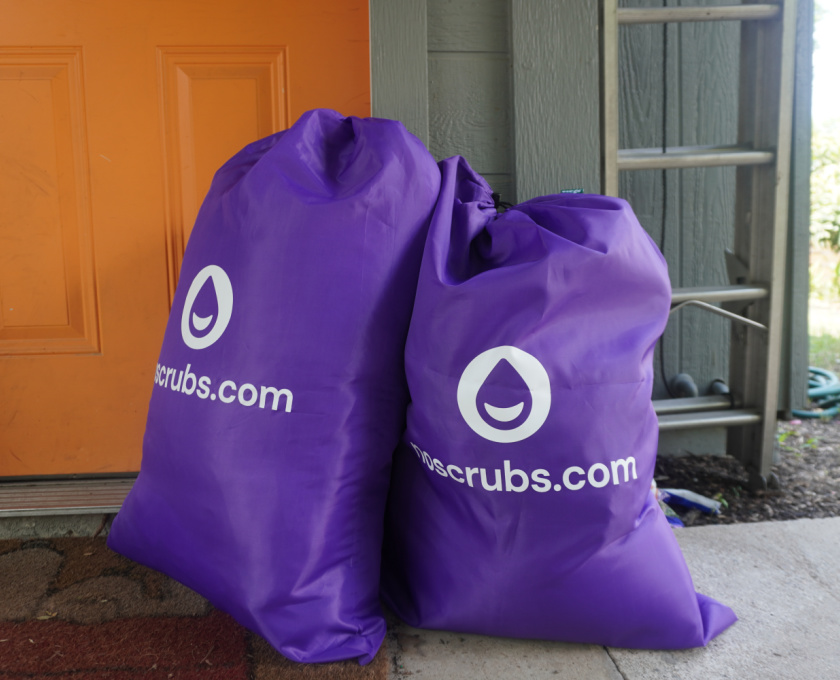
“They may not have in-unit laundry, so we offer benefits for the residents on those properties as well,” he said. “So, it can take the worst point about living at a particular property — that you don’t have any in-unit laundry — and flip that around. You don’t have any in-unit laundry, but you do have a same-day laundry service.”
O’Connor opined that if his business scales at the rate he’d like it to, there could be broader implications for real estate. Consider that between in-unit laundry hookups and machines, there’s billions of dollars of value at play, not to mention the freed up square footage.
“The concept of owning a laundry machine or having a laundry room when there’s a service that’s faster and better than doing it yourself … becomes moot,” he said. “Developers can avoid having every single unit with a laundry machine, which is a ton of [capitalization] back and a ton of square footage.”
O’Connor said he’s looking to partner with property owners in Austin, Dallas, and Houston.
Commenting on the entry of NoScrubs into the D-FW market, hampr’s Hess expressed excitement, saying that it actually serves as further proof of concept.
“It validates the need,” Hess said. “In such a fragmented market, success isn’t about picking up laundry. It’s about building real infrastructure and trust. That’s what we’ve been doing for the last four years.”