
City Zoning Authority Increasingly Under Threat From Texas Legislature, Critics Say
Share News:

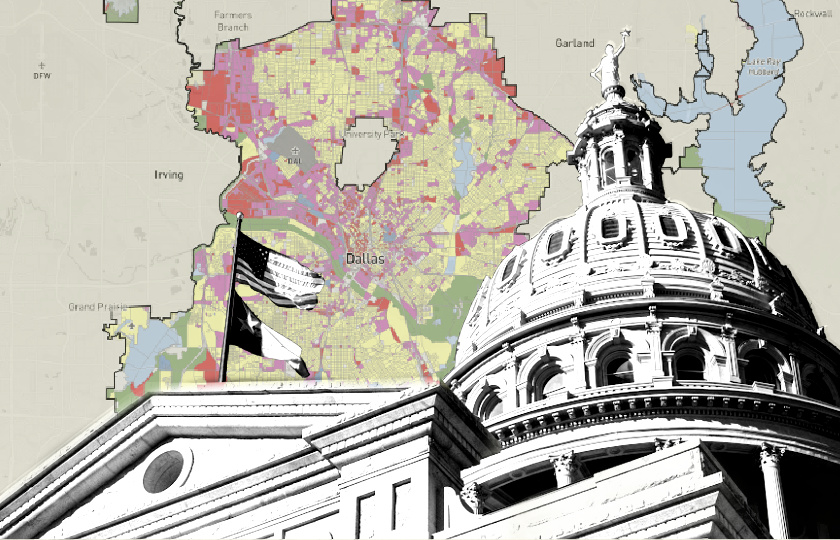
State lawmakers have made no bones about how they plan on alleviating the housing shortage in Texas: stripping cities of their ability to regulate space through zoning.
Zoning has traditionally been the purview of municipalities, allowing local officials (elected or otherwise) to plot out what things can be built where in a way that makes the most sense for their communities.
While it’s not uncommon for cities to make unpopular decisions in zoning cases, the court of popular opinion in a local context gives residents and stakeholders the ability to duke it out at city hall over particular builds.
Last week, Irving residents successfully mobilized to pressure their city council to drop a proposal to allow casino gaming at a planned resort development. On Wednesday, Dallasites living in District 11 hope to convince council members to put the kibosh on nearly 1,000 apartment units at Pepper Square.
That kind of venue appears to be coming under fire, with multiple bills filed this session seeking to strip municipalities of their planning and zoning authority in certain cases when it comes to housing.
A Threat to Single-Family Neighborhoods?

Retired corporate attorney and D-FW resident David Schwarte has been busy testifying against legislation in Austin that he and like-minded homeowners consider to be a threat to single-family neighborhoods.
He told CandysDirt.com that the group he co-founded, Texas Neighborhood Coalition, which originally formed to fight short-term rentals, successfully beat back a number of “up-zoning” bills last legislative session but that they’ve returned with a vengeance this year. So, what’s up-zoning?
“It’s a euphemism for destroying single-family residential neighborhoods,” Schwarte said.
Rather than messing with cities’ ability to regulate planning and zoning, he said the legislature should focus on checking institutional investors from buying up housing to flip for a profit, a dynamic that has put upward pressure on pricing.
“The worst thing that the legislature could do is disrupt the legitimate expectations of people who bought into single-family neighborhoods and relied on that zoning,” Schwarte said.
Lawmakers have been tripping over themselves to file bills that could potentially boost housing stock. Some look to make permitting more efficient and encourage the construction of affordable housing through incentives. Others are seeking to enable property owners to build accessory dwelling units (granny flats). Texas Neighborhood Coalition has a problem with a lot of it.
“They’re cooking up stuff in the state legislature that would kill single-family zoning statewide, and few Texans know what’s being cooked up,” Schwarte said.
‘Each City Should Decide If and Where This Makes Sense’
Last week, the Texas Senate passed SB 15 in a 29-2 vote. If enacted, the bill would eliminate minimum lot size requirements greater than 1,400 square feet for new subdivisions in cities with populations greater than 150,000 that are located in counties with more than 300,000 residents.

“We are unblocking government regulations from getting in the way of [the] private sector for housing affordability solutions,” said the bill’s author, Sen. Paul Bettencourt (R-Houston), per a press release. “SB 15 is a critical part of that effort.”
Neighborhood Coalition of Dallas called SB 15 the “best of the bad bills” being considered by the Senate in an email blast to residents.
Even more threatening, according to the local group, are SB 840 and SB 854, which would purportedly “wreck our residential neighborhoods.”
SB 840, filed by Sen. Bryan Hughes (R-Mineola), seeks to prohibit cities from maintaining many regulatory barriers to converting commercial properties into residential. If the bill is enacted, developers would not need to secure a zoning change in most cases.
Additionally, they’d be able to build as high and densely as the tallest and most dense building in the city or county and be exempt from impact fees unless the land was previously subject to one.
The bill only applies to municipalities with a population greater than 60,000 located in a county that has at least 420,000.
“Cities work to reduce the tax burden on residents by increasing the percentage of property and sales tax from commercial properties,” the Neighborhood Coalition of Dallas said. “Eliminating commercial properties, particularly in cities that are nearly built out, has the unintended consequences of becoming a tax increase to residents.”
“Each city should decide if and where this makes sense,” the group added.
Neighborhood Coalition of Dallas also has a problem with SB 854, which seeks to forbid municipalities from requiring religious organizations to secure a zoning change or city approval to build multifamily housing or mixed-use developments.
Some single-family residents in Dallas have been especially apprehensive about the push to build more apartments in and near their neighborhoods for years now, citing concerns like the potential for increases in crime and traffic. City staff and planning consultants refute their claims, saying apartment homes don’t necessarily correlate with crime and residential zoning drives more traffic than retail.
The city’s update to its comprehensive land use plan (ForwardDallas) last year drew considerable opposition from pro-single-family homeowners who feared its guidance on increasing density would open the door for aggressive rezoning in and around their neighborhoods.
Now, it seems, the Texas Legislature is poised to do a lot of the dirty work.







This kind of fearmongering is the reason home prices are so high right now. It’s not “institutional investors.” All they do is buy houses to rent out. This does not make housing prices any higher. Zoning regulations, however, like single-family zoning, cut right at the heart of supply and demand market dynamics.