
Does Housing Density Bring Crime? Studies and Sources Are Mixed
Share News:

Some longtime Dallas residents have made it clear they don’t want housing density or multifamily development in their single-family neighborhoods. Typically they cite potential impacts on traffic and property values. Few will say out loud that they’re concerned about living next to poor people or criminals.
And while those conversations aren’t occurring frequently at recorded City Hall meetings, they are taking place.
CandysDirt.com wondered if there’s any research to support a correlation between crime and housing density. We reached out to our sources at the Dallas Police Department, the Dallas Communications and Marketing Department, and Planning + Urban Design. All responded quickly and were eager to help. However, none had a silver-bullet white paper or academic study to point us to, either corroborating or debunking the theory that apartment complexes attract crime.
To find out for ourselves, we dug through hours of archived Public Safety Committee meetings and looked for independent research.
Here’s what we found.
Housing Density and Crime
University of Texas at San Antonio criminology professor Michael R. Smith, who has consulted with the Dallas Police Department via the San Antonio-based Center for Applied Community and Policy Research told CandysDirt.com that apartment complexes do not inherently “cause crime” when appropriately planned and managed.
“Most multifamily complexes in Dallas have violent crime rates that do not differ from comparable single-family home neighborhoods,” Smith said. “That said, violent crime in Dallas, and in any other big city, concentrates in relatively few places. And in Dallas, those places are disproportionately older apartment complexes.”
Smith has told the Dallas City Council and the Dallas Public Safety Committee about how older apartment complexes can be challenging to police. “Much of that has to do with challenges involving the ownership and management in some of those communities,” he said.
During an April 23 meeting of the Dallas City Council’s Housing and Homelessness Solutions Committee, District 12 Councilwoman Cara Mendelsohn said multifamily housing is the No. 1 location for crime. The city has shifted to 50 percent multifamily housing in recent years, and multifamily makes up 65 percent of District 12’s housing stock in Far North Dallas, she said.
“What we hear over and over, especially in the southern sector, is that we need more single-family homes,” Mendelsohn said during a discussion about builder incentive programs. “It seems like we would want to incentivize the thing we’re looking to have happen.”
District 10 Councilwoman Kathy Stewart, who represents Lake Highlands, also has said that the majority of crime in her district is concentrated around apartment complexes in the Skillman corridor.
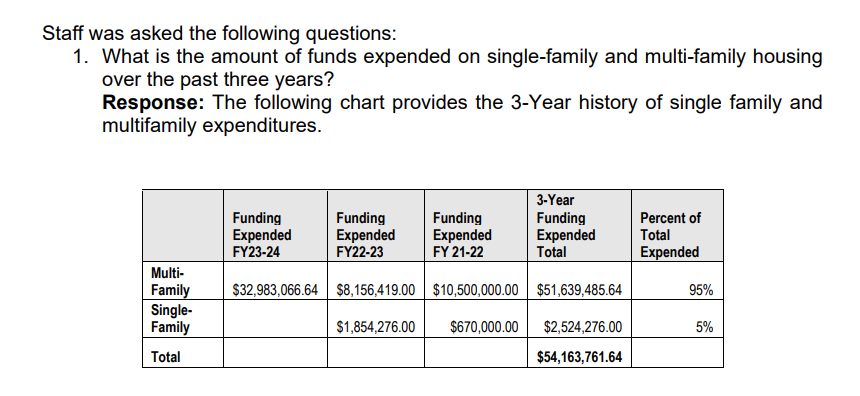
But there appears to be a push for affordable apartment units and Low Income Housing Tax Credit projects, particularly in Southern Dallas, where some residents say they’d prefer to have opportunities to own a home.
Hot-Spot Policing
Dallas has put a lot of stock in its Violent Crime Reduction Plan and saw a 25 percent decrease in some areas over this time last year, according to a recent report. Murder is at a six-year low, dropping more than 28 percent from last year, officials reported during an April 9 Public Safety Committee meeting.
The Violent Crime Reduction Plan focuses on reducing murder, non-negligent manslaughter, robbery, and non-family-violence aggravated assault, Smith said. Primary strategies include hot-spot policing, place network investigations, and focused deterrence.
Smith told the City Council during an April meeting of the Public Safety Committee, which Mendelsohn chairs, that hot-spot policing is working.
“There’s not a lot of scientific literature out there that can draw a direct line between hot spots and citywide reduction of violent crime,” he said. “You always see big impacts in the hot spots themselves. When you engage in hot-spot policing the right way, systematically over a long period of time, you can actually move the needle on violent crime across an entire city. That’s what we’ve seen, and we’re very excited about that.”
Place Network Investigations
Smith also pointed out that the five place network investigations, or PNIs, are netting positive results.
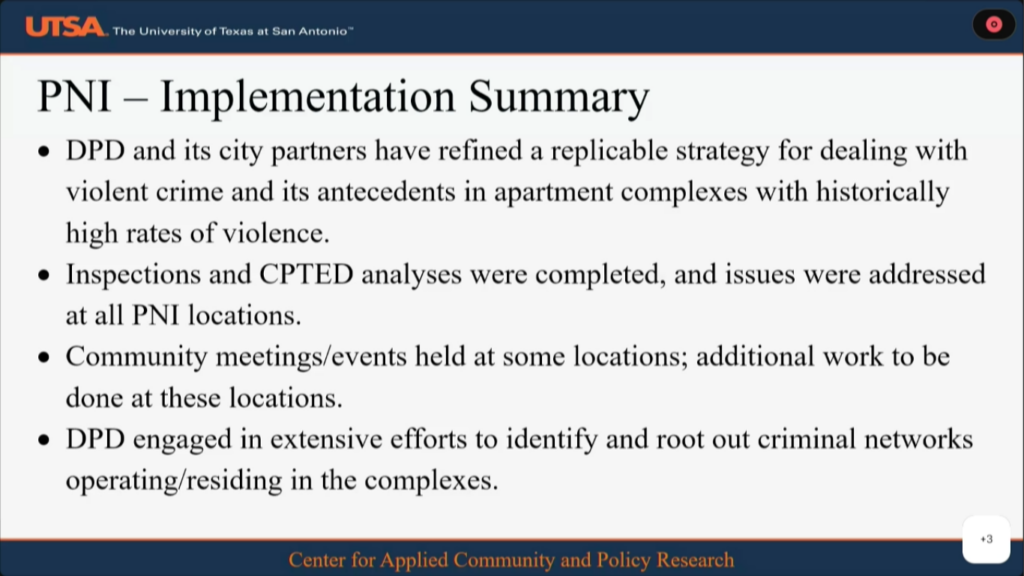
The Dallas Police Department has built a “replicable strategy” for addressing crime in apartment complexes, Smith said.
“All our PNI sites are apartment complexes,” Smith said. “DPD itself has engaged in what I would characterize as extensive efforts to root out criminal networks in these locations, to set the groundwork for the quality of life solutions to actually be able to take root. Oftentimes, that can’t happen until some of the violent criminal networks that have been operating in these locations — in some cases for a very long time — have been rooted out. What we have seen, with some variation, is some pretty consistent reductions.”
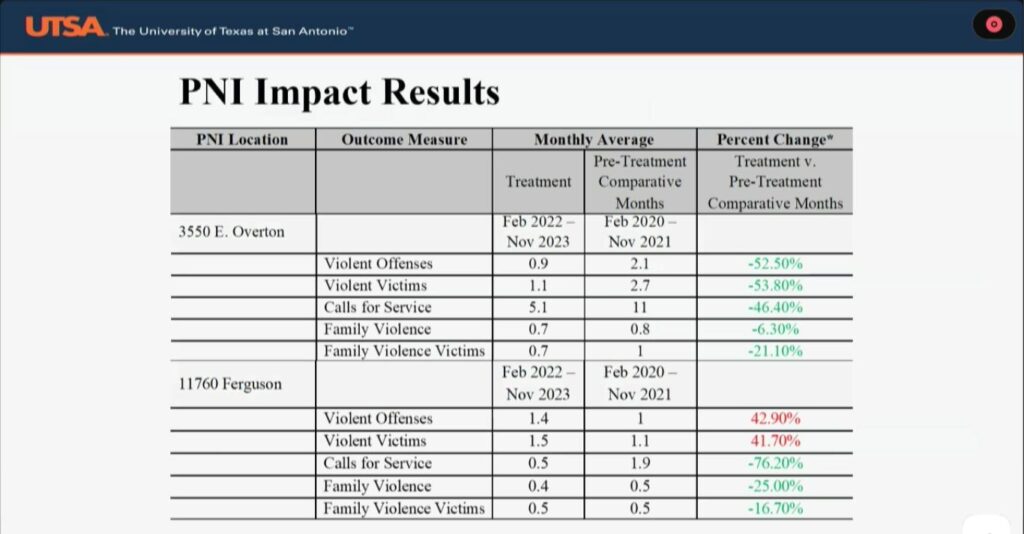
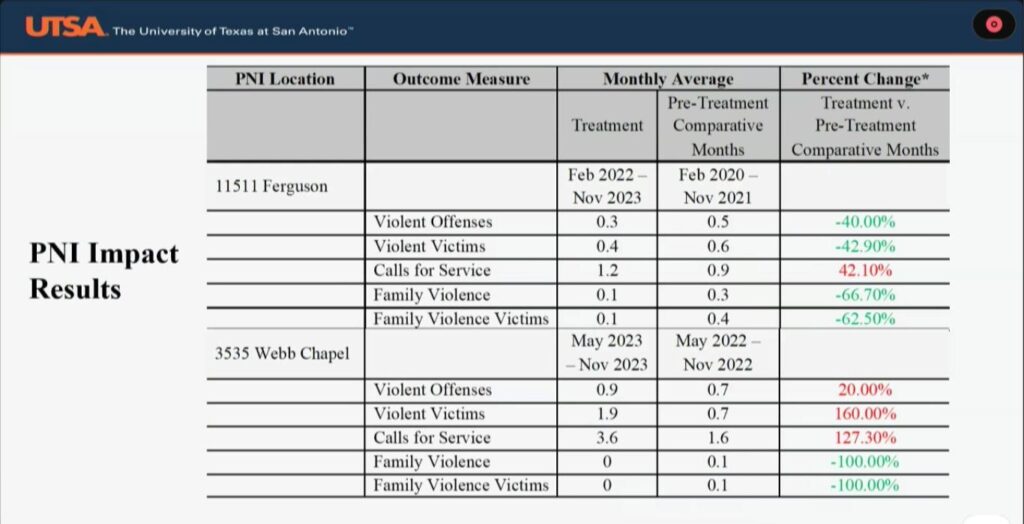
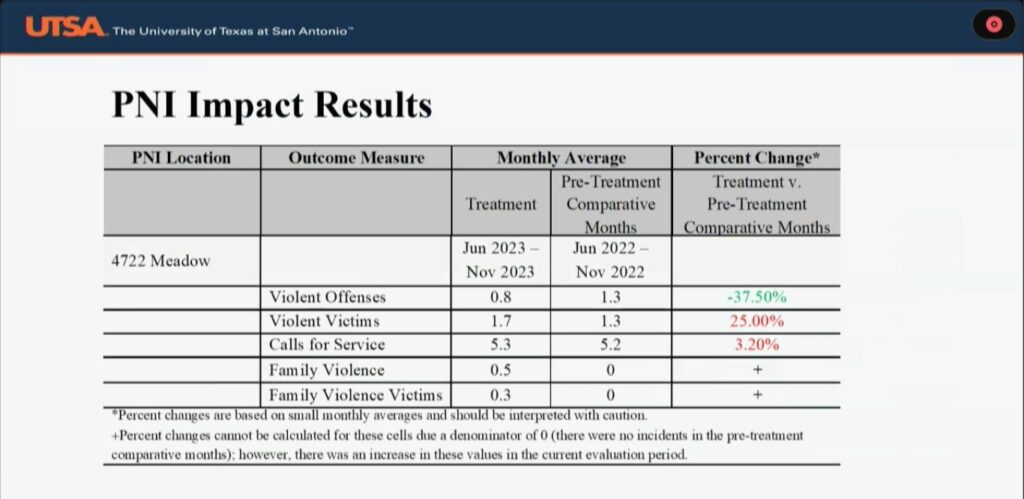
The first PNI location experts identified was the notoriously crime-ridden Volara Apartments at 3550 East Overton Road in Southern Dallas.
“Just the fact that all of those numbers are green and the percentages are as large as they are, even with the small numbers we’re talking about, shows you the impact that the PNI strategy has had at Overton,” Smith said.
Other PNI locations include two sites on Ferguson Road, one on Webb Chapel Road, and Rosemont at Meadow Lane Apartments at 4722 Meadow St.
“PNI is working,” Smith said. “There’s lots of activity going on across multiple partners to address the underlying conditions that cause crime at some of Dallas’ most challenging crime-prone locations. We’ve got a good strategy now that can be replicated at additional apartment complexes.”
The police department is partnering with the district attorney’s office, parole and probation offices, and the South Dallas Employment Project to offer services to convicted felons and implement a focused deterrence initiative.
Research on Crime And Housing Density
A white paper authored by Jianling Li, an assistant professor at the University of Texas at Arlington, and Jack Rainwater, senior planner in the Irving Department of Community Development, explores the topic of crime and housing density, but most of the data is more than 20 years old.
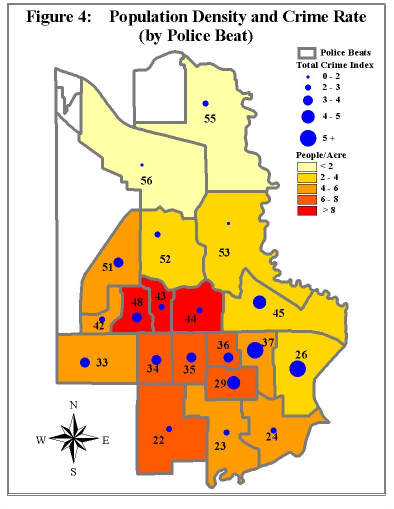


The research is, of course, open to interpretation, but appears to imply that high crime rates in multifamily developments are not necessarily linked to high housing density but rather a low socioeconomic status.
“A widely held belief is that high-density land use is intimately associated with [a] high crime rate,” the report states. “As a result, elected officials often resist undertaking projects of high-density development in their jurisdiction. However, results of GIS analysis show that high crime rate is not necessarily linked to high-density development, but more to the low socioeconomic status of the delinquents. This paper demonstrates the utility of GIS in the study of the relationship between land use patterns and crime rates and in the development of livable communities.”







Thank you so much for looking more deeply at these issues and for not just parroting, as some publications do, what a councilmember wants them to say. These issues are far more complex than we would like them to be. As someone in the trenches for the last eight years, I can attest that there are multiple nuances, no simple solutions, and that talking points that say otherwise are meaningless.
This is interesting but not a surprising result. I have long held that the rise in crime is consistent with the lack of probability of being detected, caught, arrested, tried, and punished. Since those probabilities no longer exist, crime will rise.
When our traffic fatalities and pedestrian fatalities mirrors in numbers the murder rate, the causal factor is not enough traffic enforcement which is tied directly to not enough cops!
If we had enough police Officers on the street maybe hot spot policing wouldn’t be as necessary and then maybe I’d see a police car in my neighborhood that is not on a call.
Ms. Towery,
I have been catching up on Forward Dallas debates and reporting today. It’s been a long time since I have actually read robust journalism that is publicly available and not tied to well developed and researched private subs that are very macro specific and typically of a national or global focus. That said I have read hours of your work today and bravo!!! Your work stands out for its depth, clarity and objectivity. Thank you and well done.
(DMN and the like is like reporting for third graders now and that’s the state of most news outlets with the few exceptions that aren’t not owned by the 5 conglomerates or overtly politically motivated. It was refreshing to read local news by adults for adults! lol)
Cheers!
Davina
Thank you Davinia! You have expressed our most sincere objectives here at CandysDirt.com