
Dallas Water Utilities to Conduct Water Line Inventory Looking for Lead Pipes
Share News:

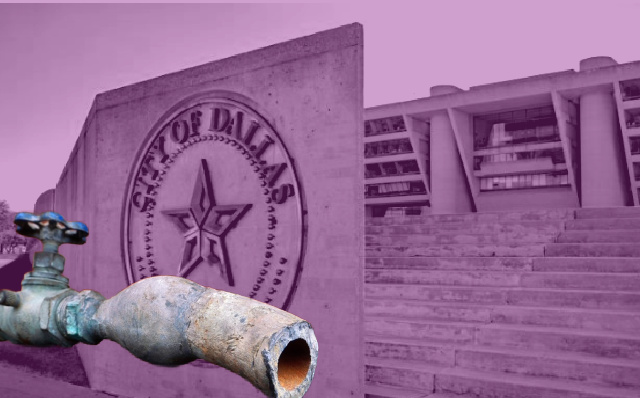
The City of Dallas wants to know what material was used to make the pipe that carries the water from a water main, under the yard, and to the faucets inside residences. Due to changes in the Environmental Protection Agency’s Lead and Copper Improvements Rule, municipalities throughout the country, not just Dallas, need to complete an inventory of all the water pipes in their respective cities so those made of lead or galvanized steel can be replaced.
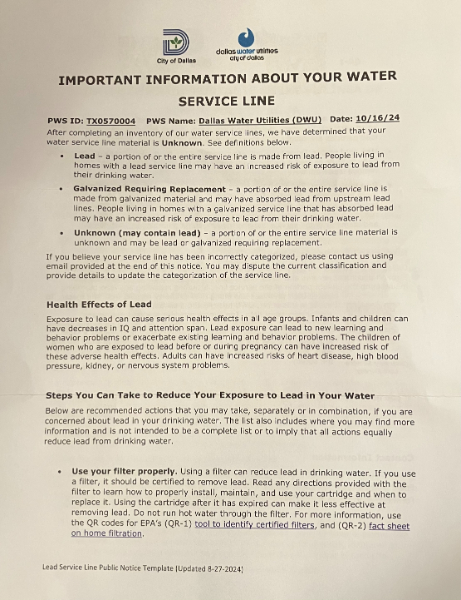
Unfortunately, a letter Dallas residents received earlier this month did not make that clear and raised concerns for homeowners that they may be on the hook for tens of thousands of dollars to replace a water service line on their private property if it is made of lead or some other questionable material. Then there are also the health implications of drinking water potentially contaminated with lead.
That is why at one of the first community meetings held to address the matter, a Dallas Water Utilities representative addressed the City’s water quality and what is being asked of water customers.

“First off, you do not have anything to worry about,” said Alfonso Morua, superintendent for DWU’s Water Quality Division. “We have had the safest water for years, We treat our water with an anti-corrosive called orthophosphate and we’ve done tests that show it prevents metals from leaching into the water. We do not have lead in our drinking water … We have not found a lead pipe so far,”
District 2 Councilman Jesse Moreno also attended last week’s meeting to assure his constituents that the water coming into their homes is safe.
“I have faith in our water utility,” he said. “The city is committed to testing those lines.”
So what is all the brouhaha about?

DWU has more than 324,000 active service lines. To date, the water utility has identified the material for 204,396 services on the public side, and about 90,000 on the private side, as non-lead, Morua said.
The EPA’s Lead and Copper Improvements Rule was finalized on Oct. 30, 2024, and all water municipalities in the nation have 10 years to complete the inventory of every public and private water line in their respective cities.
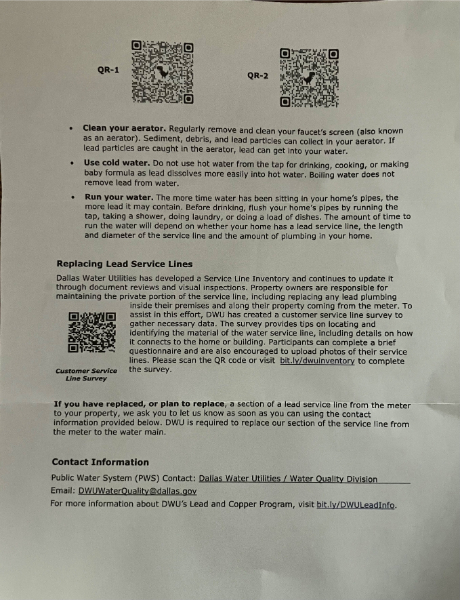
Because the city is not allowed onto your property or inside your home to inspect the water pipe carrying the water to your home, DWU is asking homeowners to inspect their own water pipe and then fill out a survey so the city can complete its inventory as required by the EPA.
The survey developed by DWU provides information on where you can find the pipe bringing the water into your home and steps on how to test and identify what type of material the pipe is made out of, Morua said.
What happens if a private service line is made of lead?
“If you find a lead pipe we will go and verify it,” Morua said.
If the pipe is verified as being a lead pipe, residents will not be required to replace it, Morua said.
“We will do a test,” he said. “We want to make sure the water is still safe to drink.”

He said it will be recommended that the lead pipe be replaced but the city will not force residents to replace the pipe nor will they have their water turned off. Morua said the water treatment process is thorough and the city is constantly testing the water through different types of pipes made of different materials, including lead, to ensure none of the toxic metals are leaching into the water.
“Even if it is a lead pipe you do not have to do anything,” Morua said. “The water treatment process deters metal from leaching into the water.”
If residents need additional reassurance that their water is lead-free, Morua said they can call 311 and request a free test. Residents can also see how their water line is categorized in the Lead Service Line Inventory by simply entering their address.
4 Comments
Leave a Comment







Thanks for the post, Mimi… I received one of those letters, which could have been written much more clearly to convey the true purpose of the letter. Now let’s get back to WTF Wednesdays!
I know what you mean. WTF this week is a keeper. Thanks for the read. Have a great week.
Well, perhaps they should have had a journalist write that original letter because it scared me!
A worthy idea. Thanks for the idea.