
A Last-Minute ForwardDallas Amendment Changed Bishop Arts Placetype, Resident Explains Why
Share News:

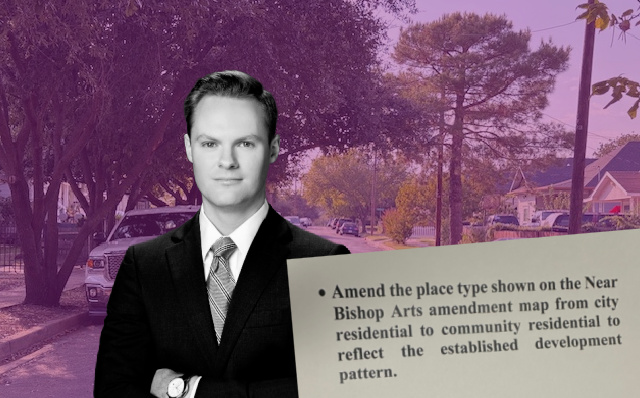
Throughout the process of developing and revising the ForwardDallas 2.0 comprehensive land use plan, city officials repeatedly asked for public input and echoed the mantra, “We hear you.” So when Bishop Arts resident and former WFAA journalist William Joy read the plan and found a glitch, he reached out to City Hall.
In Joy’s case, he knew what questions to ask and he knew when he was being “plan-splained” that the document was not about zoning. He knocked on doors, talked with neighbors, and sought clarification on what he perceived to be an oversight.
When the time came for the City Council’s Sept. 25 vote, a little-known, last-minute amendment was made to the plan’s controversial “placetype map,” reflecting Bishop Arts’ established development pattern — thanks to William Joy.
‘I Think a Mistake’s Been Made’
Joy, 32, and his wife moved to Bishop Arts in April 2024, so they’re not exactly longtime residents, but they care about the neighborhood and its future.
“It’s always been an area that we loved to visit, even when we first moved to D-FW in 2020,” Joy said. “It’s our first home. We’ve been in apartments and I think maybe it being a first home is partly why I feel so invested.”
Of particular interest to the newsman were the “placetypes” that outline particular land uses for specific regions of the city.
Joy said he’d heard about the comprehensive plan but didn’t pay much attention until he read a Sept. 3 op-ed in the Dallas Morning News written by his council member, Chad West. At that time he realized a vote was imminent.
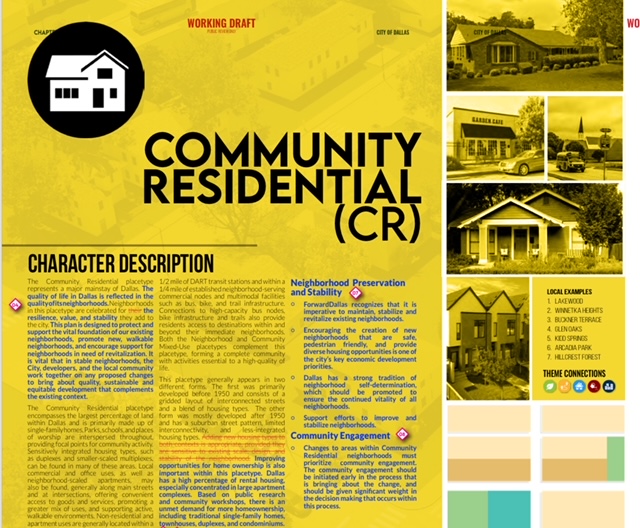
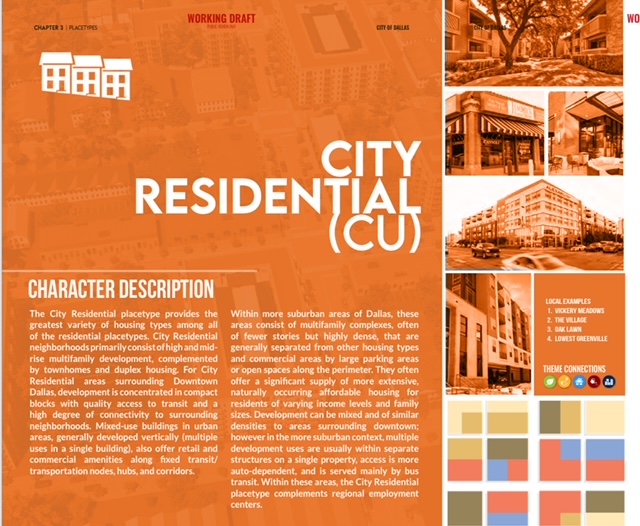
“I opened the plan and I remember trying to figure out what’s what,” he said. “There’s City Residential and Community Residential [placetypes] and you gotta go to the index to find your exact neighborhood. I remember looking at it and seeing that my neighborhood was City Residential. I’m thinking, if I’m reading this right, that means the ideal land use for my neighborhood isn’t single-family homes or duplexes — which is all that’s over here. It’s eight-or-more-unit apartment complexes and mixed-use development. Nobody over here is living in an apartment complex, and there’s no mixed-use.”
The next morning, Joy emailed Councilman West.
“I said, ‘If I’m not misunderstanding this, I think a mistake’s been made,’” Joy recalled.
After a week of calls and emails with West’s Office, Chief Planner Lawrence Agu, and Deputy Planning and Development Director Andrea Gilles, “we finally got to the bottom of it,” Joy said.
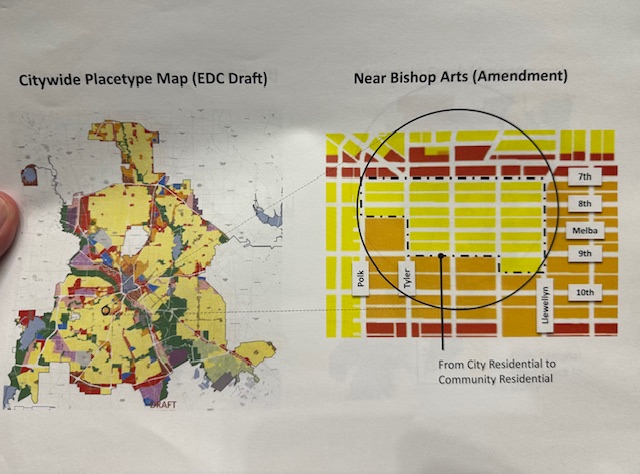
The language read into the record at the Sept. 25 council meeting, at which Joy provided testimony, reads, “Amend the placetype shown on the Near Bishop Arts amendment map from city residential to community residential to reflect the established development pattern.”
The plan as amended passed 11-4.
Support for Community Residential Placetype
In his research, Joy determined that he lives in a subdistrict within a planning district where the primary use is supposed to be single-family homes and duplexes — not apartments or mixed-use development.
“To be frank, the average person wouldn’t have been able to figure that out,” Joy said. “There are layers on top of layers on top of layers. Basically, the [land use] was wrong. They said, “Don’t worry; we’ll make the change.’ But the Sept. 25 vote was the next thing coming up.”

Joy knew the change would have to be introduced as an amendment. The placetype map had already been recommended for approval by the City Plan Commission and the last public hearing was scheduled on the same day the council vote was taken.
Until staff asked Joy whether his neighbors were also concerned about the placetype map, that wasn’t something he considered. He put on his walking shoes and set out to meet the other residents of Melba Street.
“For a lot of people I was breaking this news to them for the first time,” Joy explained. “One guy on my street has lived here for his entire life, like 60 years. He took a more nihilistic view that developers are going to do what they’re going to do, but he agreed that this was a problem and they should fix it.”
Are developers just “going to do what they’re going to do?” Maybe, but Joy said he believes that the plan does matter, and the process matters.
“Everybody I told, cared,” he said. “We have a Goldilocks element here, where we’re close enough to Bishop Arts that we can walk but not so close that we feel like we’re absorbed into it with apartments and restaurants and retail. There’s a pocket of homes between Davis and Jefferson and between Llewellyn and Polk that’s really a vibrant neighborhood.”
Why the Placetype Matters
While Joy’s neighbors may not be poring over zoning documents in their spare time, they take comfort in knowing that their Goldilocks neighborhood is composed of single-family homes — and they want it to stay that way.
“The woman who lives across the street does not speak English,” Joy told CandysDirt.com in an Oct. 11 phone interview. “The only thing you need to know about her is that, as we are speaking currently, she is using a blower to blow the leaves off the curb. I know that as soon as she finishes that, she’s going to sweep. And she does that every single day. We’ve only been here since April, but the people who live in our neighborhood truly care about their homes. I knew right away that whether they knew about this plan or not, they needed it to stay the way it is.”
Joy said he bought his home not because it was the only residence on the market but because it was the perfect home in the perfect place.
“While the home may stay the same, if the place changes, then it’s not about value at that point,” he said. “It’s about quality of life.”
When it was all said and done, staff and Councilman West thanked Joy for his vigilance, attention to detail, and holding city officials accountable.
“It was very collaborative,” West told CandysDirt.com. “It was a pleasant experience. Bishop Arts is really at the center of what people use for good zoning and development and what people use for bad zoning and development, depending on where you fall in that debate. This was a good example of a neighbor identifying a problem and the city banding together to fix it.”