
Meeting Set Oct. 29 to Review Final Revisions for Lakewood Conservation District
Share News:

When Summer Loveland inquired in mid-2022 about initiating a conservation district in her beloved Lakewood neighborhood, she just wanted to make sure that historic Clifford Hutsell-designed homes wouldn’t be demolished in lieu of new, incompatible construction. Now the stakes are even higher and the opposition has grown.
Brad and Julie Broberg love Lakewood too. They’ve lived in the area for 35 years and recently sold their home on Tokalon Drive to care for ailing parents out of state. Although they’re no longer permanent Dallas residents, they’re not abandoning the fight to preserve property rights and ensure that homes aren’t devalued.
“We feel an obligation to finish and support a cause that we believe in,” Julie Broberg told CandysDirt.com on Wednesday.
Conservation districts are a zoning tool that allows neighborhoods to establish exterior design criteria and other standards to preserve the character of an area. An ordinance is established for each conservation district that details the regulations homeowners must follow in any renovations or new construction and must ultimately be approved by the Dallas City Council. Those who oppose conservation districts are generally concerned about property rights, as in, “I bought this home and should be able to do what I want with it.”
The original Lakewood Conservation District, formed in 1988, only covers a portion of Lakewood. Hundreds of the original homes on Lakewood, Lakeshore, Avalon, Tokalon, and Westlake are not protected, according to the Lakewood Conservation District Facebook page. The current conservation district starts at Abrams Road and does not extend east of Brendenwood Drive or Copperfield. The new area could include up to 275 homes.
The ForwardDallas comprehensive land use plan, approved 11-4 by the City Council in late September, includes language that gives conservation districts extra protection when new development is proposed. Neighborhoods concerned about teardowns have been encouraged to explore options such as a conservation district. It’s common knowledge, though, that such processes aren’t always easy and they are rarely quick.
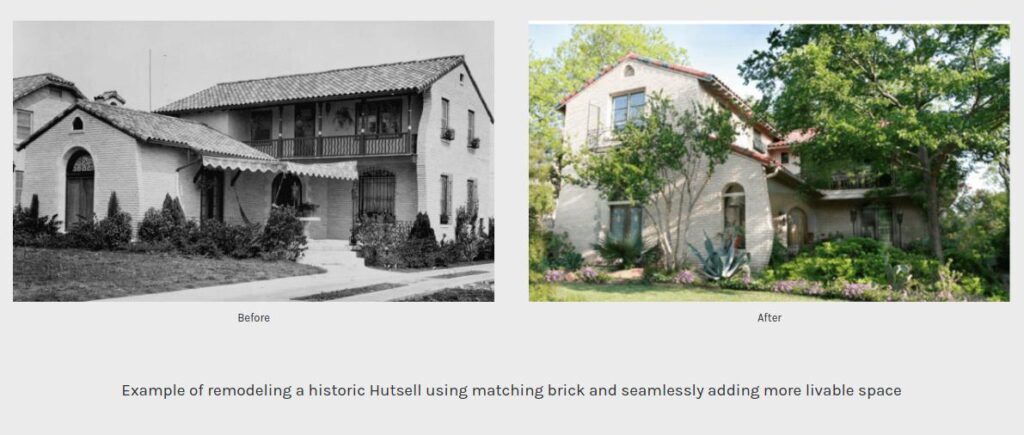
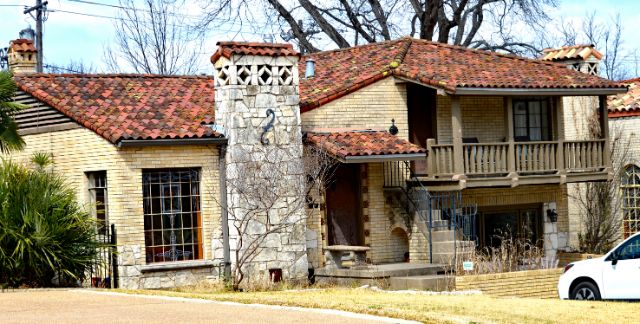
“As we can see all around us, there is an increase in the number of homes being torn down,” Loveland told CandysDirt.com last week. “Our lots are large and there are a lot of new homeowners who would like to use those lots and that prime address to max out what they can build on the lot according to base code. We see it happening all around us. We can see how well the existing CD is doing and there’s no reason that shouldn’t be extended into the rest of the neighborhood where all the Hutsells are. Not a single Hutsell is protected.”
A public meeting to review the new draft ordinance is set for 6 to 8 p.m. Oct. 29 at Samuell Grand Recreation Center, 6200 E. Grand Ave.
Opposition to Lakewood Conservation District
CandysDirt.com reported in August 2023 that Lakewood Conservation District advocates faced serious opposition when the “NoToCD2” group formed. Those in favor of the district’s expanded boundaries rallied and made changes. Loveland said she hopes the recent changes will “bring back many of the people who were initially in support who have since flipped to the opposition.”
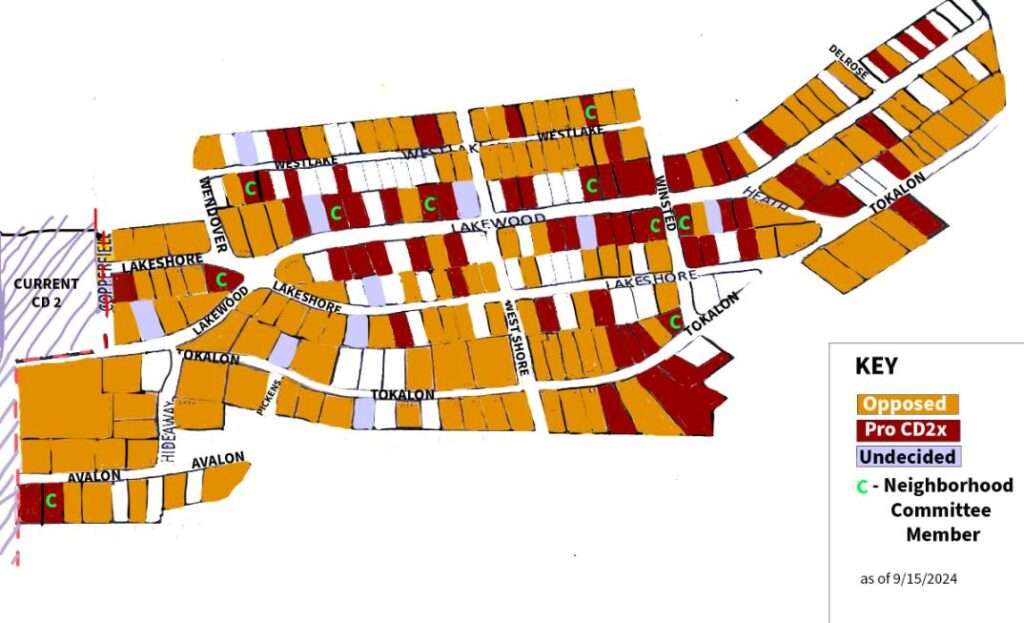
The Brobergs led the NoToCD2 effort and say there are now as many people against the new conservation district as for it. Julie Broberg said she signed the petition that kicked off the new conservation district because she was told it would halt the teardowns of historic homes.
“It became more obvious that it was less about preservation and more about controlling other houses that they didn’t like,” she told CandysDirt.com. “I was initially for it.”
The process was not followed properly because it was treated as an “expansion” rather than a new initiative, eliminating the need for “pre-petition” meetings, Brad Broberg explained.
“Labeling a new CD effort an ‘expansion’ doesn’t magically transform the substance of it.,” he said. “Read the steps in Dallas Development Code 51A-4.505 for yourself for doing a new CD, an amendment, an expansion, etc. Compare the neighborhood meetings authorized in them. In any process that permits zoning to be changed by neighbors after petitioning, there have to be two sets of meetings — a set before petitioning and a set after petitioning.”
The pre-petition meeting requirement was added in 2015 to ensure transparency and inclusion, to “let folks know what’s coming before anyone can start petitioning and let the neighbors craft a part of the petition itself,” Broberg said.
“We didn’t have those [pre-petition] meetings,” he said. “The city now says you can avoid letting neighbors know what’s coming or any discussion or dissent before petitioning just by labeling it an expansion because that section doesn’t include those pre-petition meetings in the steps.”
Broberg said Wednesday that he reviewed this information with a city planner and a lawyer from the City Attorney’s Office, who essentially dismissed the claims.
“They can pick and choose the meetings to conduct in an expansion that accomplishes exactly what a new CD does,” he said. “It’s absurd and irreconcilable. Whatever your feelings about the goal of the effort, you can’t make up a process to do it. You have to follow the rules outlined.”
Spreading Misinformation?
Loveland said she recognizes that there are areas of the expansion map that are “strongly opposed” but said she hopes to regain support for the expansion now that the Brobergs have moved.
“We have followed all the regulations,” she said. “At this point, it is like a personal vendetta of theirs.”
About 68% of the neighbors signed the petition asking for a conservation district expansion. Fifteen neighborhood meetings were held, and for the most part, everyone was moving in the same direction, Loveland said.
“Unfortunately, it took 10 months to get the draft out,” she said. “During that 10 months the Brobergs … felt like they couldn’t do what they wanted to do with their ranch-style home. They basically spread a lot of misinformation about what it would mean to people. They had a very long time to rally opposition and scare people. During that time, at least according to the Brobergs’ map, we lost quite a bit of support.”
The majority of Tokalon Drive, Hideaway Drive, and the 7000 block of Westlake Avenue will likely be excluded when the map is finalized by the City Council, she said.
Julie Broberg said she believes misinformation has been spread but the culprits are supporters of the conservation district, not her and her husband.
“They need to start over,” she said. “They need to start with the correct data, so people know what we are doing to our neighborhood. It’s very unpopular. If they actually listen to the neighborhood, they don’t have the support, and it’s not going to pass.”
The Brobergs said that District 9 City Plan Commissioner Neal Sleeper and Councilwoman Paula Blackmon have asked the neighbors to reach a compromise.
What Changed in the Latest Conservation District Ordinance?
Loveland addressed concerns in an email to neighbors, noting that “significant revisions” “were made based on community feedback on the first draft.
“These changes allow for the continued vitality of our neighborhood while preserving the overall character,” she said. “Neighborhood self-determination is key and concerns have been addressed.”
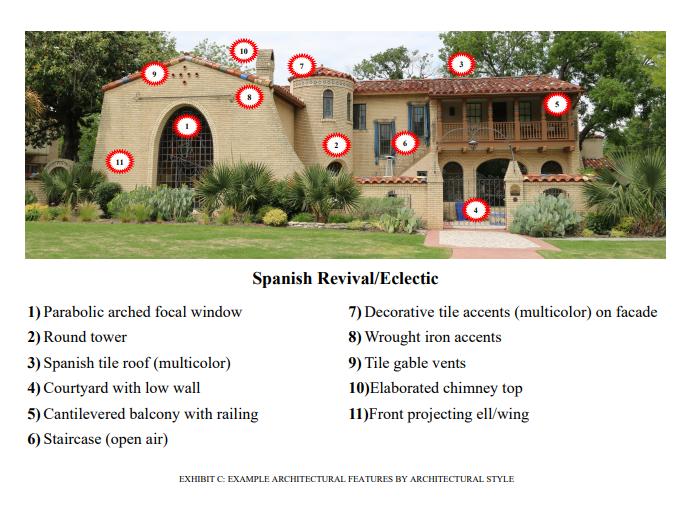
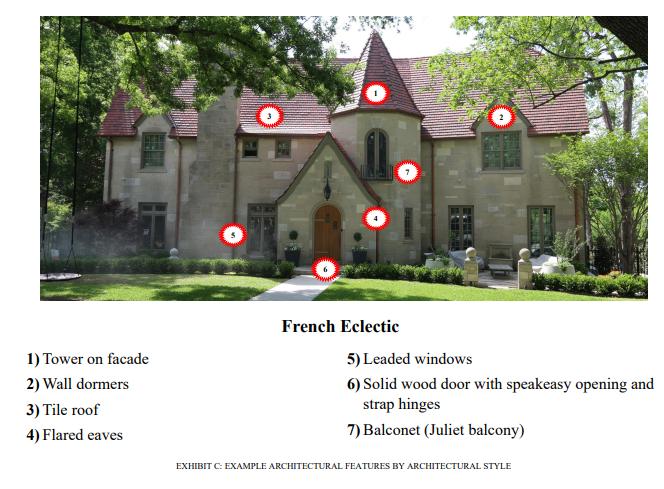
A “Comparison Notes” document is posted on the city website outlining the changes. The nine-page document addresses architectural standards, simplification of language, and removal of a “points system” for architectural features when constructing a new home in one of the five approved contributing styles.
The five approved styles include Spanish Eclectic/Revival, French Eclectic, Neoclassical, Tudor, and Colonial Revival.
“In new construction, a minimum of six of the listed features must be present,” Loveland explained. “The lists of available features are significantly longer than those in the original CD2 ordinance, allowing for much more flexibility.”
Loveland said she remains hopeful that the ordinance will at least go before the City Plan Commission before the winter holidays. She said most of the resident feedback has been addressed, with the exception of, “Don’t tell me what to do with my property.”
“If people are paying attention and reading it, they should see that their feedback has been heard and addressed,” she said. “Unfortunately, people are very fatigued by this because it’s gone on for so long.”
The Brobergs agree that it’s been a long and arduous process, and they would add the term “unnecessary.”
“Lakewood is the most desirable place to live in the City of Dallas without a CD, and the houses aren’t being torn down,” Julie Broberg said. “As one of our neighbors, Steve Hutto, would say, ‘This is a solution looking for a problem.'”





Not enough people in
Lakewood know about this.