
‘We Will Deliver For Dallas a World-Class Park’: Conservancy Unveils Plans For Activating Trinity River Corridor
Share News:


A 250-acre West Dallas park will be in “full-blown construction” by this time next year, officials with the Trinity Park Conservancy told a crowd of supporters Thursday evening.
Tony Moore, president and CEO of the Trinity Park Conservancy, reviewed the $325 million Harold Simmons Park project, which is expected to fulfill a decades-old vision to activate the Trinity River between the Margaret McDermott and Margaret Hunt Hill bridges to become a place for the public to engage with the Trinity River.
Moore previously guided the construction of The Gathering Place in Tulsa, named the No. 1 park in America by USA Today.
“Dallas wants a world-class park,” Moore said. “After recognizing the potential in Dallas, what’s happening in Dallas, the growth in Dallas, this was just an opportunity of a lifetime. Truly I’m honored to be a part of this.”
The Plan For Harold Simmons Park
The Trinity Park Conservancy’s plans for the massive Harold Simmons Park call for a cable ferry, a great lawn, sport courts, a roller skating rink, a splash pad, and a café to create “a repeatable experience.”
Landscaping will be added to enhance the “ugly and dangerous walk” from Trinity Grove south along Beckley Avenue to the west overlook, Moore said. A large shed will be repurposed as a covered area “with the sides taken off” for art crawls and “sophisticated flea markets.” A picnic grove features long tables “so you have different families from different areas sitting together,” Moore said.
“This is a free park with zero admission,” he said. “It’s a public park, an inclusive park, where everyone will feel welcome.”
The benchmark for the West Dallas park is Dallas’ crown jewel, the nationally recognized Klyde Warren Park, Moore said.
“Had it not been for Klyde Warren, it would be very difficult for Dallasites to imagine what this park is going to be,” he said.
Lake | Flato Architects is planning an event space for about 250 people. Other partners assisting in the design and construction include Michael Van Valkenberg Landscape Architects, Beck Construction, EJ Smith, Crossland, and Wernerfield.

“Coming from the theme park industry, my idea of landscaping was well-manicured, very precise, very geometric landscaping work, and color was a must in everything we do,” Moore said. “Then I met Michael Van Valkenberg … Their approach to architecture is that the art is in the landscape. I had to go through a school of rehabilitation to understand how to appreciate his type of landscaping … what is manmade to look like it is God-made. It took me a while to get it and now I’m the biggest fan of how natural landscapes can enhance.”
Fundraising And Breaking Ground on Harold Simmons Park
Former Dallas Mayor Mike Rawlings received a $50 million pledge for the park in 2016 and determined he wanted it to be between the two iconic bridges in the city center. The idea for Harold Simmons Park, however, dates back at least 30 years, Moore said.
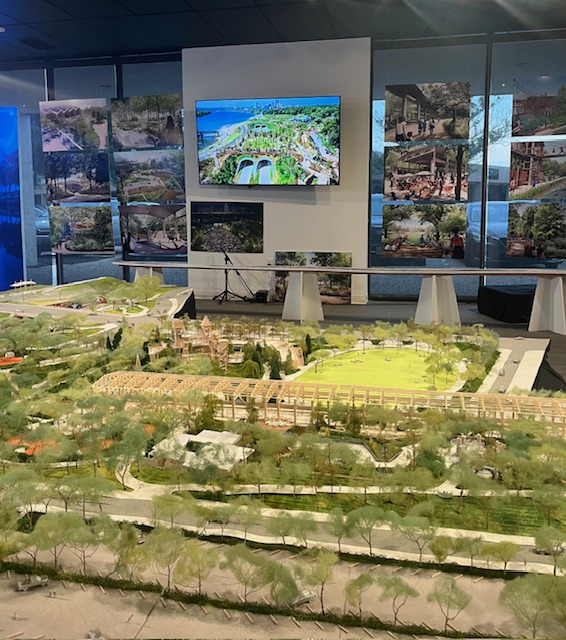
A $30 million endowment is allocated for operations and maintenance that will have a 4.5 percent draw annually. The park is expected to generate a $6 billion economic impact over the next 30 years.
Construction is set to begin with demolition and a groundbreaking by the end of the year.
“We’ve heard from so many people, ‘Just get something started,’” Moore said. “A year from now, a park will be in full-blown construction. This thing is happening.”
Construction on the west side of the park will take about 2.5 to three years to complete, Moore said.
The Conservancy already has raised about $130 million, including large donations from the offices of U.S. Representatives Marc Veasey and Colin Allred.
Bridging a Divide Between East And West Dallas
The Trinity Park Conservancy is tasked with oversight of about 10,000 acres along the Trinity River, a not-so-simple task that involves collaboration with the U.S. Army Corps of Engineers.
The Army Corps re-engineered the Trinity River in 1908 after a devastating flood, Moore said.
“There were these 30-foot barriers on opposite sides intended to contain the river and [they have} done a phenomenal job,” he said. “The problem with that is the same barriers that contained also separated.”

The park will connect neighborhoods from the east and west regions of Dallas.
“Of course, you know the disparities of earning income,” Moore said. “We have a social function as well, not just to be a park for recreation but a park for unity that helps to bridge that gap.”
Park designers remain cognizant of the potential impact on nextdoor neighbors in the West Dallas community, Moore added.
“Some gentrification is good; it’s growth,” Moore said. “Displacement is what’s terrible. We’ve had tough discussions. We go out to the communities and have conversations about what the park means to them … It’s a difficult decision to build a park in a built environment around underserved homes … but we would be insensitive just to forge ahead with building a park and not understanding what is going on.”
A video of Thursday’s presentation will be posted on the American Institute of Architects Dallas’ YouTube channel later this summer.
While some of the details are still being hashed out, one thing is certain, Moore said.
“We will deliver for Dallas a world-class park,” he said.





Justn to be clear, all these built amenities are OUTSIDE the levees. If you look at the drawing and video, you will see that the three areas being developed are adjacent to the levees. So the cafe, skating area, shed and event space will not be flooding regularly. Inside the levees will be extensive plantings of wildflowers and native plants (note that Dallas cannot plant trees because it would slow the movement of water and exacerbate upstream flooding) along with walking/jogging trails.
Concern about flooding of any amenities has been the most common criticism and question about this plan for years, Unfortunately, I don’t think many people will realize that unless they watch the video,
I don’t understand to invest this much money in an area that has a possibility of major flooding I’m 62 years old I’ve seen the levy almost breach I don’t get it you have to manage that Trinity River in order to be prepared for major flooding .
I think it’s a waste of money and very unsafe .