
Keller Authorizes Legal Action Against Westlake Over Data Center Project
Share News:

Tensions over a proposed data center project on Westlake’s side of its border with Keller are on track to become a full-on legal battle between neighbors.
On Tuesday, the Keller City Council unanimously authorized the pursuit of legal action against Westlake, potentially opening another front in an increasingly bitter dispute over the roughly 88-acre project.
As previously reported by CandysDirt.com, developer PowerHouse Data Centers is planning a four-building data center campus totaling roughly 1.1 million square feet along U.S. Highway 377. The property is inside Westlake but sits only about 500 feet from some Keller backyards.
In a social media post, Keller officials said they had exhausted diplomatic efforts to resolve their concerns, stating they haven’t been meaningfully addressed by Westlake leaders.
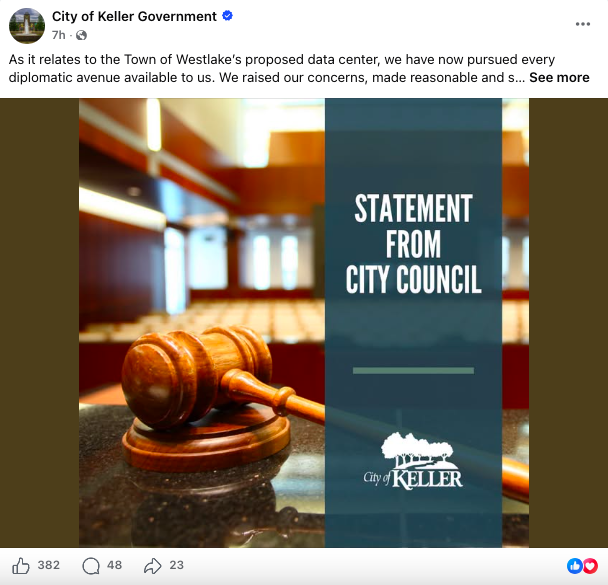
“We find no joy in this decision. But we are confident that exploring every legal avenue is in the best interests of our residents and the City of Keller itself,” the city council said, questioning whether Westlake handled the data center proposal in accordance with state transparency requirements.
Officials in Westlake were poised to vote on a development agreement for the project on Monday following a recommendation from the city’s Planning and Zoning Commission, but a Tarrant County judge instituted a two-week temporary restraining order against the city an hour before the meeting.
Two Keller residents and The Lakes at Marshall Ridge Homeowners Association petitioned the court for the order, arguing that allowing the project to advance could cause “irreparable harm” to their properties and neighborhood. Judge Kimberly Fitzpatrick of the 342nd State District Court in Fort Worth will consider granting an injunction at a hearing on August 26, which could stay in place until the litigation is resolved.
Keller residents have been up in arms about the proposal for months, citing potential environmental and quality-of-life impacts. For their part, Westlake officials claim the project has been carefully evaluated and would have minimal effects on traffic, noise, utilities, and nearby neighborhoods. The closest Westlake residence would be over 3,000 feet away.
Westlake officials have pointed out that the site is already zoned to allow a data center by right. Monday’s aborted vote concerned an agreement with PowerHouse intended to impose additional requirements covering noise, water, electricity, infrastructure, architecture, landscaping, and other elements of the project. The agreement would also require PowerHouse to contribute $914,000 toward improvements to an adjacent Westlake pump station used for water distribution.
“I feel bad for the situation. But this issue is really around, does the town of Westlake have a right for economic development the way we see fit inside our own borders?” Westlake Mayor Kim Greaves told WFAA.
Greaves noted that Keller had rezoned the neighboring land to allow for homebuilding despite its lack of jurisdiction just across the border and the growing industrial attraction of the Alliance corridor, which is drawing logistics, manufacturing, technology, and commercial investment.
“It’s just a terrible situation, but should we be penalized for our economic development for decisions they made years ago?” Greaves said.
The data center campus is expected to increase Westlake’s tax revenue by 14%.
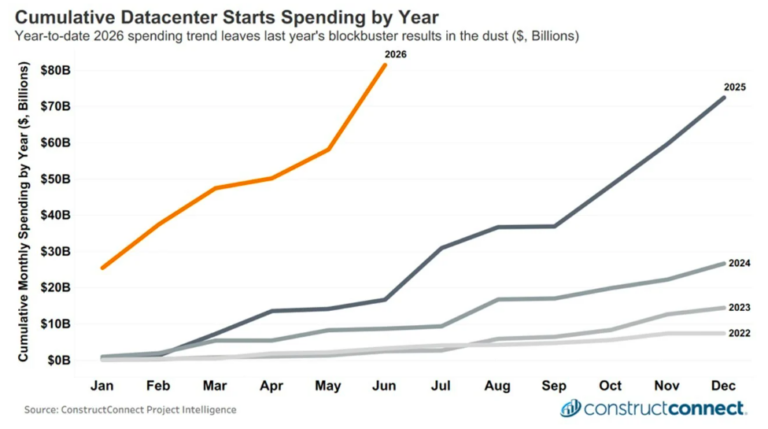
Texas remains among the hottest markets for data centers. Developers launched $81.5 billion worth of U.S. data center projects during the first half of 2026, already exceeding the total for all of last year. However, opposition has erupted from North Texas to the Hill Country over electricity demand, water consumption, noise, and the placement of industrial-scale facilities near homes.
Dallas is beginning to reconsider its own rules as data center investment accelerates across the D-FW. Council Member Chad West (District 1) and four colleagues recently called for a public hearing on updating the city’s development code, potentially creating a new land-use category specifically for data centers.
On Tuesday, the same day Keller officials voted to pursue legal action, Gov. Greg Abbott announced that PowerHouse was among three data center developers that had agreed to comply with new standards he established for the rapidly growing industry.
The guidelines call on developers to pay their own infrastructure costs, address power needs, conserve and reuse water, and mitigate impacts on surrounding neighborhoods, including noise, lighting, traffic, and setbacks.
“I established clear guardrails to ensure data centers protect our electric grid, conserve our water, respect our neighborhoods, and pay their own way,” Abbott said. “They must not pass costs on to Texas families or interfere with their quality of life.”