
Dallas City Hall’s Future Remains Unclear After New Repair Estimates Reveal Complicated Scope of Work
Share News:

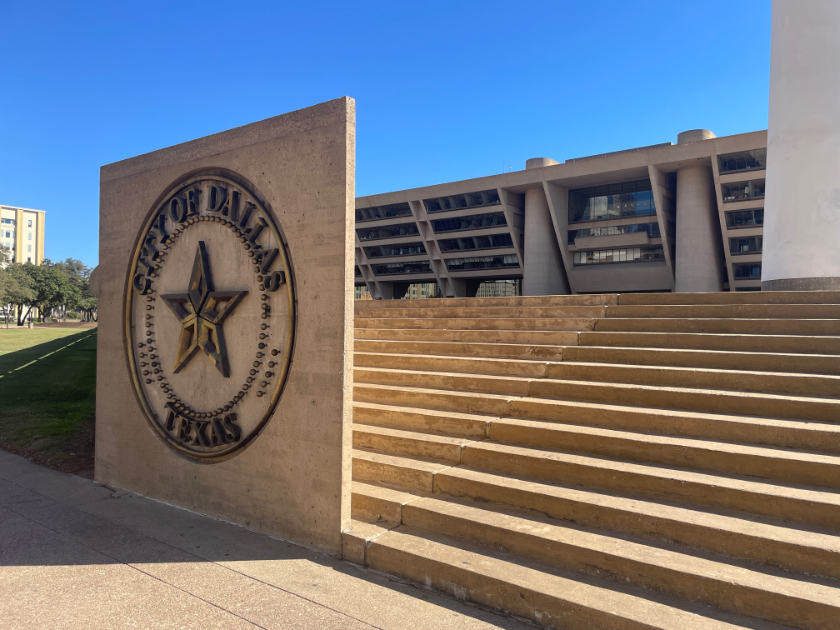
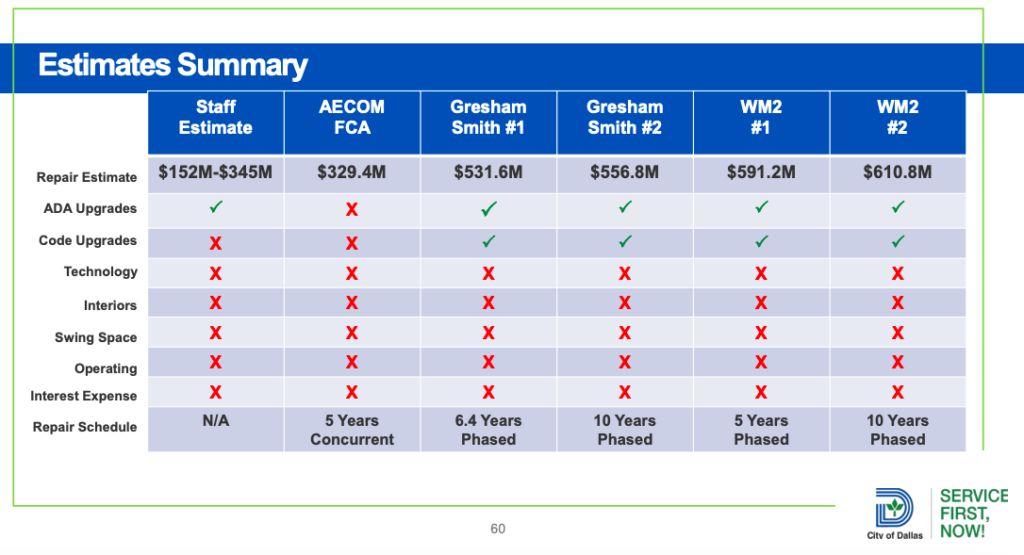
More insight into how much it might cost to repair Dallas City Hall emerged during a City Council briefing Wednesday, where consultants presented new repair cost estimates between $532 million and $611 million to bring 1500 Marilla St. into proper working order.
The latest figures gave council members alternatives to consider beyond the controversial estimate released earlier this year. That $1 billion-plus all-in estimate by AECOM sparked controversy because it assumed a full evacuation of the building and included upgrades to Class-A commercial office standards, temporary relocation costs, and financing costs. Of that total, the repairs themselves accounted for about $329 million.
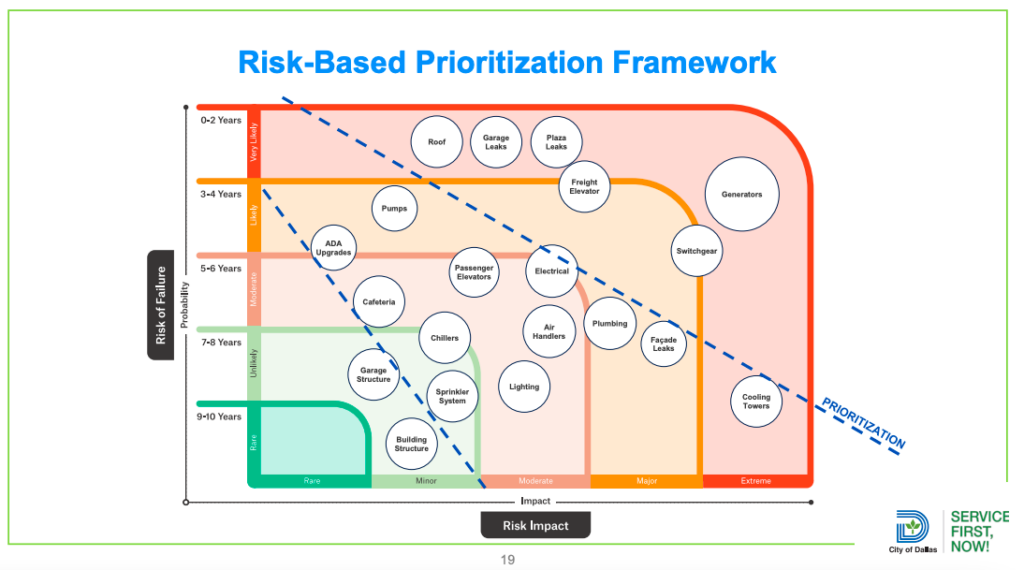
Phased programs were put together by consultants Gresham Smith and WM2 Company, who explained their approach to modeling the repairs last month. One option prioritizes efficiency, bundling work together to reduce construction mobilizations and speed up repairs. Another would prioritize minimizing disruption to city operations but would take longer and cost more.
Gresham Smith’s estimates came to $531.6 million across 6.4 years of construction or $556 million across 10 years. WM2 Company’s estimates were $591.2 million across five years or $610.8 million across 10 years.
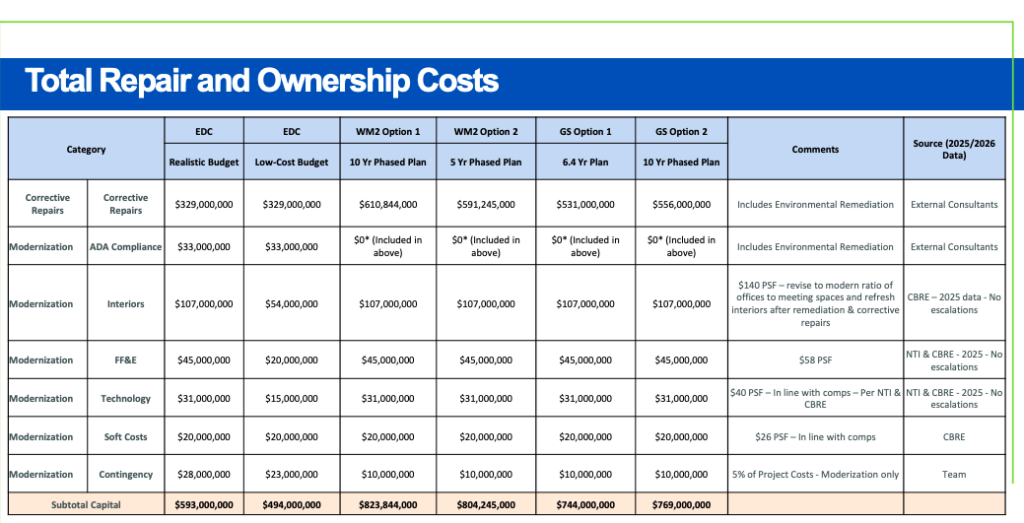
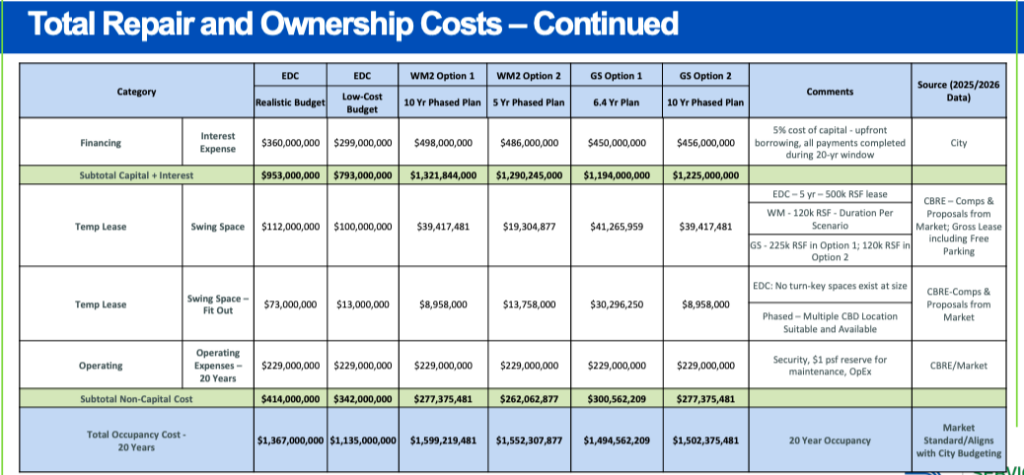
Repairs in all their scenarios were prioritized according to the building’s structural and mechanical needs, and also included ADA and code-compliance work that would be triggered by the project’s scale. Renovations to interiors, furnishings, and equipment, soft costs, and any temporary relocation costs were not included.
Will Mundinger, president of WM2 Company, described the electrical system as a particularly serious concern, arguing that much of the building relies on obsolete Federal Pacific equipment that cannot realistically be repaired and must be replaced. Other systems were also flagged for at least partial replacement.
Some council members who have been adamant about repairing City Hall rather than relocating city operations argued that the March council resolution called for phased repair programs focused on critical needs, not broader renovations or replacements.
The consultants and staff pushed back, explaining that many of the building’s systems are so old that repairs inevitably trigger replacement work and mandatory code upgrades.
The question of how any large-scale repair of the building would be paid for was also raised, considering how strapped for revenue the city is.
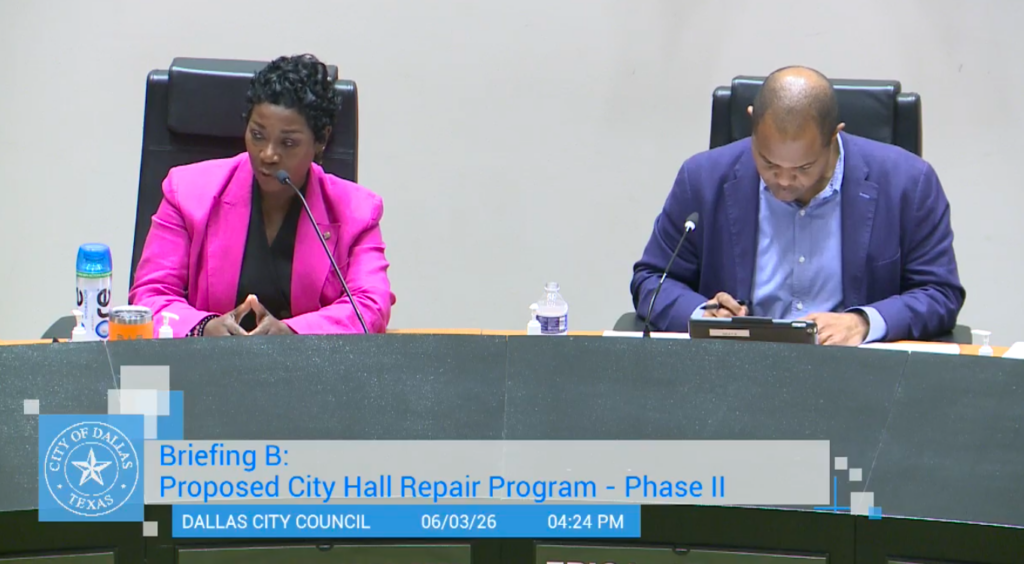
“If you’re asking me today, do we have the current funds in our existing budget to pay for — whether it’s the numbers we have from Gresham or the numbers that we got from WM2 — it really doesn’t matter, my answer would be, ‘No we do not,’” said City Manager Kimberly Tolbert, referencing the ever-present option to take on additional debt.
Council Member Paula Blackmon (District 9) argued that the city would face substantial costs even if officials decide to leave 1500 Marilla St., citing relocation expenses and the cost of either leasing or acquiring another facility.
“Either way, we’re going to be hitting the budget,” she said. “It’s just a matter of how big the hit is going to be.”
Council Member Jaime Resendez (District 5) claimed that the phased repair programs essentially vindicated the initial assessment conducted by AECOM.
“Their estimates were credible,” he said. “In fact, if anything, the criticism may have been misplaced in the opposite direction because the subsequent analysis suggests that their estimates may actually have been conservative.”
Council Member Adam Bazaldua (District 7) pushed back, insisting that criticism of the AECOM report stemmed from the packaging and headlining of the $1 billion figure “constructed to make repair look impossible.”
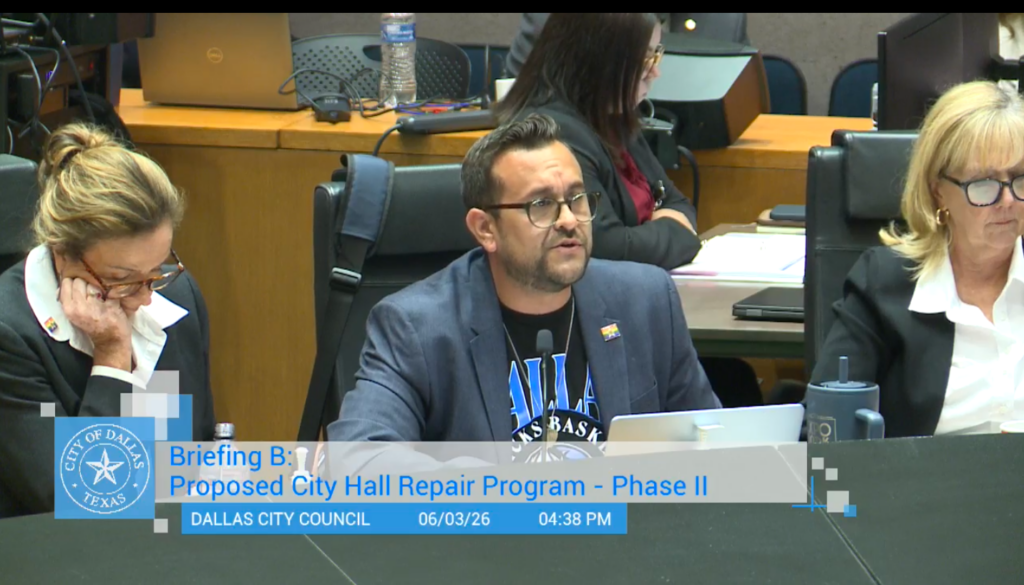
“The scrutiny was needed. The taxpayers deserve it and we aren’t going to accept a predetermined outcome on a decision this big, this generational,” he said. “What we have gotten now with these two independent assessments is drastically different, more granular with better detail, and gives us more options to make a sound decision.”
Tensions have been running hot at the horseshoe over whether City Hall should be repaired, with previous council meetings seeing staff and consultants grilled — at times harshly — about their motivations and the integrity of the process.
The stakes have been high, too. Proponents of relocation argue that redeveloping 1500 Marilla St. could revitalize the central business district and bring more opportunity to the southern sector.
Wednesday’s briefing followed a series of gut punches to downtown stakeholders early this week.
First, the Dallas Mavericks entered into an option agreement with the owners of the former Valley View Center property, signaling serious interest in building their new arena and entertainment district in North Dallas.
Then, Saks Global announced it would shutter the iconic Neiman Marcus Downtown after months of uncertainty.
And now, it appears the Dallas Stars are destined for Plano, pending city approval.
As the briefing wrapped up, Mayor Eric Johnson implored his colleagues to move beyond questioning the integrity of the estimates and clearly evaluate the information before them, referencing the week’s news and its potential impact on the city center amid growing investment in the northern suburbs.
“The wolf is at the door, and the wolf is not in this room,” he said. “The wolf is up the Tollway.”
Editor’s note: An earlier version of the headline, “New Estimates Put Phased Dallas City Hall Repairs Well Below $1 Billion,” was changed to reflect additional context.