
D-FW Housing Market Softens as Prospect of Prolonged War Raises Alarm Bells
Share News:


The D-FW housing scene is continuing its transition from a booming seller’s market to something more balanced, but sales are slowing, and fresh headwinds stand to put a check on homebuyers.
Housing reports for the month of February show a 2.2% year-over-year decrease, bringing the median price to $385,000 across the North Texas area — see all the counties included — according to the MetroTex Association of Realtors. Listings were up 7.3%, and the months of inventory increased from 3.6 to 3.9. January also saw the median price come down some (2.9%) as listings ticked up (3.7%).
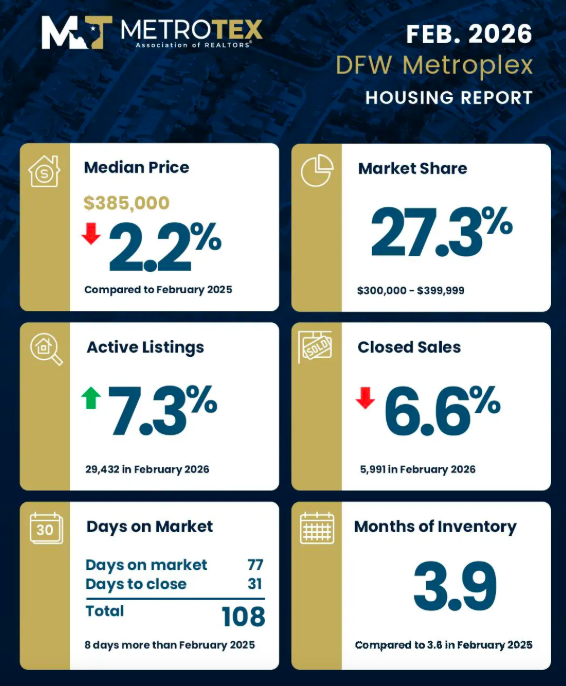
The Metroplex also posted another consecutive month of year-over-year decreased sales, with successful closings going down 6.6% last month. In January of this year, closed sales dropped 5.8%. Listings also stayed on the market longer, averaging 108 days in February.
Prospective buyers are finding a less punishing environment with more home options and opportunities to negotiate listing prices down. This follows a year of creeping transition in the area, with the Texas Realtors’ recently published 2025 Real Estate Year in Review clocking a 2.1% dip in median price in the narrower Dallas-Fort Worth-Arlington metro. While D-FW and some of the other biggest markets in the state saw prices soften last year, listings elsewhere around Texas continued their upward march, resulting in an overall 1.2% decrease for the year.
“Some markets where prices jumped quickly a few years ago are now dipping a bit, while other areas that had a slower rise are still going strong,” said Jennifer Wauhob, chair of Texas Realtors. “It is crucial to know your own market and base decisions on hyper-local information.”
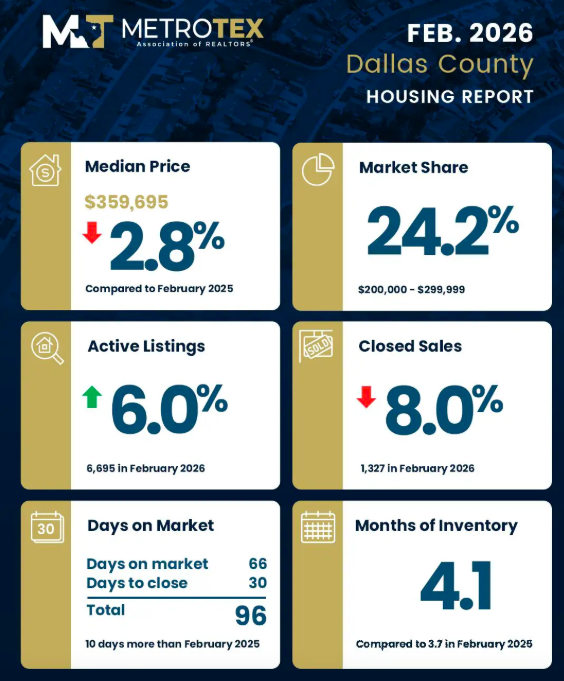
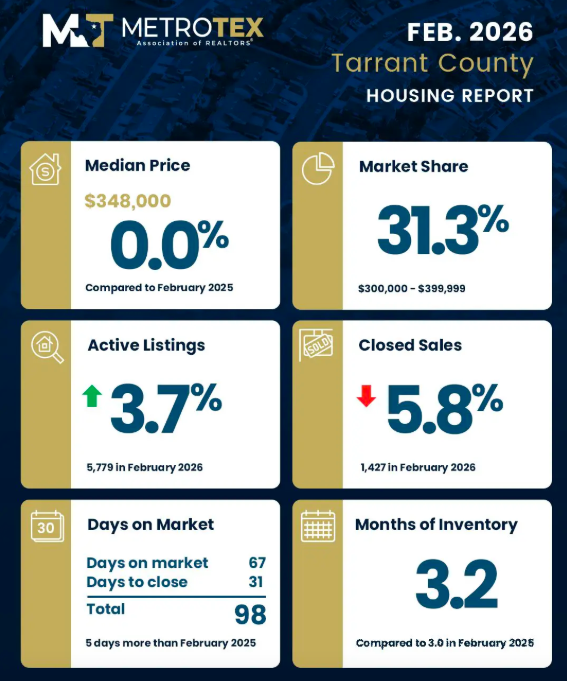
Good advice. Just looking at the Big Four (Collin, Dallas, Denton, and Tarrant counties) in MetroTex’s February reports, you’ll see some differentials in opportunity. Every county saw increases in listings, but Collin County and Denton County logged double-digit hikes with 17.8% and 12%, respectively.
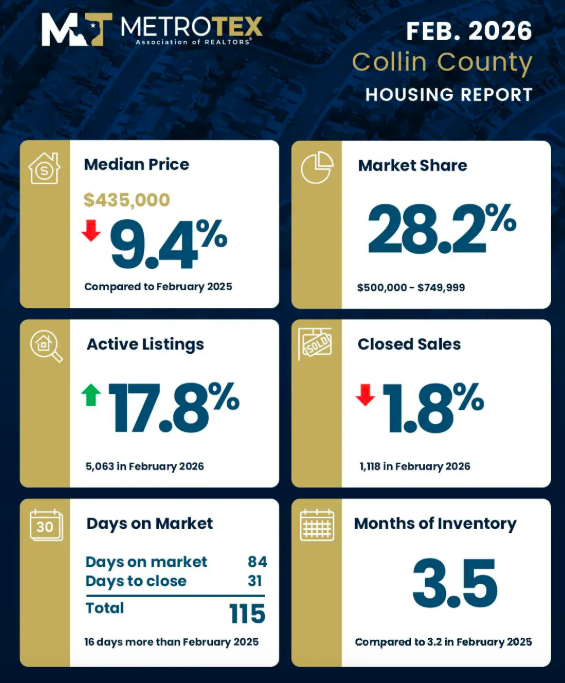
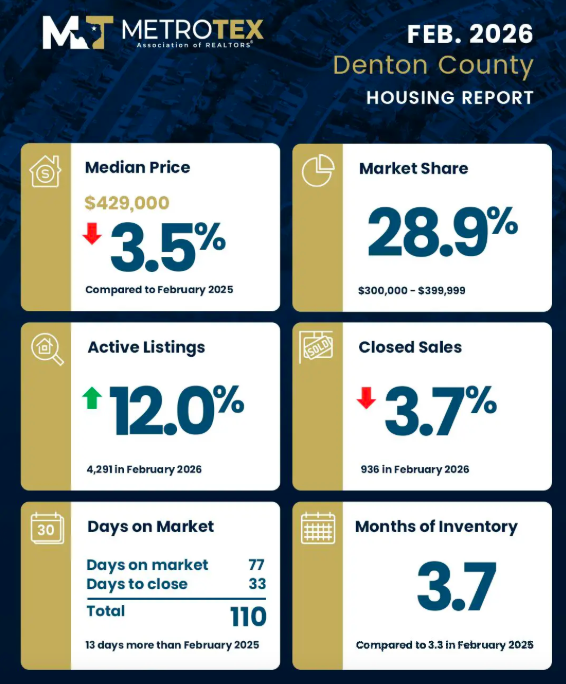
Collin County is kind of the standout, though, clocking a significant 9.4% drop in median price last month. Granted, it’s still the county with the highest median price among the Big Four at $435,000.
All Big Four counties also saw some slowdown, with Dallas and Tarrant logging the steepest decreases in closed sales, clocking 8% and 5.8% drops, respectively.
War-Time Housing Market Drag
Those hoping that overdue price corrections might lead to significantly increased buying activity could be in for a rude awakening, though. Implications of the current war with Iran are becoming crystal clear as the Islamic Republic’s capacity to strangle the Strait of Hormuz and threaten oil infrastructure in neighboring Gulf nations appears more durable than expected. Crude oil prices have skyrocketed, and experts say the longer the war goes on, the greater the chances of sustained inflationary pressures and a possibly serious economic downturn, as previously reported by CandysDirt.com.
Naturally, there would be impacts on the housing market.
“Geopolitical shocks often create ‘risk-off’ behavior among investors and consumers. Even in a strong regional market like D-FW, buyers may become more cautious during periods of global uncertainty,” said Sriram Villupuram, associate professor at UT Arlington’s Department of Finance and Real Estate, speaking at a real estate symposium earlier this month.
“The region is already transitioning toward a more balanced housing market, with homes staying on the market longer. Added uncertainty could reduce discretionary spending and delay large purchases, such as homes, which may further slow sales activity if geopolitical tensions persist,” he said.
The supply side of the market is also poised to feel the impact of the war, with energy-intensive building supplies like steel, cement, and aluminum vulnerable to price shocks from the oil crunch that would be caused by a prolonged closure of the Strait of Hormuz, reported Newsweek. Like with the Trump administration’s tariffs, you can expect that cost trickling down to the consumer.
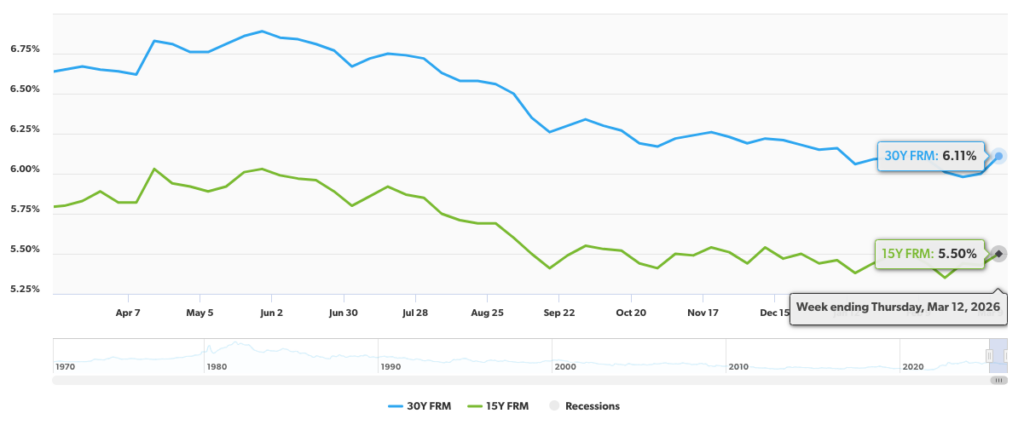
Mortgage rates, which have also been a damper on many would-be homebuyers’ ability to enter the market, also stand to reverse their practically year-long downward trajectory. On Thursday, the 30-year ticked up to 6.11% after enjoying only one week last month under the 6% mark for the first time since 2022.
“Affordability pressures from higher mortgage rates are a major impediment to the DFW housing market. While conditions have improved slightly, mortgage rates remain high compared with pre-2022 levels, limiting buyers’ purchasing power and slowing demand,” Villupuram said. “Average 30-year mortgage rates declined from about 6.7% to 6.1% in 2025, but they remain elevated. Higher interest rates combined with already high home prices reduce the pool of qualified buyers and keep monthly payments high, particularly for first-time homebuyers.”