
High Home Prices Appear To Be Doing a Number on America’s Birth Rate
Share News:

A lot of noise has been made about the housing affordability crisis in the United States. From a real estate perspective, many of the dynamics involved are obviously economic in nature. However, there’s also a very serious existential factor at play: the nation’s birth rate.
There appears to be a pretty clear relationship between single-family home prices and fertility over the last couple of decades. Birth rates began a steady decline at the start of the housing market crash in 2006. Then, in the aftermath of the Great Recession, home prices began their virtually uninterrupted climb to the heights we’re seeing today.

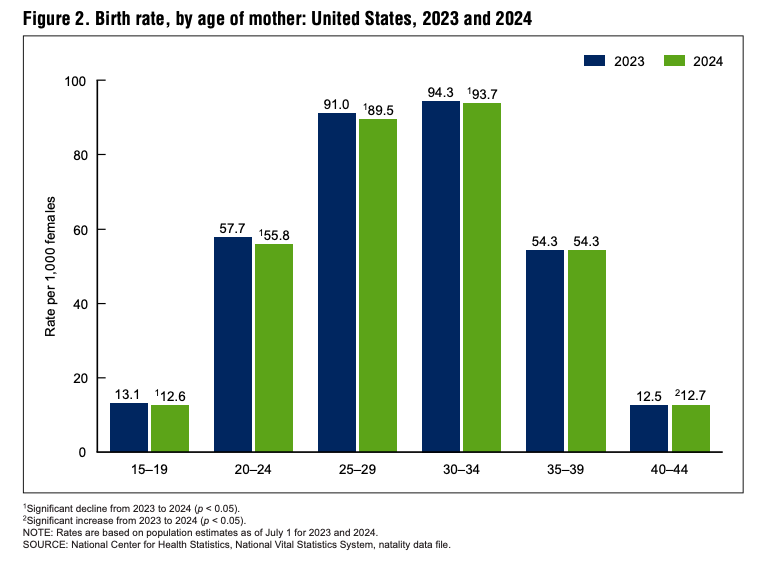
Birth rates apparently hit a record low of fewer than 1.6 children per woman in 2024, according to data published by the Centers for Disease Control and Prevention. This marks a roughly 24% decline from 2006, when the birth rate was 2.1 children per woman.
Year over year, the most pronounced drops were among the 20-24 and 25-29 age groups.
Meanwhile, the median home price shot up from just under $222,000 to around $410,000. Now, in real terms, the increase isn’t so dramatic. Adjusted for inflation, the difference is roughly $66,000, per Realtor.com. Even still, try telling prospective homebuyers things aren’t that bad out there.
As previously reported by CandysDirt.com, Zoomers are especially disillusioned with their chances of ever owning a home, citing a variety of economic factors, not least of which is how high home prices have gotten.
The impact of such high prices has likely had an impact on the nation’s birth rate. While a decline is to be expected since younger Americans on the whole are waiting longer to have children than previous generations and family planning is a bigger part of the culture than in decades past, the overlapping but diverging trajectories of birth rates and home prices suggest some correlation.
“[W]e know that people generally still report that the ideal family size is around two kids, and that some people are not achieving their desired family size,” said University of Colorado Boulder fertility and population policy researcher Leslie Root, speaking with Newsweek. “So it is a mix of things — later births, some people avoiding unintended births, and some people not having the births they actually want to have.”
A previous study shed some light on how housing prices can impact birth rates. Researchers at the University of Notre Dame looked at data from 1990 to 2006 and concluded a 10% increase in home prices was tied to a roughly 1% decline in births among female non-homeowners between the ages of 20 and 44. Meanwhile, they found that fertility increased by 5% for homeowners.
Still, the study’s conclusions don’t quite map onto the last 20 years. Home prices steadily increased between 1990 and 2006, but the birth rate more or less held steady and even creeped up at the end of the period. The turning point very much seems to be around the Great Recession and its aftermath, when a number of factors like growing student loan debt and job insecurity began mounting. Then, of course, there was the COVID-19 pandemic. It seems a lot of lessons were learned.
“The United States doesn’t have paid family leave. We have a really shaky child care system, as the pandemic pointed out. We don’t have sick leave for most people. So there’s a lot of things to consider before you decide to have kids in this environment,” University of Nebraska-Lincoln sociology professor Julia McQuillan previously told NBC News about the nation’s declining birth rate.
Considering that housing is ultimately the biggest expense when raising a child, it’s hard to imagine that anything short of another housing crash (which itself would have far-reaching economic consequences for the country) or a significant increase in housing stock will turn things around.