
Dallas Sets Property Tax Rate Ceiling, Could Still Go Lower
Share News:

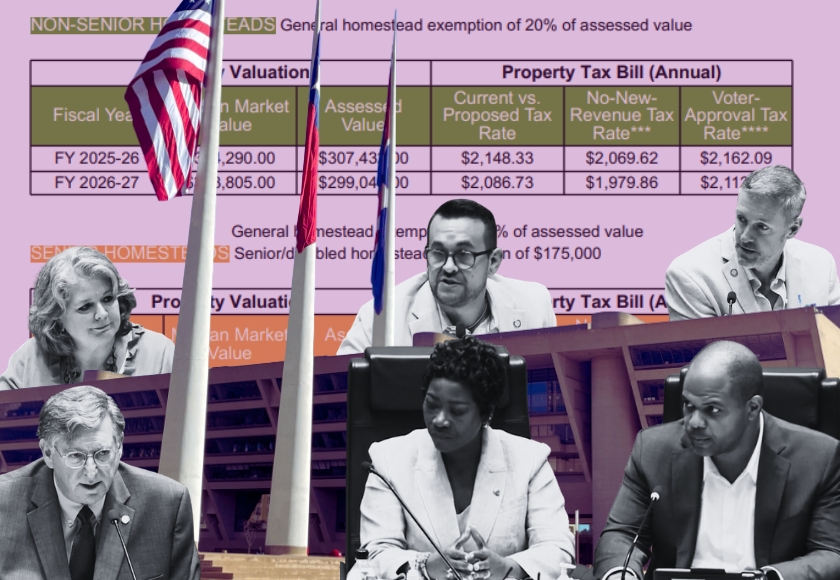
Dallas City Council members set 69.78 cents per $100 of assessed value as the ceiling for next year’s property tax rate Tuesday, landing on the city manager’s proposed rate. The final rate could end up going lower when the council adopts its final budget and tax rate next month.
Acknowledging economic pressures on both city coffers and taxpayers, majorities rejected two alternatives: one by Council Member Cara Mendelsohn (District 12) to reduce the ceiling rate to 68 cents per $100 assessed valuation, and another by Council Member Adam Bazaldua (District 7) to raise it to 70.6325 cents, the city’s maximum allowable without requiring voter approval.
City Manager Kimberly Tolbert’s proposed rate is 69.78 cents, one-tenth of a cent lower than this fiscal year’s rate and, if adopted, would be the 11th consecutive rate reduction. Property tax revenues would go toward supporting Tolbert’s record $5.66 billion proposed budget. The vote came out 8-6 with one absent to set it as the ceiling for upcoming budget negotiations following a debate over the three competing rates.
Bazaldua argued that setting the ceiling at the 70.6325-cent voter-approval rate would preserve flexibility while council members consider amendments to the city’s proposed spending plan.
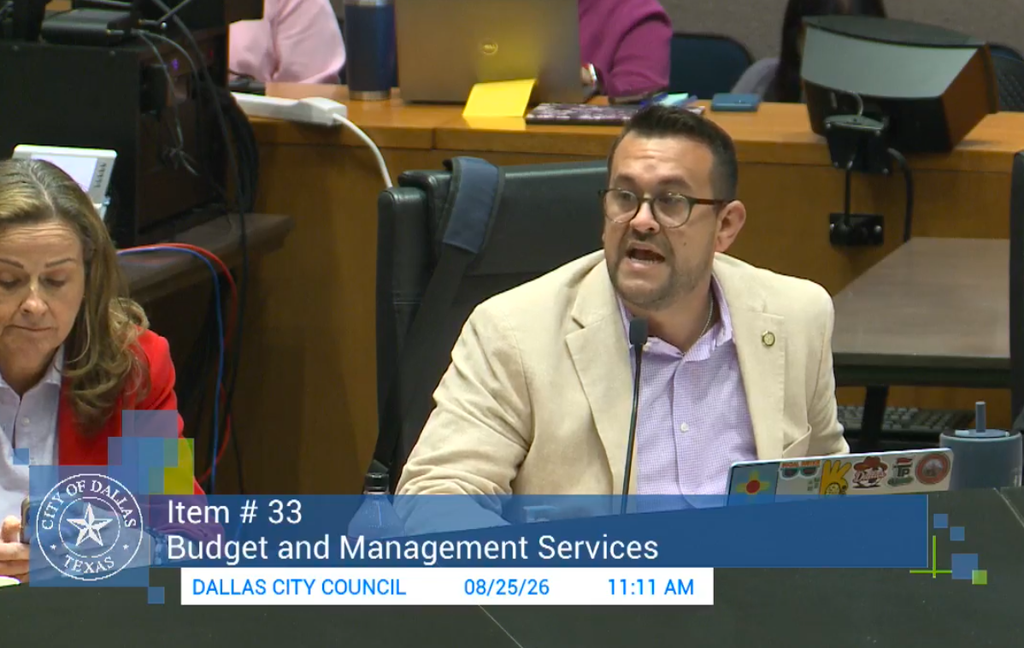
“We can’t keep chasing a headline to say that we have nominally changed your tax rate when we are doing it at the expense of providing quality services and resources for our residents,” he said.
A lower tax rate does not necessarily produce a lower property tax bill. During the discussion, CFO Jack Ireland said Dallas property values have increased roughly 136% over the past decade, far outpacing the approximately 12% reduction in the city’s tax rate during that period. Additionally, the city only sets one portion of the total bill, which includes separate levies from Dallas County, Dallas ISD, Parkland Health, and Dallas College.
Bazaldua argued the roughly $9.9 million in additional revenue that would be collected from his proposed rate should go to unfunded liabilities in Dallas’ police, fire, and civilian retirement systems. Combined pension contributions are projected to rise from $404.4 million next fiscal year to $436.2 million the following year, and around $30 million each year after that.
While some expressed support for Bazaldua’s amendment, others questioned whether the money would remain untouched. Ireland noted that council members could redirect the funds during the budget amendment process.
Council Member Chad West (District 1) pointed out that Dallas currently has the highest rate out of every major city in Texas, with San Antonio and Austin down at around 52 and 54 cents, respectively.
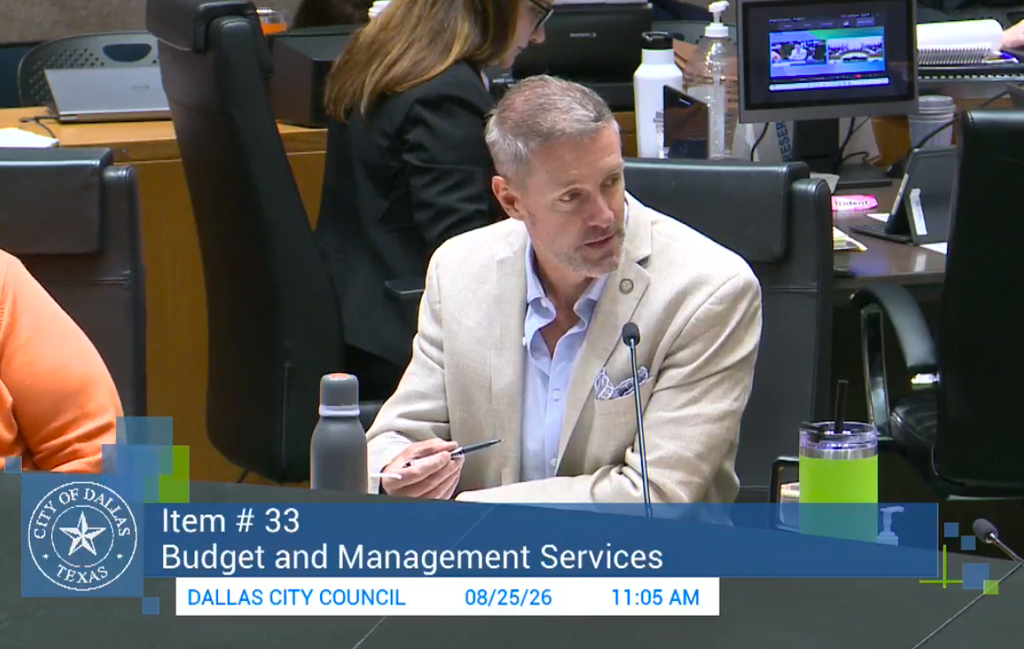
“This is a balancing act between having the funds in our budget to pay for services, which we’re doing, but it’s tight, thanks to the city manager making the cuts necessary to bring us a balanced budget, and also protecting our taxpayers and our homeowners and not sending a message that we’re going to take every penny from them we can allowed by law,” he said.
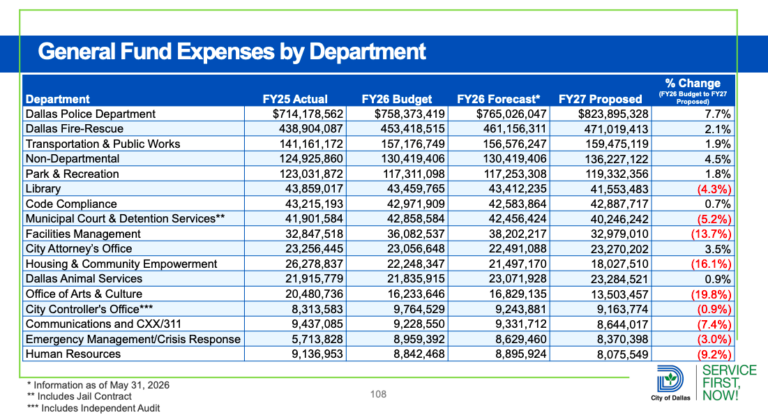
Revised sales tax projections and unanticipated spikes in public safety and employee health claim expenditures earlier this summer resulted in a roughly $51 million gap heading into budget season. Tolbert closed the gap by identifying nearly 300 positions for elimination and various non-uniform departmental cuts.
Mendelsohn’s competing 68-cent proposal would have required officials to remove another $41.2 million from Tolbert’s budget. She argued the lower ceiling would force the city to scrutinize consulting expenses, tax abatements, and services that could be handled by nonprofits or other entities.
Council Member Bill Roth (District 11) agreed.
“We are not trying to limit our ability to provide services to our citizens,” he said. “Our duty is to be fiscally responsible and force ourselves to make hard decisions. We’ve got to find savings, and we’ve got to find other revenue sources, and we’ve got to pay attention to what we are giving away, and this forces us to do that.”
Council Member Gay Donnell Willis (District 13) countered, claiming 68 cents was too drastic and warning residents would feel the resulting service cuts since the difference would have to come out of the General Fund.
“I’ve actually had some D13 residents reach out to me, surprisingly, to say, ‘Hold the line. We can’t go any lower,’” she said.
Even Mayor Eric Johnson, who has argued the city council repeatedly votes for unnecessary bloat in the budget every year, said a 68 cent rate this late in the game would be “too big of a gamble, even for someone who really wants to cut the rate like I do.” He said he thought there was certainly $41.2 million in spending to cut, but that the 68 cent rate wasn’t near as thought out as Tolbert’s proposal.
Mendelsohn’s amendment failed 2-13, with only Mendelsohn and Roth voting for it. Bazaldua’s proposal, which the mayor characterized as having “no [fiscal] discipline whatsoever,” failed 6-9.