
Mayor Johnson Blames Colleagues for Self-Inflicted Budget Woes
Share News:

Mayor Eric Johnson let loose on the city’s spending practices in a newsletter on Sunday, criticizing his fellow council members for repeatedly voting for “bloat” every budget season.
As previously reported by CandysDirt.com, City Manager Kimberly Tolbert implemented a number of emergency spending measures last month to mitigate a projected budget shortfall in the tens of millions. She put in place a non-uniform departmental hiring freeze, overtime restrictions, a freeze on non-essential travel, and departmental spending reductions.
The city blamed a decrease in sales tax revenues and increases to police and firefighter overtime and medical claims by city employees.
“Since the announcement, several council members have made public their thoughts, acknowledging the pressure on the City’s budget and the need to implement fiscally responsible practices to balance it this fall,” the mayor said. “But this is precisely the problem — elected officials who pay lip service to fiscal responsibility year-round, and then vote for bloat when the time comes.”
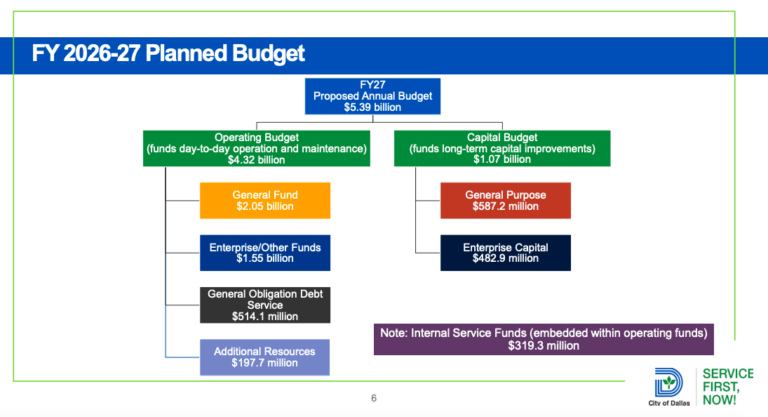
Dallas City Council has consistently outdone itself each year over the last decade or so, adopting record-high budgets. As a starting point, staff crafted a $5.39 billion budget proposal for FY 2025-2026. If adopted, it would be another record-breaking spending plan, split between a $4.32 billion operating budget (which includes $514 million for debt service) and a $1.07 billion capital budget for long-term projects.
Property tax relief, while popular, can’t be ignored as a factor in the budget dynamic, with the city increasing exemptions for seniors and disabled homeowners for several years now and officials adjusting the rate annually to mitigate spikes in home valuations. Mandatory increases in public safety spending due to Proposition U are also putting pressure on officials this budget season.
Johnson has argued for more budget discipline during his tenure as mayor, going so far as to challenge his colleagues at the horseshoe last fall to propose budget items for trimming so the property tax rate could be lowered further. Most of the suggestions were voted down by a majority of the council.
“Council members will pay lip service to fiscal responsibility, but when it comes time to vote, few are willing to follow through,” he said, pointing out he voted against three budgets he found to be deficient. “Each has favored projects and programs to which they will tolerate no reductions. And when most of the horseshoe takes that approach, meaningful spending restraint is impossible.”
The mayor pointed to staff’s plan to reconfigure the Dallas Public Library system, something council members agreed to in principle when they voted for the FY 2025-2026 budget, knowing implementation would result in the closure of four branches.
“But once staff began to implement the council-approved plan, some members — including those who voted in favor of the budget — began actively fighting against it,” Johnson said. “Fiscal responsibility is a year-round, full-time job. If your elected officials talk about it 11 months of the year but refuse to support spending reductions when voting on the budget — or if they vote in favor of budget reductions only to fight against their implementation — Dallas’s budget will never be fixed.”
The remark may have been a swipe at Council Member Cara Mendelsohn (District 12), who has typically been the city council’s most vocal fiscal hawk. She positioned herself against the library plan this year. One of the proposed branches for closure was in her district. Mendelsohn instead proposed identifying cuts that could be made in human resources and data operations. She and a handful of other council members have also been critical of the city council’s practice of repeatedly signing off on PFC deals that take new mixed-income housing developments off the tax rolls.
Johnson said he hoped Tolbert’s cost-containment measures will serve as a wake-up call as the city council heads into summer budget discussions. He went on to suggest that each council member should find something to cut for every project or program they want to save.
The city currently has its annual Budget Priorities Survey open through June 30. Click here if you’re a Dallas resident and haven’t taken it already.
A public hearing on next fiscal year’s budget is scheduled for May 27.







Part of the irresponsibility our Mayor speaks of is putting in a number for police overtime that was never going to be held to. That was part of the move to come under a Tax Increase Ceiling that was imposed by the state.
Another brilliant move was to charge an illegal “Environmental Clean Up Fee” on to Utility bills that has absolutely nothing to do with utilities.
Police will also be entitled to back pay when the Prop U violations are litigated. Dallas Police are being paid a starting salary of $81,232 putting them 12th in the area (Not 5th as the Charter says) 5th place is Irving paying a starting salary of $86,412
So with back pay and a reimbursement of those clean up fees our City Budget will be much deeper in the hole. All Courtesy of a City Manager that either didn’t know it was illegal or did know and didn’t think she’s be caught. I think its the later since she so easily violates every Police Officer on their compensation.