
After ‘Lemon on Stemmons,’ City of Dallas Rethinks How It Manages Real Estate
Share News:


Dallas officials are working to overhaul how the city handles its real estate portfolio, with staff pitching a new framework to manage real estate assets following a series of high-profile missteps.
On Monday, staff outlined a proposed governance framework to the Finance Committee that would place the Office of Real Estate at the center of acquisitions, dispositions, leases, and other significant property actions.
Staff developed the framework with assistance from consultant CBRE after identifying inconsistent practices across city departments, including inadequate due diligence and a failure to identify operating costs and risks before transactions move forward.
The proposal follows a push by City Manager Kimberly Tolbert to reform Dallas’ real estate practices in the aftermath of the Lemon on Stemmons debacle in 2024. Officials had paid $14.1 million for an office building at 7800 N Stemmons Fwy without a thorough review of the property. Permitting staff were moved into the building despite fire-code violations and occupancy problems, and the city ultimately concluded that making the building usable would require millions more.
Last April, Tolbert acknowledged that Dallas lacked both a structured acquisition process and a clearly designated project leader. She then temporarily suspended unapproved property purchases and brought in CBRE to examine the city’s real-estate operations.
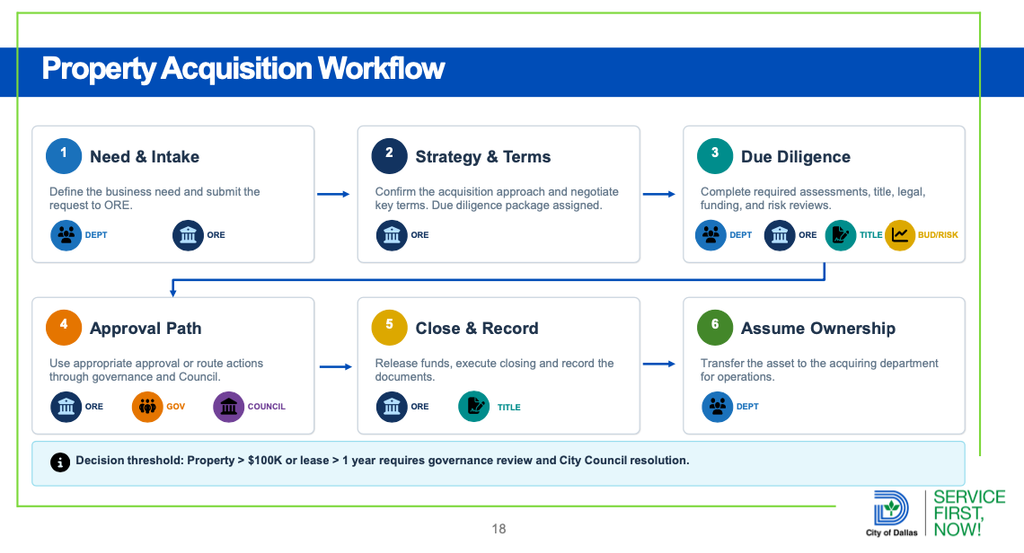
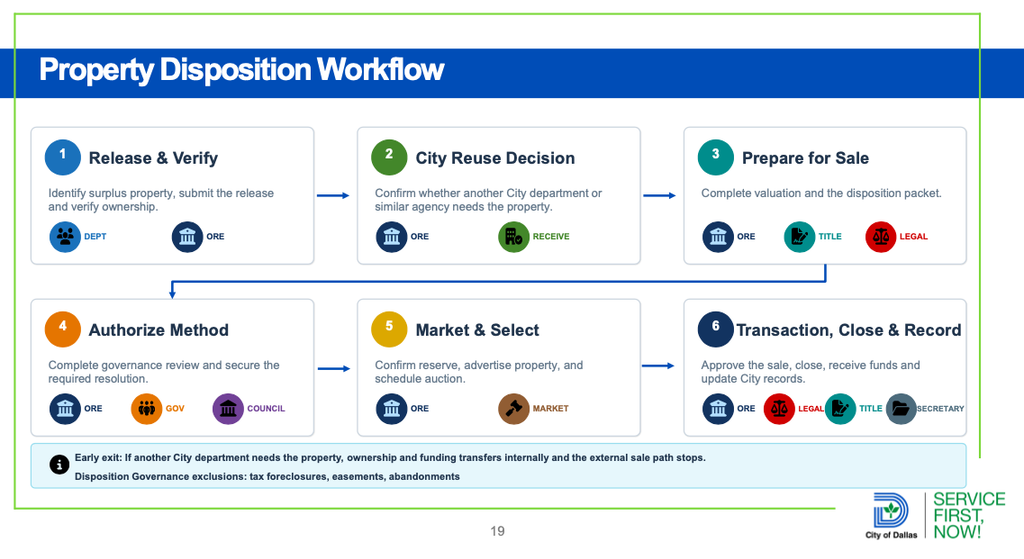
Under the proposed framework, departments would identify their business needs and remain responsible for identifying funding, intended use, operational impacts, and assigned due diligence. The Office of Real Estate would oversee the transaction strategy and coordinate reviews involving legal, budget, risk management, and other technical staff. Once that work is complete, significant transactions would go before a management-level governance board for cross-departmental review. Acquisitions worth more than $100,000 and leases longer than one year would require governance review and city council approval.
“Collectively, this allows the organization to make better-informed decisions related to the city’s real estate portfolio,” said Chief of Real Estate John Johnson.
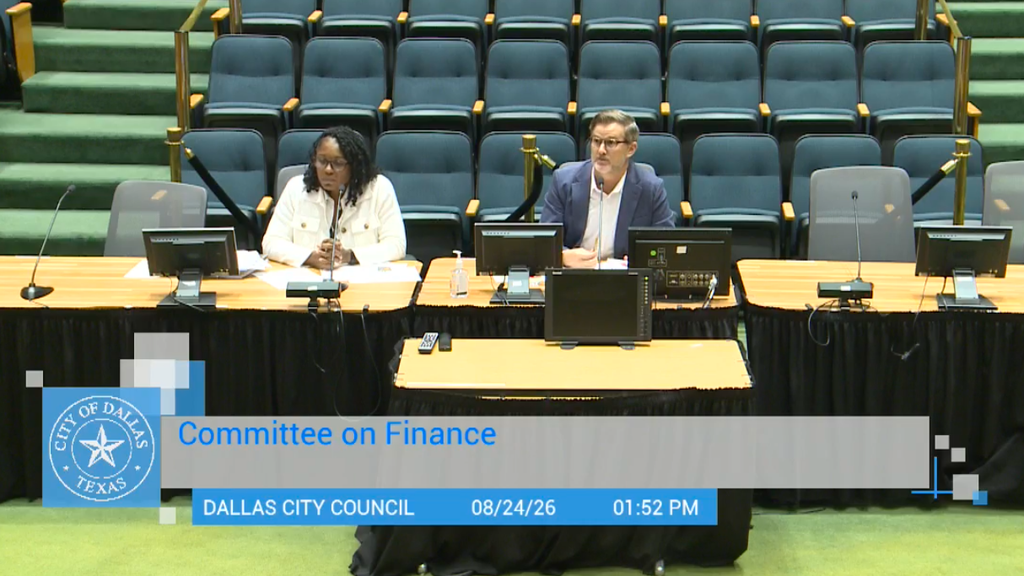
Assistant Director of Real Estate Ashley Eubanks (left) and Chief of Real Estate John Johnson (right)
Staff also plans to develop — with the help of an outside real estate consultant — a Real Estate Master Plan that inventories and assesses city-owned property, identifies opportunities to improve its use, and establishes a long-term portfolio strategy.
Council Member Chad West (District 1) expressed concern that the accompanying Real Estate Master Plan could lead to “analysis paralysis,” delaying action on properties that officials have discussed selling or redeveloping for years. Questions were also raised about why Dallas needs an outside consultant to establish what property it owns when the Office of Real Estate has 33 employees.
“How do we have a city that doesn’t know its real estate portfolio?” Council Member Cara Mendelsohn (District 12) said.

Johnson pushed back, explaining that the city’s aging land and building management system makes producing an accurate list unnecessarily labor-intensive.
Dallas’ real estate portfolio includes about 1,210 city-owned improved structures, although that figure counts smaller facilities such as park pavilions, restrooms, and storage sheds. Johnson said approximately 510 of those structures are actually buildings. The city also controls roughly 50,000 acres, including parks, floodways, rights of way, operating properties, and potentially surplus land. About 23,000 acres — nearly half the total — are dedicated parkland.
Mendelsohn and some other officials have previously suggested the city should unburden itself of some of its extensive holdings and refrain from accumulating more if it can’t conduct appropriate due diligence or execute on its plans.
The Lemon on Stemmons, along with briefings on how much deferred maintenance has accumulated, exposed a broad problem. Officials identified siloed acquisitions, poor communication, underused properties, unfunded operating obligations, and buildings acquired without a clear or workable long-term purpose.
Examples have ranged from the former Family Gateway property overrun by squatters to properties purchased for homeless housing that languished after the proposed uses encountered opposition or proved unworkable.
Council Member Jesse Moreno (District 2) cautioned against approaching the city’s portfolio too aggressively.
“We can’t just say we’re going to offload everything that we own because we don’t need it today,” he said. “If there’s a need, even if we don’t have bond dollars identified, but when it comes to a fire station or a police station or a library that we know there’s going to be an influx of residents going into the area, that should be part of the discussion as well.”
Staff said a pilot program for the new framework is expected to begin October 1, with the governance board initially meeting roughly once every 60 days. Staff will incorporate council member feedback and make adjustments during the trial period before formally implementing the system at the beginning of next year.
The city also plans to seek proposals for a master plan vendor in October or November and award a contract in January or February.