
Dallas Tightens Its Belt, But Proposed Budget Still Hits a Record $5.6 Billion
Share News:

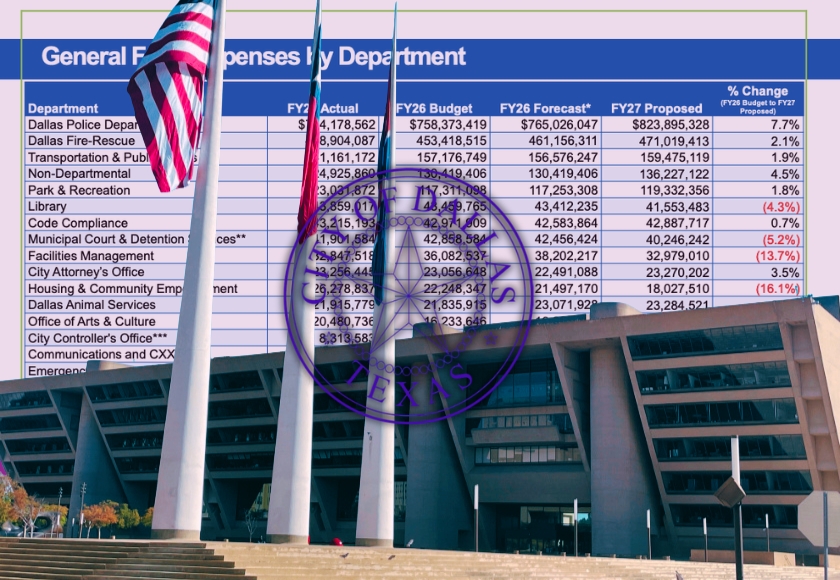
City Manager Kimberly Tolbert’s proposed budget for FY 2026-2027 totals roughly $5.66 billion. It’s another record-high spending plan council members will consider as a starting point before adopting an official budget and property tax rate in September.
The proposal comes as Dallas continues to grapple with financial headwinds. Sales tax revenues, which make up about 25% of the General Fund, have been coming in below projections. A city charter amendment adopted in 2024 requires greater commitments to public safety spending, laying claim to 50% of additional revenues each year.
Unexpected spikes in police and firefighter overtime and employee health benefit claims put the city further on its back foot, prompting Tolbert to implement selective hiring and spending freezes and non-uniform furloughs to keep the city at or below this fiscal year’s $5.2 billion budget. And revised projections earlier this summer identified a roughly $51 million shortfall for FY 2026-2027.
While some at the horseshoe have been calling on their colleagues to get spending under control for years now, recent budget talks suggest more council members see the need for reform. Even still, the current proposed spending plan, if adopted, would be the biggest in Dallas history, despite population growth in the city limits remaining basically stagnant.
Tolbert said staff took a priority-based budgeting approach that aligns with what residents told the city in the annual Community Survey and feedback from council members. The top overall priorities from the former are street and infrastructure improvements and police services.
“By listening to our residents and making thoughtful, strategic decisions, we are protecting the services people value most while positioning Dallas to be stronger financially, more efficient operationally, and better prepared for the opportunities ahead,” Tolbert said.
The proposed budget calls for growing Dallas’ sworn police force to 3,651 officers by the end of fiscal year and 3,800 the following year. It also includes higher starting pay and step increases for police and firefighters. Staff also plans to modernize aging police systems, deploy AI-enabled body cameras and first-responder drones, and pursue federal funding to help reduce crime and improve response times.
Zeroing in on the Dallas Police Department, annual operating expenses would go up by $65.5 million (7.7%) for a total of roughly $823.9 million after departmental and outside agency reimbursements.
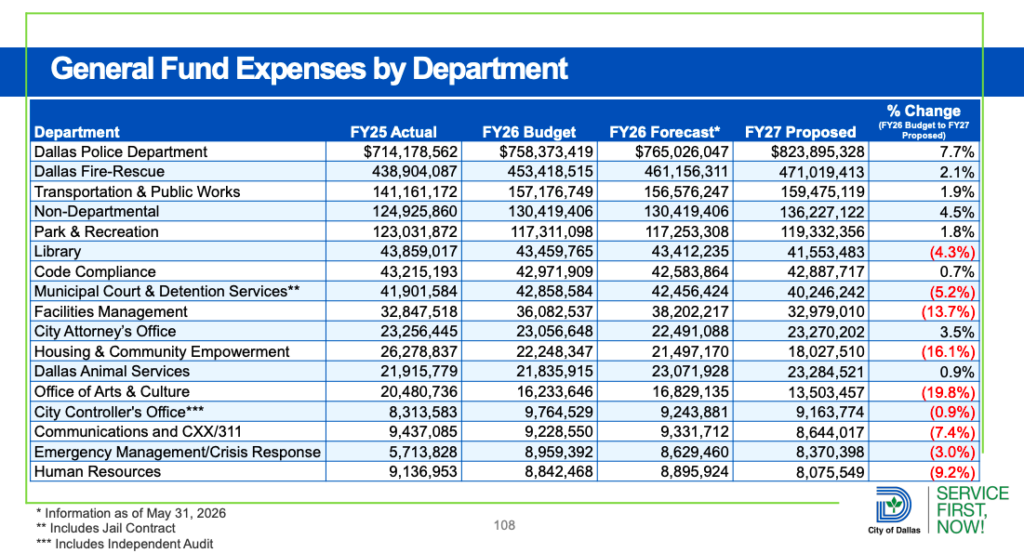
The budget provides $142.8 million to maintain and improve 800 miles of Dallas streets, up from 759 lane miles this fiscal year. It also calls for additional roadway safety improvements, including better pavement markings, increased bridge maintenance, and new traffic signal projects, while continuing the city’s Vision Zero initiative aimed at reducing severe crashes and traffic deaths. Investments would also be made to continue upgrading all parking meters across the city to smart technology.
Residents will be pleased to see that no neighborhood libraries would be closed under the proposed budget. A previous proposal to shutter some branches as the Dallas Public Library system transitions to a flagship regional model spurred residents and civic organizations to pack City Hall and speak out against the plan. The regional model is still going forward, though, which will concentrate additional resources, programming, and expanded hours at five locations.
The proposed budget cuts library spending by $3.3 million and eliminates 72 positions, about 30 of which are currently filled. It would also shift some jobs to part time and end city-run adult education programs, including GED, citizenship and English-language classes. The city hopes outside organizations can step up and fill the void, operating out of Dallas’ 29 library branches.
A total of 296 positions were eliminated across departments, including 30 at Dallas Park & Recreation and a dozen at the Office of Arts & Culture. Tolbert also wants to lean on outsourcing and cuts to programs outside the city’s core services. Private operators would be sought for city-owned Cedar Crest Golf Course and Southern Skates Roller Rink.
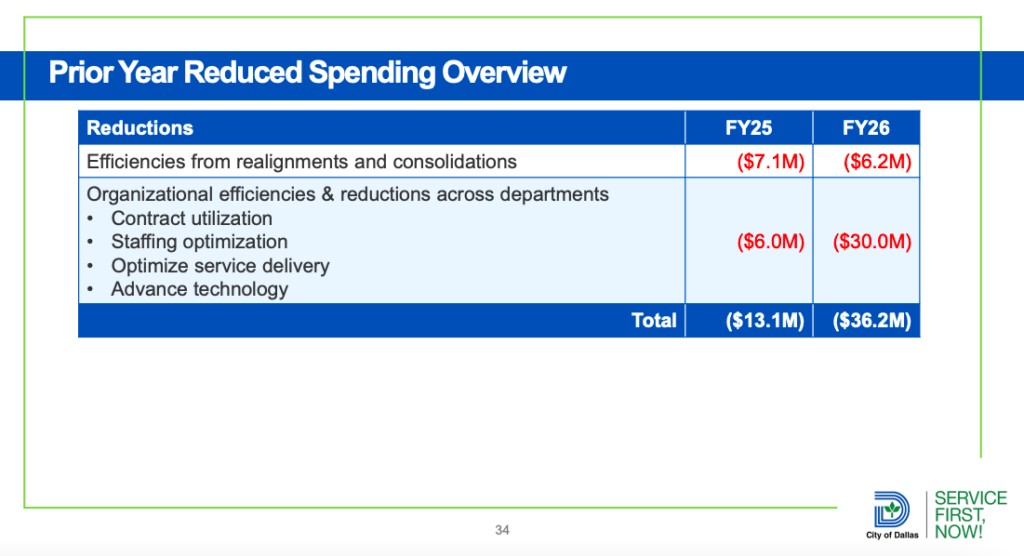
Other savings would come from cutting the IT budget by $8 million, eliminating an underused municipal court sobering program and removing 164 underutilized vehicles from the fleet, avoiding an estimated $16.22 million in future replacement costs. The proposal would also reduce roughly $719,000 in payments to outside partners and increase several city service fees.
All recreation centers and water parks would remain open, though, but Tolbert noted some could operate with fewer hours or programs and many positions would be converted to part-time jobs. Relatedly, park officials are exploring different ways to generate additional revenue and reduce expenses. Authorizing digital billboards and other advertising opportunities is one strategy being seriously considered.
Unfortunately, debt service is a hefty chunk of the proposed spending package. Some $451 million in principal and interest payments are budgeted to keep up with the combined $8 billion the city owes across tax-supported debt and revenue bonds.
While some would prefer a reduction in the property tax rate that might actually translate into smaller property tax bills, Tolbert’s proposed budget would lower Dallas’ property tax rate for the 11th consecutive year, trimming it by 0.1 cent to 69.78 cents per $100 of assessed value. The reduction would come entirely from the portion of the tax rate used to repay city debt, while the rate supporting General Fund operations would remain unchanged. The city estimates the decrease would forgo about $2.3 million in revenue.
“This budget is about more than balancing the numbers, it’s about building the future of Dallas,” said Tolbert. “Our team identified efficiencies, leveraged technology, and strengthened partnerships to maximize resources and ensure taxpayer dollars are invested where they achieve the greatest results.”
Council members have a budget workshop scheduled on Tuesday, August 11, during which they will be briefed on and discuss the proposed spending plan. Budget town hall meetings are also being held across the city through August 25. Click here to see the finalized schedule. No doubt there will be plenty of refinement in the following weeks.
A final budget and property tax rate will be adopted on September 16.
CORRECTION: This article was updated on August 11, 2026, at 11:37 a.m. to correct the proposed budget adjustment for library services.