
Zaida Basora of AIA Dallas: City Hall ls Not a Neglected Failing Asset
Share News:


by Zaida Basora, FAIA —Executive Director, AIA Dallas
Former Assistant Director, City of Dallas Public Works and City of Dallas Building Services, and Past President, AIA Dallas
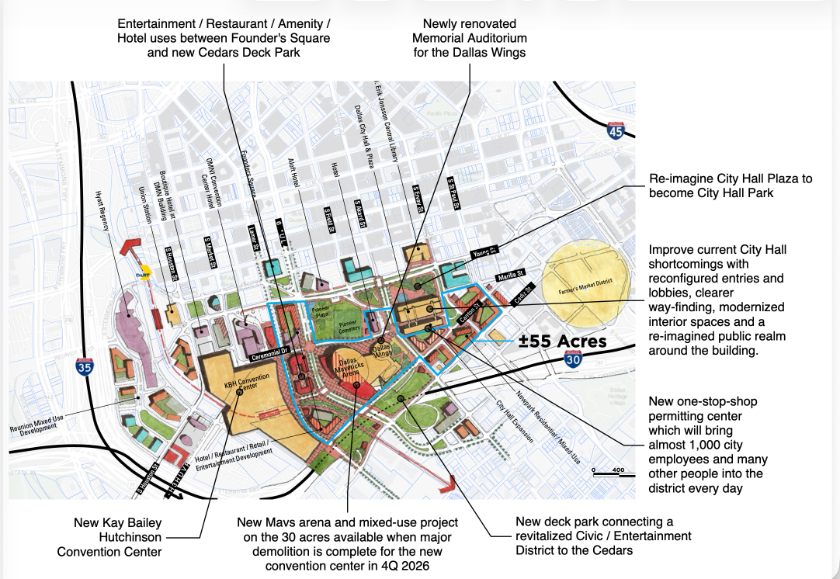
Decisions on economic development start at home. The Civic Center district: City Hall, courts,the convention center, the Omni, and a future arena are the front doors of Dallas. In successful arena districts across the country, when the venue is woven into a downtown of offices, government buildings, and public spaces, the area stays active and productive every day. When it stands alone, it comes to life only on game nights. The map in your handout makes that vision concrete. On city-owned land alone, there is room to keep City Hall where it is, rebuild the convention center, and site a new arena in a single, connected civic and entertainment district, instead of scattering these pieces across the city. And because demolition of the current convention center is scheduled to be finished by the end of this year, that land is available on a timeline that matches your arena and convention planning.

We Need an Apples-to-Apples Comparison
We have been told it will cost “around a billion dollars” over 20 years to stay at City Hall. In the city’s own figures, only a fraction of that is actually labeled as corrective repairs. The rest is interiors, furniture, technology, soft costs, routine operating costs, and hundreds of millions in interest. These are costs the city will face in any scenario. What has not been shared with you is an apples-to-apples comparison that includes the full cost of moving out, leasing and fitting out space, and paying escalating rent for decades. Once you account for those costs, relocation is the costliest path, and staying at City Hall is the fiscally responsible option.
Even the $329 million repair figure is not a hard fact. It is a rough estimate that assumes an empty building, escalates items beyond recent bids, and loads in work that prior studies treated as limitedissues, not full replacements. When you remove costs that occur in any scenario and correct the obvious overstatements, the true 2026 repair need is well under $200 million, before even counting potential historic and federal tax credits. These repairs can be put on a 20-year capital schedule, the same scope already assumed for financing a move.
A few quick examples: the generator project that has escalated from a roughly $17 million bid in 2025 to a $20 million line item (2028 dollars) after its ARPA funding was deliberately reprogrammed, and the $61.5 million line for “garage structural repairs,” even though a structural report has described the garage issues as localized and addressable with targeted retrofits, not wholesale reconstruction.
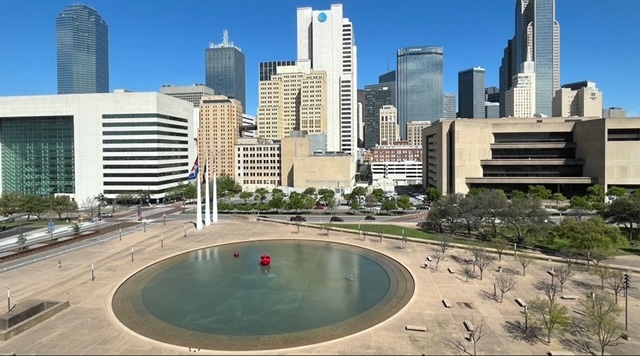
City Hall is not a neglected, failing asset. In roughly the last decade, the city has invested tens of millions of dollars in this building: electrical and waterproofing work, 911/311 and fire dispatch upgrades, Traffic Management Center and EOC buildouts, elevator modernization, and heating system replacement. The 2026 assessment says the building and garage remain operational and that deficiencies do not generally represent imminent failure, but increased risk over time if ignored; exactly what a disciplined schedule of repairs, modernization, and upgrades is meant to manage.
Economic development, fiscal responsibility, and Dallas’ identity as a great city all point in the same direction: keep City Hall at the heart of the Civic Center and fix the numbers before you evenconsider walking away from a taxpayer-owned landmark. Reject this relocation-biased study as a basis for action and direct staff to bring back a corrected plan that keeps City Hall, and the people who work there, at the center of Dallas’ future.






Please save the beautiful city hall in Dallas Texas There is and will never be a beautiful building like that again
I agree with Ms. Basora’s comments overall, but I’d challenge the assertion that it isn’t neglected. Whatever money they’ve spent the last few decades, I sure couldn’t tell you what it’s actually done for the building. There’s still a big leak in the second garage level (it’s been leaking for years), IT connectivity is still stuck in the stone age, elevators are inefficient, and the crappy HVAC that makes everything either too hot or too cold is the stuff of legend.
That said, none of these problems are insurmountable. A well-managed investment of money to repair and modernize the building would make it a much better place to work and visit. It’s like a classic car that just needs a capable mechanic, new upholstery and a good detail, not a decrepit Yugo with the axles falling off.
The Dallas City Hall will always be a timeless classic that can provide a wage producing work space for many people from all parts of town. If Dallas builds an arena, in a few years the city will have an outdated disposable arena like the old Reunion arena, Texas Stadium, now American Airlines arena and Globe life field and the seldom used Cotton bowl. With the high cost of maintaining an empty stadium there is a good chance that once the teams tire of the new arena it will become a vacant lot, like Reunion arena became. If a developer decides to build now or after the new arena becomes outdated i’m sure that the tax payers will also be taxed for builder incentives for the site. What will those costs be?
A 10 year lease for Class A space – $25.00 sf x 400,000sf = $100,000,000 plus $6,000,000 broker commission. Yet Council can’t even repair our streets. Throw em’ all in the harbor!
Ed Zahra
This well-thought-out and reasoned argument by someone who loves and cares for the “art” in architecture makes way too much sense to be considered by the monied, money-minded moguls who want to tear down and build another behemoth sports monument.
During the many times I’ve been at City Hall, it’s notable how many employees have remarked (in passing in the hallways) how much they like the building and working there. They admit it can be too cold and “it’s musty on the lower floors”, yet they are quick to say, “But those things can be fixed. I love my office here.” They also do not feel they are free to express their opinions. (Their boss is the City Mgr, afterall.) As a matter of good building and on-going maintenance practices, joints in concrete should be resealed, office lay-outs shouldn’t block air flow, broken bathroom tiles should be replaced, surfaces re-painted, ADA compliance met, and carpet replaced. Outdoor spaces should be improved and programmed for staff breaks and lively engagement for Dallas visitors and downtown employees and residents. Cost estimates were inflated to drive the highly suspect move-out motives. Consultants’ numbers did show that longterm leasing of offices for scattered city functions cost MORE than staying and repairing City Hall; Repairs pay for themselves in 10 years; and we would still own this valuable asset. And, unending, ever increasing leasing costs are paid by TAX dollars — forever. For its fine architecture, efficiency, functionality, and financials: Save and Repair City Hall.
This write up is well done, fact based, and way too nice. I would like to see an outside investigation on what’s really going on here. I don’t want toske any accusations, like someone may be getting paid, or big donors getting what they want, or businesses (sports teams) dictating if this building is torn down. But experts who know, and who are thoughtful, not conspiracy theorists, who genuinely want the best for the City of Dallas, say this makes no sense.
It is important to acknowledge the deep architectural passion and respect that preservationists like Zaida Basora have for I.M. Pei’s vision; however, a growing body of forensic data and economic analysis suggests balancing the public buildings future usage and fiduciary responsibilities to our city has more weight than preservation of the 1978 building. The reality is that 1500 Marilla, and modern needs, has moved beyond its intended design. While the building remains a significant historical landmark, I would offer these counter points to address why it is increasingly viewed as a failing asset and a severe liability for the city:
1) A “Mechanical Graveyard” in Systematic Collapse: Despite claims of stability, the building is suffering from the end-of-life failure of virtually all major systems, including HVAC, plumbing, and electrical distribution. The structure relies on R-21 refrigerant, which is strictly banned by the EPA, and the roof leaks so severely that the city has been forced to install internal gutters to catch water dripping directly over mission-critical 911 dispatch and IT equipment.
2) The Massive Opportunity Cost of a Tax-Exempt Liability: Retaining City Hall is not a “free” or low-cost choice; it represents a $1.1 billion – $1.4 billion total occupancy liability over the next 20 years, including vacating for asbestos removal (yes, you can’t patchwork that part for city liability to city workers, as well as $229m in debt servicing.) By clearing the 15-acre site, Dallas could transform a tax-exempt budget drain into a $10 billion economic engine, placing high-value private development (see Shawn Todd’s sale of~ 30 acres to JPMorgan Assent Mgmt) around the city owned property on the tax rolls to fund police, parks, and libraries, and the anchor funded through the PFZ and Brimer Bill incentives granted by the state.
3) “Functional Dead Zone” Severing the City: Urban planners and economists note that the building and its desolate concrete plaza act as a fortress that severs downtown from southern and eastern neighborhoods. Removing this “bunker” would allow the city to “re-stitch” the urban fabric, especially after Txdot loweres I-345 and I-30 starting in 2029, thus creating a contiguous flow of pedestrian energy at grade level and connecting the core to the Cedars and Deep Ellum…a move critical for stabilizing a downtown office market currently facing a 27.2% vacancy rate.
4) The Myth of Recent Maintenance: While critics and Ridley suggest the building has been well-maintained, forensic reviews show that recent repairs were merely “reactive patchwork”. For example, assertions that the HVAC system was recently replaced are disputed by engineering data showing that while a boilers were swapped, the corroded chillers, expensive controllers, and original 49-year-old ductwork remain in a state of advanced decay and inefficiency.
5) The Need for a “Civic Molt” and Transparency: Beyond the physical structure, there is a powerful argument that the current City Hall…born from the trauma of 1963…no longer reflects the transparency or innovation of our 21st-century global city. Replacing the opaque concrete fortress with a transparent “glass box” headquarters in an existing downtown tower would not only save hundreds of millions in tax dollars but also symbolize a commitment to ethical reform and open governance.
John: how would we save hundreds of millions of tax dollars by LEASING a transparent glass box over leaving a building we already own, flaws and all. To quote Cara M, City Hall doesn’t have to be the Four Seasons. How are we going to square leasing from a developer who then comes to the city with multiple requests for zoning changes? And this “re-stitching the urban fabric” is about as empty as the argument that City Hall is racist. “desolate concrete plaza act as a fortress that severs downtown from southern and eastern neighborhoods. Removing this “bunker” would allow the city to “re-stitch” the urban fabric, especially after Txdot loweres I-345 and I-30 starting in 2029, thus creating a contiguous flow of pedestrian energy at grade level and connecting the core to the Cedars and Deep Ellum…a move critical for stabilizing a downtown office market currently facing a 27.2% vacancy rate.” Please! There is a high downtown vacancy rate because the city has not enforced state laws that forbid sleeping on the streets — the homeless problem. And after Covid, commercial is struggling to stay alive: more people wrk remotely. The only good argument I have heard about this is so many city employees work remotely the building is practically empty. One, we need to stop the remote work nonsense, and two, if we truly have empty space, sub-lease it!
Candy, I get your skepticism, and you’re right…on the surface, “free” ownership sounds better than a monthly lease. But when the “free” building comes with a $1.1 billion to $1.4 billion 20-year occupancy liability, the math changes quickly. And I have NO DOUBT that the figure could escalate no matter what people think a fair figure is right now. Anyone who has ever remodeled their house will tell you the costs escalate as unforeseen issues manifest during the actual contracted work.
Here is why I think the “glass box” actually saves tax dollars:
The “Owned” Debt Trap cycle: Staying at 1500 Marilla isn’t free; immediate corrective repairs alone were pegged at $329.4 million (back when everyone agreed to a figure.) To do that work, the city must still pay to relocate 2,200 employees for ~five years, costing up to $185 million. There is no way a city attorney or manager is going to allow workers to stay in the building when they dig out asbestos off the old pipes stuck in the cement walls. By the time you add 20 years of financing interest, you’ve essentially spent a billion dollars on a building that generates $ in tax revenue.
PFZ AND Brimer “Cheat Code” Funding: If the city relocates, it can trade the tax-exempt liability for a $2 billion private arena/mixed-use and anchor to a new district in SE downtown. This transforms the 15-acre site into a “high-yield tax revenue powerhouse” that pays permanent property and sales taxes , and state mixed-beverage tax incentives into the General Fund…something City Hall will never do refurbished or not.
Market Stabilization: You mentioned the 27.2% vacancy rate—relocating municipal operations into a vacant downtown tower would immediately absorb roughly 500,000 square feet of “dead” office space, helping to stabilize the very market you’re concerned about.
The Sub-lease Dilemma: Regarding sub-leasing the current building: who would sign a lease for a “mechanical graveyard” where internal gutters were installed just to catch leaks over 911 mission-critical IT equipment? Between the “entombed” asbestos and a layout so confusing it “fights you the whole way, to go speak publicly, finding a private tenant for the bunker is a tough sell.
Urban Connectivity: “Re-stitching” isn’t just an urbanist buzzword…t’s about removing a “concrete barricade” and heat island that currently severs pedestrian energy between downtown and the Cedars…and even Deep Ellum & Farmers Market. Especially when the highways come down starting in 2029. It t’s a waste to spend $1.6 billion on a TxDOT highway with capping and decking to connect neighborhoods if the Marilla site remains a “functional dead zone” as a natural barrier to the path.
As for the ethical “squaring” of leasing from developers, the City Council has already mandated language to identify and mitigate potential conflicts of interest among firms involved in the assessments.
Does the financial trade-off between a “billion-dollar repair” and a “revenue-generating anchor” make the relocation path seem more like a business decision than a “silly game”? We could look at the Victory Park as a case study next to see how an “anchor” actually affected property values there at an old graywater site. AAC was paid off in HALF the time expected and is now a revenue generator. Imagine adding Brimer Bill incentives as well and having whatever is built paid of in a quarter of the time?