Dallas Central Library Faces ‘Reimagining’ While Four Branches Face Closure
Share News:


It’s never too early in the calendar year to start the bitter conversations about how and where to realize budget savings in Dallas. In 2026, that debate is kicking off with library services. Four neighborhood branches are being proposed for closure, and the historic J. Erik Jonsson Central Library is in for a “reimagining.”
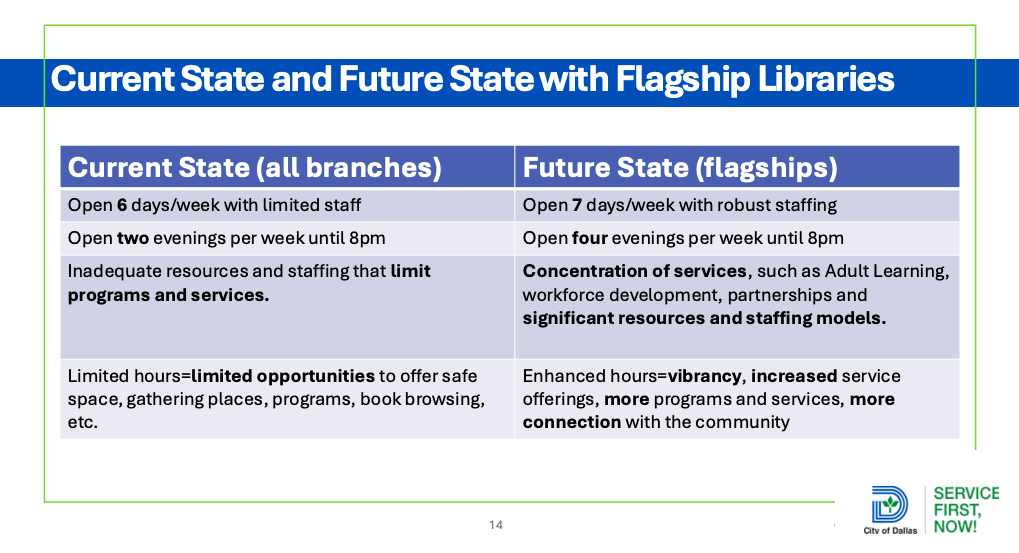
On Tuesday, the Quality of Life, Arts & Culture Committee will be briefed on Library Director Manya Shorr’s plan to transition the city’s public library system to a “regional model” anchored by several flagship locations with expanded hours but fewer neighborhood branches.
The first casualties being pitched by staff include the Oak Lawn Branch, the Skyline Branch in Buckner Terrace, the Renner Frankford Branch in Far North Dallas, and the Arcadia Park Branch in West Dallas.
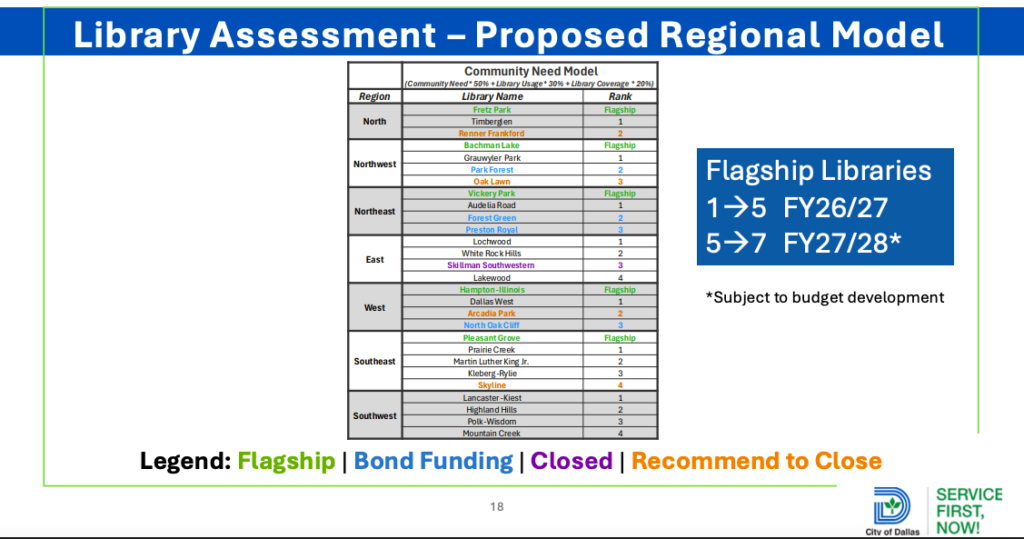
Staff arrived at the closure recommendations by evaluating branch usage, community need, and existing branch coverage geographically.
“The regional model is designed to align services with community needs while supporting a sustainable annual budget,” Assistant City Manager Liz Cedillo-Pereira said in a memo. “The approach is expected to generate cost savings, strengthen long-term operational and financial stability, increase access to services during peak demand, consolidate high-impact services within five flagship libraries, and provide a pathway for adding additional flagship locations in future years.”
Budget season last year had elected officials and staff make real tough decisions as they juggled record-high spending with property tax rate reductions. Library services were one of the areas flagged for right-sizing.
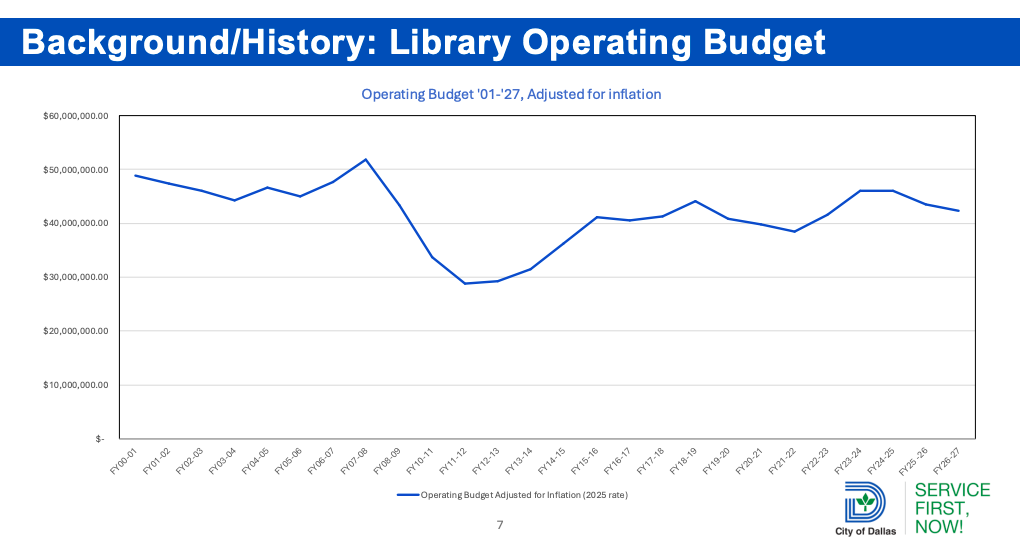
According to the city’s presentation, the library system’s operating budget has remained stagnant since 2001, despite population increases and the addition of new branches through bond spending but no increases in operational funding.
The plan notes that the Central Library will not be a flagship branch under the new regional model. Instead, a proposal will be developed to reimagine the historic building, which opened in 1982. It was designed to complement City Hall’s Brutalist architecture. Spanning eight floors, the library houses special collections, research materials, art galleries, and community spaces.
More recently, the Central Library has dealt with maintenance issues and become a resource for people experiencing homelessness downtown.
In an email to staff and the Municipal Library Board last fall, Shorr reportedly said that rumors of a possible sale of the Central Library were false.
“The services we offer are incredibly valuable, as is the work you do with our community. But they are separate from the space they occupy and that’s what I ask us to focus on. No matter what happens in the future, there will always be a plan for the services to continue, including the unique and valuable collections we have,” Shorr wrote, according to The Dallas Morning News.
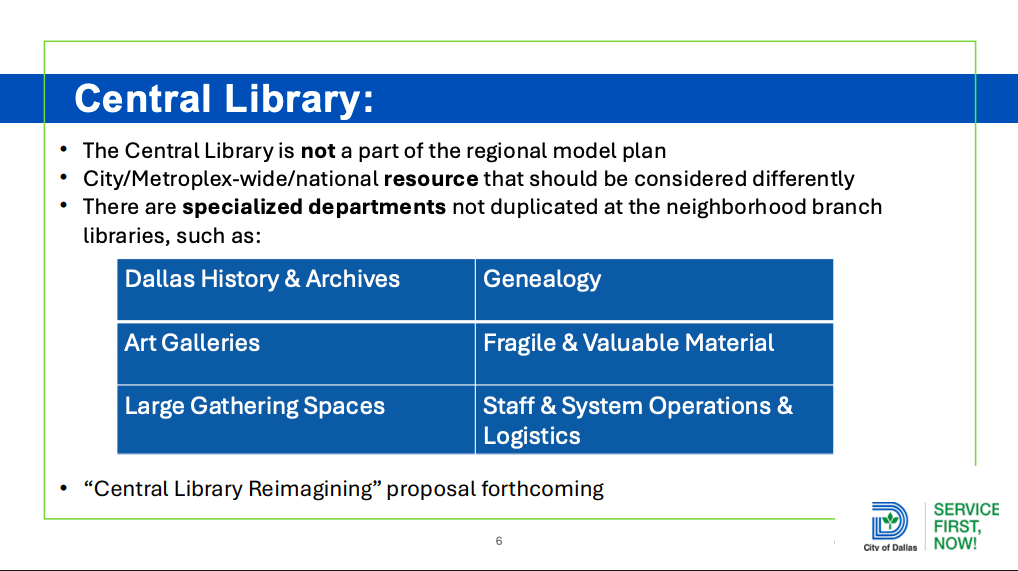
Shorr’s presentation describes the Central Library as a “City/Metroplex-wide/national resource that should be considered differently” with “specialized departments not duplicated at the neighborhood branch libraries.”
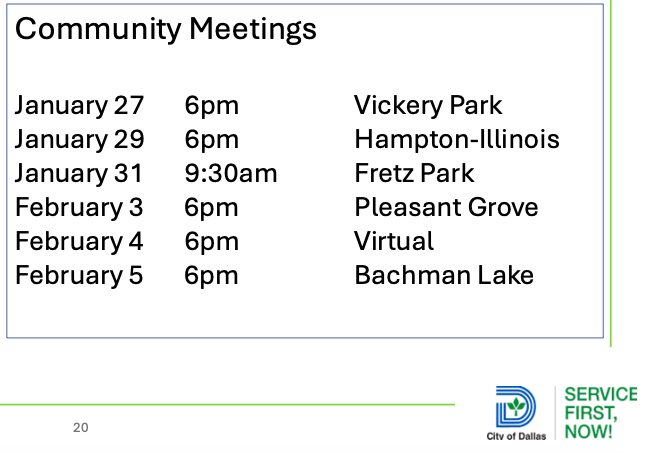
Despite its special distinction, staff do not recommend the Central Library for flagship status, choosing instead Fretz Park, Bachman Lake, Vickery Park, Hampton-Illinois, and Pleasant Grove branches as the first five flagships.
I’m sure there will be plenty of questions about the new model at Tuesday’s meetings, and residents will have the opportunity to ask their own at a number of upcoming community meetings at particular neighborhood libraries.
A reimagining proposal for the Central Library will be presented to the Quality of Life, Arts & Culture Committee in the spring or summer.