
Calculating Those Calculating Buyers And Sellers
Share News:


By Jonathan Miller
Special Contributor
Redfin has a wiz-bang calculation to quantify how many buyers and sellers there are. I will break their effort down and point out a few problems with it. They tend to get more ink because they are more negative in their story angles given the uncertainty in the market. Quick aside: Have you noticed how Redfin has replaced Zillow as the provider of housing market conversation nuggets (some would label them as “junk stats.”)?
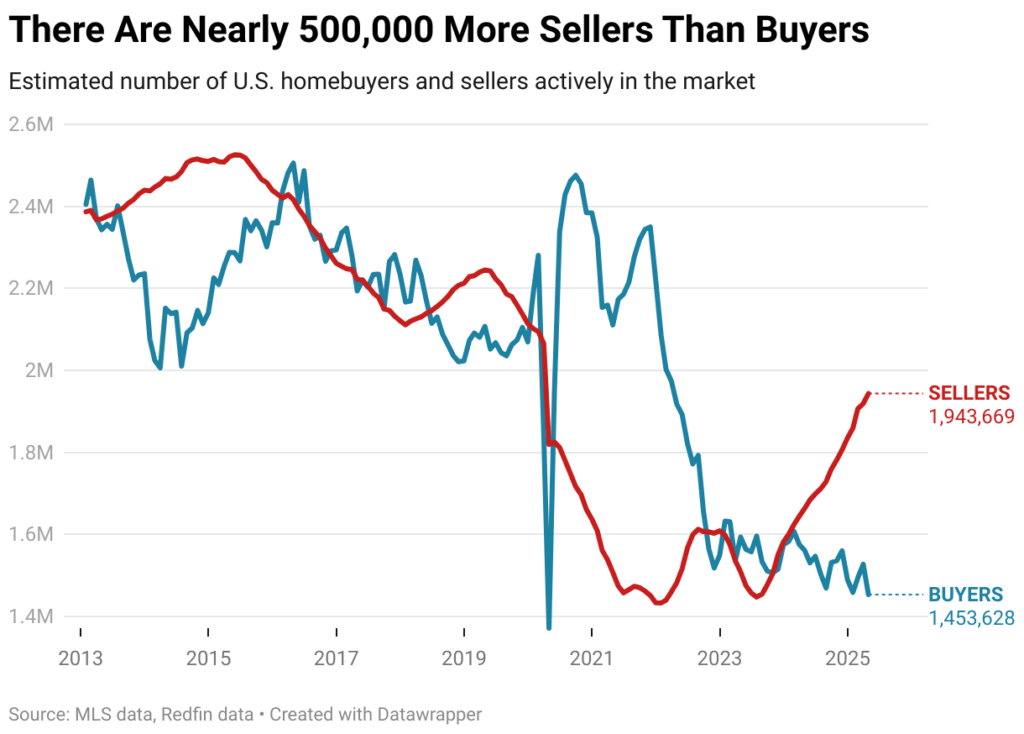
How To Calculate Buyers And Sellers
To calculate the market participants, Redfin did two things to convert transactions into people:
- Sellers = number of available listings
- Buyers = pending sales and adding an estimated time until they close
What’s Missing From The Redfin Math
- Compass has pushed for the use of private listings, and many other firms are following this practice. As a result, this growing number of private listings isn’t counted in the total inventory.
- Pending sales are harder to capture completely than closed sales so they will tend to be under-counted.
- With low unemployment and a potential stoppage of the tariff tantrums out of DC (wishful thinking), sales would surge quickly, even with high mortgage rates.
Pent-up Demand Is Not Accounted For
Generalizing the entire US as a “buyers” market is not a good idea. That is why this story seemed to go viral. For example, markets such as Long Island is not a buyers market, with 52.3% of the sales closing for more than the listing price in the first quarter, and they have been above the 50% threshold for at least ten quarters in the past three years. The Redfin report clearly identifies that market as one of the stronger areas. Southern California is in the same boat and so is Chicago and much of the US north of the Sun Belt.
Bidding wars are prevalent in the Northeast, which highlights what is missing from this methodology: pent-up demand. If 6 potential buyers are bidding for a property in a market with low supply, then they are undercounting the market by 5 buyers.
Final Thoughts
Redfin’s proxy of one sale = one buyer is wildly under counting the total number of buyers given how much of the US has inadequate supply and how potentially misleading this analysis is. This analysis is built for a stable market and not for a deeply polarized market that we are current experiencing with supply specifically.
It is clear that Redfin continues to be a creative generator of housing insights and they can be problematic like the one I’ve explained here. Redfin has clearly taken Zillow’s place in the junk stat space as media scrambles for clicks. It will be interesting to see if Redfin will sustain this lead after the merger with Rocket Mortgage is fully complete.
The Actual Final Thought – Buyers might as well “Jump” but more slowly.