Boomers Led Home Sales Last Year; Now They’re Driving Most Home Purchases in 2025

A significant generational shakeup in home-buying activity appears to have set in, with Baby Boomers overtaking Millennials in the market — again.
The National Association of Realtors (NAR) published its 2025 Home Buyers and Sellers Generational Trends Report on Tuesday, and the data suggests that Boomers are flush with cash and buying homes again.
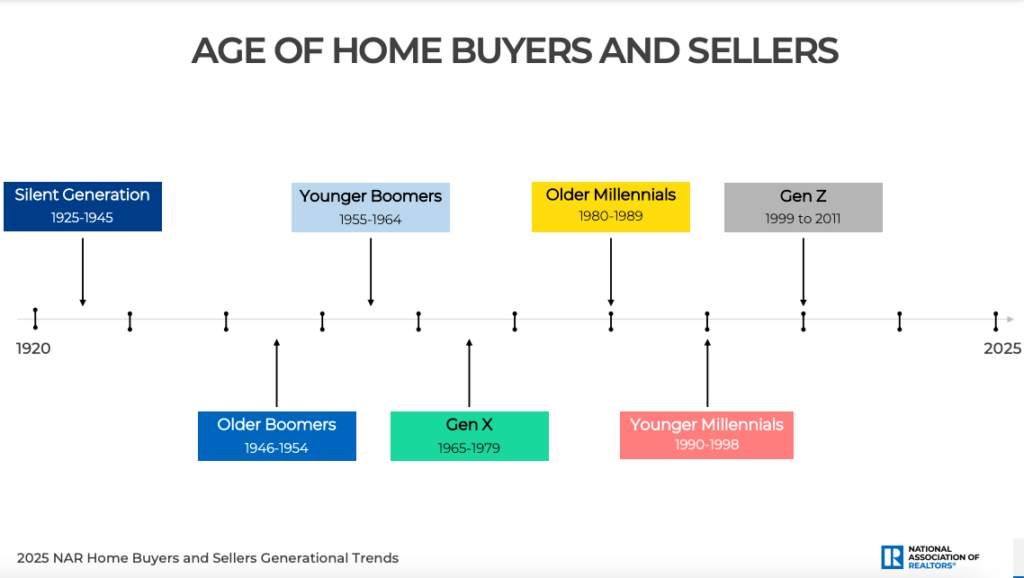
Before diving into some of the interesting data points, let’s get our generations straight.
- Boomers, born between 1946 and 1964, are now aged 60 to 78, with the NAR study splitting them at 1955 into Older and Younger Boomers.
- Generation X follows, ranging from age 45 to 59.
- Millennials, born between 1980 and 1998, are aged 26 to 44.
- The outliers—Generation Z and the Silent Generation—fall between ages 26 to 34, and ages 79 to 99, respectively.
We’ve been watching this generational tug-of-war take place for years now, sharing NAR’s 2024 report that Millennials finally bested Baby Boomers as the largest proportion of the home-buying market. Data suggested that Baby Boomers were the ones selling their homes, though regionally, we found that Boomers were hanging onto their homes and opting to renovate instead.
Now, not only did Boomers comprise 42% of all homebuyers this go around, but nearly half of them had enough liquidity to avoid financing altogether.
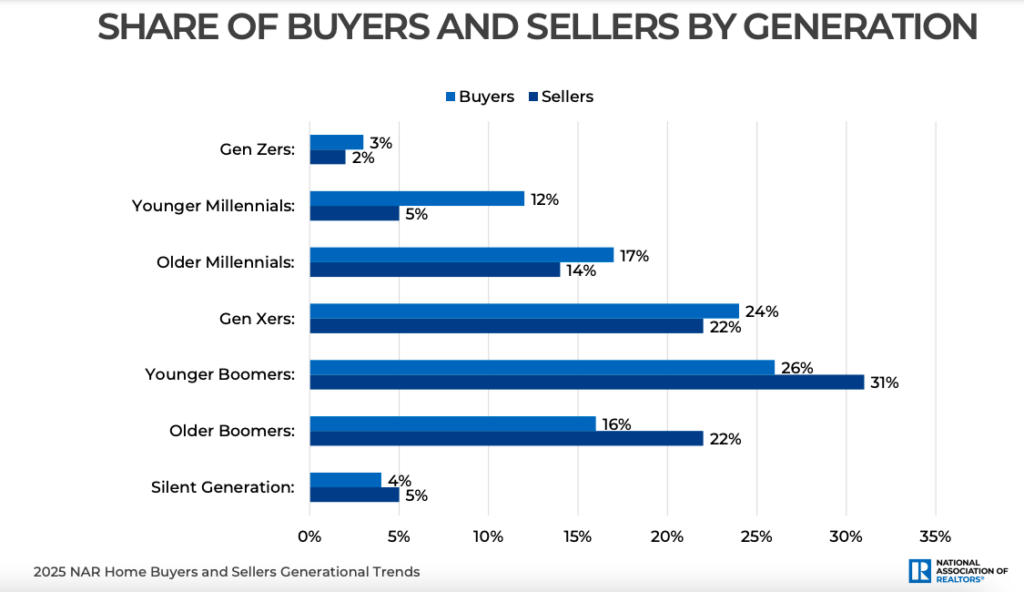
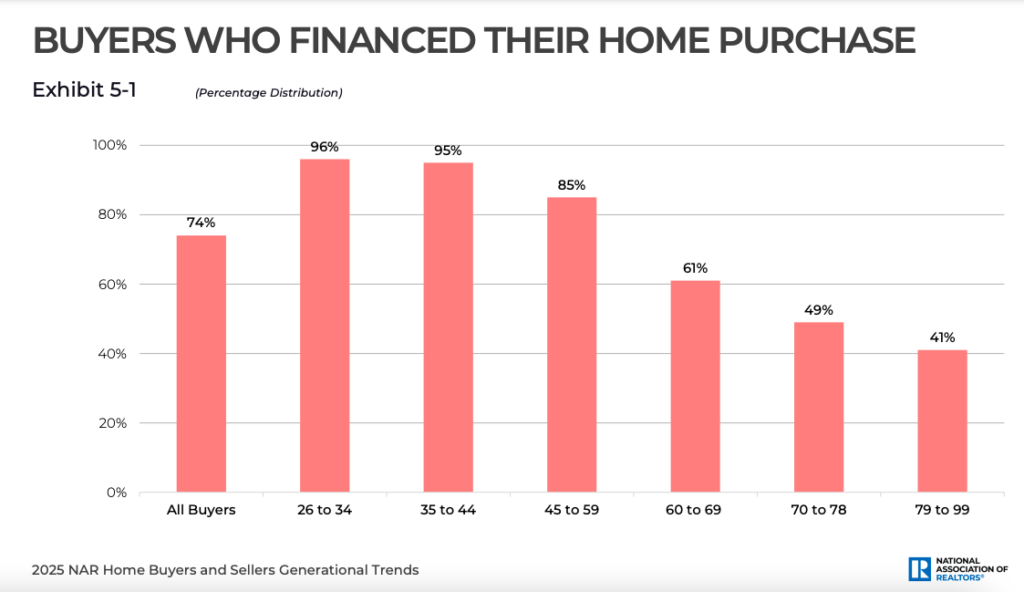
In contrast, Millennials saw their share of home-buying activity drop sharply. They only made up 29% of homebuyers, marking a decline from 38% in last year’s report. Unlike their elders in the Boomer cohort, more than 90% of them had to finance.
Additionally, the report clocked a steep decline in first-time homebuyers. Only 24% of homebuyers across all demographics were buying for the first time. Last year’s report had that figure at 32%, suggesting some significant barriers to market entry made themselves felt.
Texas has felt the strain of a housing shortage, driven in part by an influx of residents from states like California. But the reality is, the lack of supply is a nationwide issue. As a result, home prices have surged— an advantage many Boomers have leveraged to trade up (or downsize) into new homes.
“This shift reflects the increasing role of equity in enabling repeat purchases, especially among older generations, while younger buyers continue to face affordability challenges,” Jessica Lautz, deputy chief economist and vice president of research for NAR, said in a news release.
Barriers to Home Buying Linger
A lack of housing stock and the consequent increase in valuations haven’t been the only factors keeping younger prospective buyers out of the market. Money still isn’t cheap these days, and the Federal Reserve has been reluctant to cut interest rates amid the economic uncertainty that President Trump’s controversial tariffs have levied on essential goods in key commercial and homebuilding industries.
“Six-to-seven percent rates have kept monthly payments out of reach for many potential first-time buyers, and existing homeowners are locked-in at their low existing rates, unwilling to pay more or settle for less house at a similar payment,” Alex Thomas, senior research analyst at John Burns Research and Consulting, told CandysDirt.com.
And less house it may very well be. In line with the trend of apartment units getting smaller amid a push for greater housing density, new home builds are apparently also shrinking.
“The average floor area of a new single-family home has fallen 12% from its peak 10 years ago,” Thomas said.
Homes could get even smaller in Texas if Senate Bill 15 becomes law. The measure would reduce lot size minimums municipalities could impose on new subdivisions so that developers could build more (smaller) single-family homes in a given area. Ostensibly, this would result in lower price points for starter homes and an entryway for younger buyers.
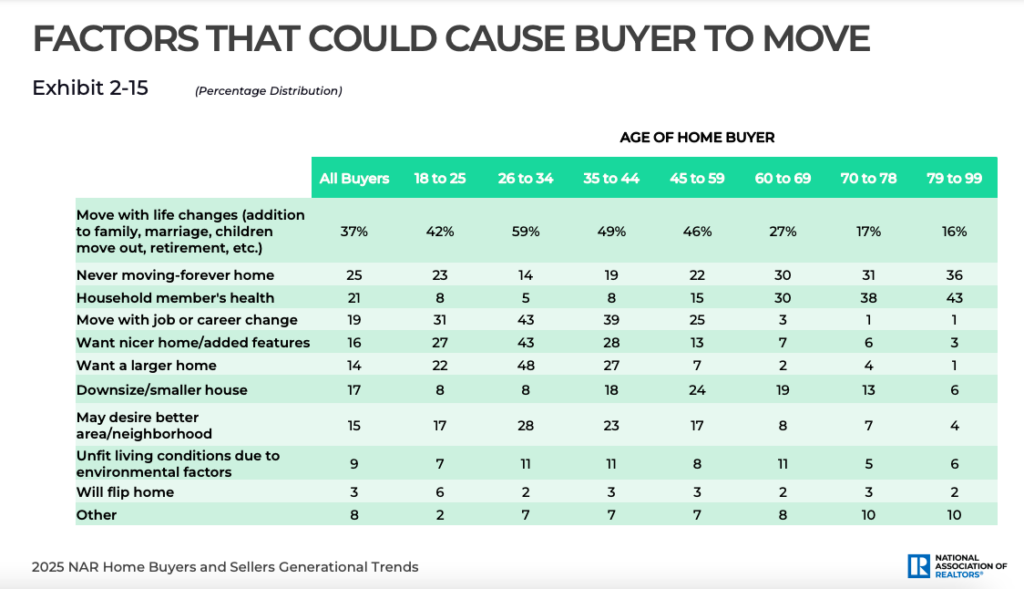
On the subject of downsizing, some 17% of homebuyers in NAR’s study reported moving into a smaller home.
NAR’s 2025 Home Buyers and Sellers Generational Trends Report is based on a 127-question survey that was sent out to more than 167,000 homebuyers who purchased a primary residence during the period of study. Some 5,390 surveys were filled out.