
3 Things You Need to Know About Fair Housing in Dallas and Why You Should Care
Share News:


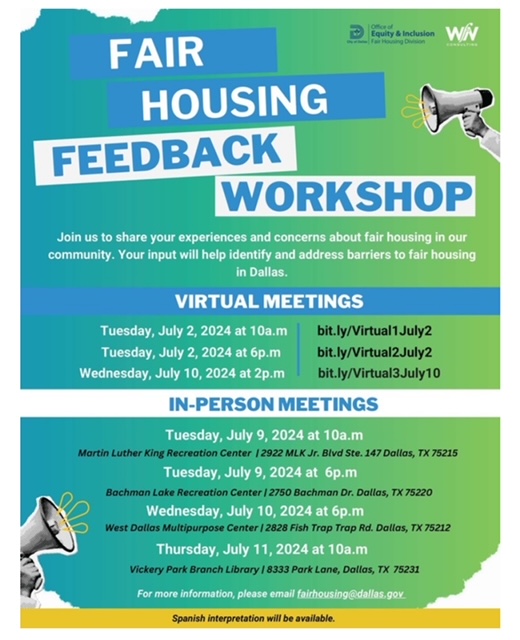
The Dallas Office of Equity and Inclusion is hosting four in-person workshops on Fair Housing this week, and there’s a good chance they won’t be well-attended. Why? Because many people don’t realize how the Fair Housing Act of 1968 affects them, or even know it exists.
We sat in on a virtual session last week and most of the dozen or so attendees were city employees. But these fair housing discussions affect not only citizens, but real estate agents who may be inadvertently breaking anti-discrimination law.
The City of Dallas is required to study barriers to fair housing and identify actions it can take to improve access to home ownership every five years, we recently learned. Here’s some useful information we gleaned from the July 3 workshop.
1. Housing discrimination still happens, despite FHA
The Fair Housing Act of 1968 and the Civil Rights Act of 1866 make it illegal for home sellers and their real estate agents to discriminate during a home sale. But discriminatory practices still exist nationwide, housing advocates say.
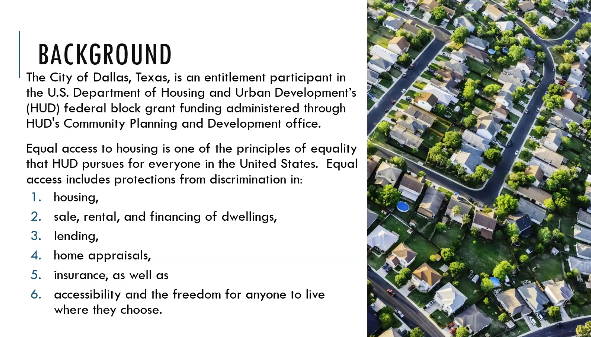
What constitutes discrimination? Denying equal access to housing for sale or lease, lending, home appraisals, or insurance, as well as accessibility and freedom for anyone to live where they choose.
For a Realtor, that could include racial steering, or opting to show their clients homes only in neighborhoods where most of the neighbors were of the same race.
“A multiyear undercover investigation by the National Fair Housing Alliance, a Washington-based nonprofit coalition of housing organizations, found that 87 percent of real estate agents participated in racial steering, opting to show their clients homes only in neighborhoods where most of the neighbors were of the same race,” according to a May 31 New York Times article. “Agents also refused to work with Black buyers and showed Black and Latino buyers fewer homes than white buyers.”
2. ‘Equity’ has been part of the conversation since 1937
The Dallas Office of Equity and Inclusion (OEI) comprises four divisions: Equity, Fair Housing, Human Rights, and Welcoming Communities and Immigrant Affairs. The OEI investigates discrimination in employment, housing, and public accommodation, provides education and outreach to the community on fair housing and human rights laws, and oversees the implementation of the ADA Transition Plan, according to its website.
Some called for the elimination of the office when former Dallas City Manager T.C. Broadnax departed for Austin earlier this year and Kimberly Bizor-Tolbert became the interim city manager. Both administrators are Black, and concerns were raised that the department pursues a “woke” leftist agenda, costing the city and producing no quantifiable results. The sources of these claims include a handful of anonymous social media accounts.
It’s a conversation many prefer to avoid, but the word “equity” is heard frequently around the horseshoe at Dallas City Council meetings as city leaders attempt to provide infrastructure and housing opportunities in historically underserved communities across Dallas.
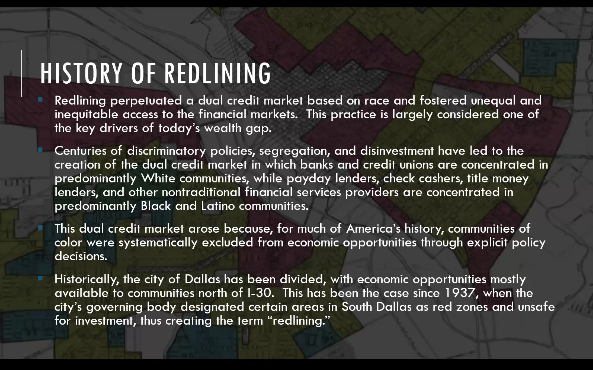
Dallas actually is an “entitlement community,” which receives federal grant funding to implement housing, community development, and homelessness programs. In order to receive funds from the U.S. Department of Housing and Urban Development, the City of Dallas is required to provide equal access to housing.
3. Dallas needs public feedback
The Office of Equity and Inclusion engaged Eryca Fambro with WFN Consulting to hear from residents about their experiences with Fair Housing. During the July 3 webinar, Fambro explained the purpose of gathering feedback and implementing new strategies.
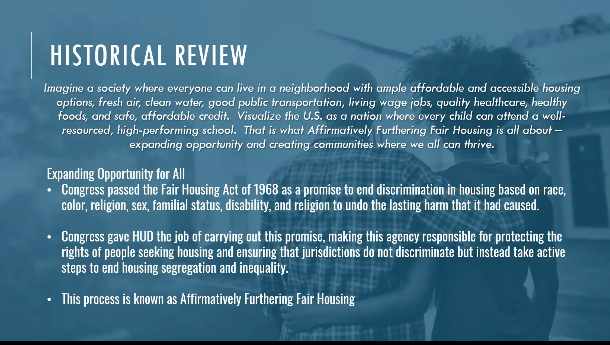
“HUD is responsible for protecting the rights of people as they are seeking housing and ensuring that jurisdictions don’t also create laws that discriminate based on those protected classes but instead are taking active steps to end housing segregation and inequality,” Fambro said. “We know those things don’t happen overnight, which is why we’re … making sure we’re taking active steps to move the needle forward.”

Bryan Tony, representing the Dallas Housing Coalition, recommended the Child Poverty Action Lab’s rental needs assessment as a good resource to identify barriers to housing. He also suggested reviewing tenant protection strategies offered by the Dallas Eviction Advocacy Center.
The DHC has held panel discussions on fair housing and discussed the need for a clearinghouse database on affordable units.
“Dallas has rolled out a lot of new financing tools and rehab where there are units being set aside for folks who are making less than our median income,” Tony said. “But those units might be obscured or buried on different properties’ websites.”
There also is considerable demand for housing among persons with disabilities, particularly in Pleasant Grove, Tony said.
“We’re trying to elevate the discussion about what attainable housing looks like for people at all income levels,” he said.