
Research Shows Residents Are Getting Displaced From Their Homes, But What is Dallas Doing About It?
Share News:


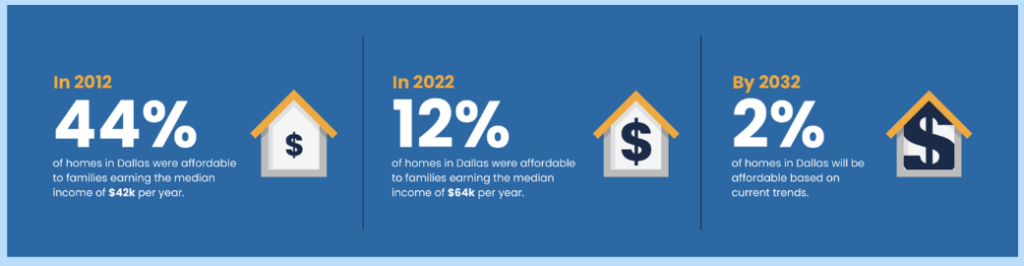
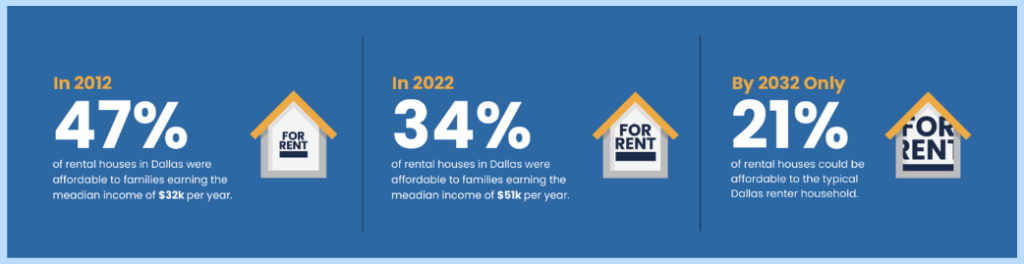
Dallas leaders are talking a lot these days about displacement — people getting forced out of their homes because they can’t keep up with rising rents, home values, or property taxes — but is anybody doing anything to solve the problem?
The short answer is yes. Builders of Hope Community Development Corporation is at the forefront of the issue, developing an “anti-displacement toolkit” for release in the fall. And Child Poverty Action Lab just released a Community Displacement Tool for determining which areas of the city are at the highest risk.
Most recently, the City Plan Commission took up the matter, questioning whether they could dig beyond the data and find some useful strategies to address the challenges.
The Dreaded G Word
Gentrification has been described as the practice of building expensive homes in low-income neighborhoods, driving up values so that poor people have to move out. It’s also been described as racist.
Stanford professor Jackelyn Hwang found in a 2020 study that gentrification disproportionately affects minorities.
“If we look at where people end up if they move, poor residents moving from historically Black gentrifying neighborhoods tend to move to poorer non-gentrifying neighborhoods within the city, while residents moving from other gentrifying neighborhoods tend to move to wealthier neighborhoods in the city and in the suburbs,” Hwang said.
But, as Dallas’ District 8 CPC Commissioner Lorie Blair pointed out, displacement is happening everywhere.
“I know when I go down Beckley [Avenue] and I see the mega-mansions, that concerns me because it looks like it’s moving south,” she said. “High-risk areas for displacement could be anywhere the builder has a vacant lot and wants to put a mega-mansion. It could be in almost any neighborhood.”
It’s Happening in Dallas Neighborhoods
District 7 Plan Commissioner Tabitha Wheeler-Reagan noted in a June 17 CPC meeting that Elm Thicket/Northpark and Love Field West — two neighborhoods separated by the Dallas Love Field airport — experienced gentrification for different reasons.
In Love Field West, a developer bought properties in an area that was already zoned multifamily, causing a rapid uptick in growth. In Elm Thicket/Northpark, developers began building large structures that residents said were incompatible with the neighborhood.
Both neighborhoods fought back, with Love Field West securing a Neighborhood Stabilization Overlay in 2021 and Elm Thicket/Northpark petitioning the City Council in 2022 to change development standards for new home construction.
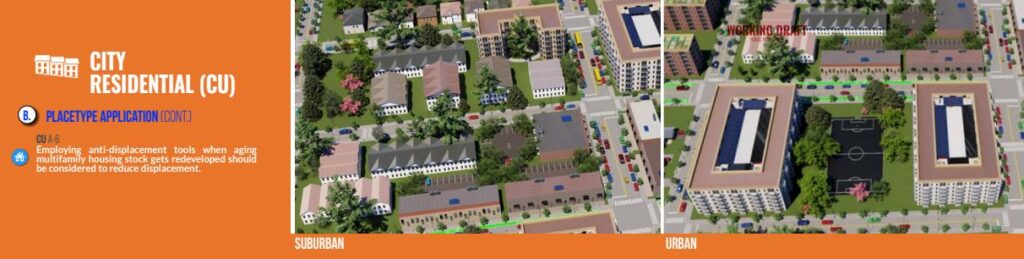
The CPC agreed last month to add language to the ForwardDallas comprehensive land use plan that states, “Employing anti-displacement tools when aging multifamily housing stock gets redeveloped should be used to reduce displacement.”
Stephanie Champion, chief community development and policy officer for Builders of Hope, said displacement is happening across Dallas in the midst of an affordable housing crisis.
“Even people with moderate to higher incomes are struggling to keep up with the pace of housing costs,” Champion said. “Our model is different because we’re really focusing on neighborhoods of historic disinvestment where you see concentrations of vulnerable populations and that rapid housing market appreciation as well. That’s how we’re defining gentrification. It’s really about where you see a specific type of neighborhood change that impacts vulnerable residents.”
Planning and Urban Design Assistant Director Andrea Gilles said a finalized map is not yet available but nonprofits, universities, and city departments are all studying areas at risk for displacement.
Anti-Displacement Toolkit
That finalized map of neighborhoods at high risk for displacement is coming soon, says Builders of Hope CEO James Armstrong.
“We know that [displacement] has become a middle-class issue,” Armstrong told CandysDirt.com. “A middle-class household that has the resources to move to another part of town is not the same as a single mother with two kids who don’t have any options. I think the CPAL methodology of mapping doesn’t take into consideration things like vulnerability and demographic change. We feel that those are key components to understanding displacement. There is a difference between a middle-wage worker and a low-income worker experiencing the pressures of gentrification.”
The team from Builders of Hope has knocked on over 1,000 doors and surveyed more than 400 Dallas residents. They created a methodology on how to measure displacement that looks into housing market change, Armstrong said.
“Industry standards, I wouldn’t say they failed to do that, but they don’t go into depth,” he said. “The benefit of housing developers doing this study is we understand that Census data is insufficient. We did an in-depth study on housing market change and created a new methodology … and now it provides a much more colorful picture of how housing market changes drive displacement in a neighborhood. It’s a first. We’re pretty excited about that.”
Builders of Hope is “socializing” the toolkit this summer to stakeholders, trusted media partners, and City Council members before it’s released to the public in August.





As you stated, a neighborhood committee (10 or more property owners) in Love Field West submitted a request for a Neighborhood Stabilization Overlay (NSO) petition in 2021. What is the status now? Did the neighborhood committee obtained enough signatures from the property owners in 2023 (which was the most recent committee meeting)? If so, did the petition get approved by the city council? Thanks.
Thank you for this article. Please note that the PCP added “should” not “must” employ anti-displacement tools to the FD plan. This addition was not added until residents pointe out how much FD violates the Dallas Housing Plan 2033.
As to the Builders of Hope study, 1000 doors is a very small sample from a city as large as Dallas. And, what type of doors? Were they apartments, houses or a mixture? And just as significant, what neighborhoods or communities were in the study? I’d like to see more information on this study and a description of what is identified as an anti-displacement tool.
The Forward Dallas plan beign overhauled at present uses pages and pages of meaningless language used to suggest the planners have done due diligence in studying and analyzing the true housing problems in Dallas. This useless language hides the utterly detrimental consequences of what they are proposing in Forward Dallas.
This article refers to one such example stated in the FD document: “Employing anti-displacement tools when aging multifamily housing stock gets redeveloped should be used to reduce displacement.” First, the city of Dallas doesn’t HAVE any “anti-displacement tools,” so this is meaningless. FD instead encourages more teardowns of existing homes to build multi-family/multi-unit buildings in existing neighborhoods EVERYWHERE. Second, this statement only refers to “multifamily housing” – what about all the homeowners in single family homeowners across all of Dallas who WILL be driven out of their neighborhoods if Forward Dallas is passed without protections for SF neighborhoods?
So far, City Plan Commissioners and staff are blatently ignoring thousands of homeowners who for months have been demanding that a SF Placetype be included so that SF neighborhoods are protected from the demolition, displacement, and redevelopment proposed and promoted by Forward Dallas.
The city planners have not included directives from the Dallas Housing Plan and they obviously haven’t included mapping of high risk areas. So HOW CAN FORWARD DALLAS be taken seriously – and moved along toward adoption -when it is based on such weak (or no) data applied in Dallas? Dallas planners already had to admit FD is NOT about affordability, yet national studies show that AFFORDABILITY is the crisis issue – not the number of housing units that FD promotes and developers drool over.
Now, as it progresses, city commissioners are throwing everything they can into the plan at the last minute, like tiny houses (mini-trailer houses & RVs) and more “cottage court” multifamily condos/apartements – which NO ONE asked for. Allowing multifamily and everything else to be builty on ANY single family / R-zoned lot in Dallas is not real planning – it is destructive de-regulation that only benefits developers and real estate investors.
All home owners want is for their neighborhoods and their homes to be protected from gentrification, familty displacement, and the home devaluation that Forward Dallas will bring.
So, beware of the fancy, meaningless, and misleading language in Forward Dallas – email and tell your CPC commisioner and your city councilmember to protect Single Family /R-Zoned Neighborhoods from the influx of multifamily/multi-unit housing allowed in this disasterous re-write of the Forward Dallas Comprehensive Plan.
Amen Melanie!
Maybe I am late to this conversation, but I live on Thurston in the Love Field area off Denton Dr. I was raised in this area since 1969 but I would like to say is – around the corner from me, on Lovedale builders/investors are buying these old homes on this street, they’re knocking them down and building townhomes to be sold or for rental. You have no idea how many cards, letters, calls and texts my fellow neighbors and myself are getting from investors wanting to buy our property, If were to sell my parents home to these greedy people, they will not pay me enough money to purchase another home, they will be making money off of me. This neighborhood has history and it’s being ruined by these property builders/investors, am so sick and tired of these vultures prying on people and I really don’t think nothing is being done about it.