City Hall Roundup: Dallas Eyes New Data Center Rules, Tackles Old Buildings and Fair Park Funding
Share News:


Running a city is partly about preparing for what comes next and partly about catching up with everything that has already happened. Officials at Dallas City Hall are doing a little of both right now, contending with new development pressures, old buildings, long-standing promises, and a budget that is leaving increasingly little room for surprises.
Officials Want To Explore New Data Center Rules in Dallas
Dallas could become the latest North Texas city to rethink how and where data centers are allowed.
Council Member Chad West (District 1) filed a five-signature memo this week requesting that the city initiate a public hearing to discuss updating its development code to specifically address data centers. The hearing could consider amending existing regulations for “communications exchange facilities” and creating an entirely new land-use category for data centers.
“There exist growing land use concerns over expanding this use throughout Dallas with very little tailored oversight,” West said in the memo. “Currently, the closest land use in the development code that planning and development staff have to categorize these data centers is the local utility sub-use of communications exchange facility. Communications exchange facilities are allowed by right in many non residential and mixed-use zoning districts, and the regulations for this use fall short of a more modern local regulatory landscape.”
A hearing, which would be held within the next 30 days, comes as data centers become a land use flashpoint across Texas. Residents have challenged projects over electricity and water consumption, noise, and proximity to homes, while proponents point to new investment and property tax revenue.
Dallas has so far seen less public controversy than several neigboring communities over data center construction, though developer Ray Washburne did threaten last year to sell the former Dallas Morning News headquarters downtown to a data center company after growing frustrated with the city over convention center redevelopment plans. The city ultimately purchased much of the property for $51 million.
Other floated and real projects have garnered less attention. Equinix is developing an $836 million facility on Mockingbird Lane, and CBRE previously projected D-FW’s data center market could double in size by the end of 2026.
Crow Holdings is reportedly planning a 245-megawatt campus on roughly 40 acres along the Stemmons corridor, beginning with a 70-megawatt facility on vacant land. The larger redevelopment could eventually claim Dallas Market Hall, which has stopped booking future events as Crow Holdings evaluates the property’s future. The rest of Dallas Market Center’s wholesale complex, including the World Trade Center, is not part of the proposed redevelopment.
“We need to better understand how this new land use fits into our city code,” West said. “Many residents have concerns about data centers’ energy and water use and compatibility in an urban environment. We need to make sure they are zoned and regulated appropriately rather than allowed by right.”
West’s memo was signed by Council Members Zarin Gracey (District 3), Laura Cadena (District 6), Gay Donnell Willis (District 13), and Paul Ridley (District 14).
Dallas Catches Up on Some Deferred Maintenance
City staff highlighted more than $14 million in recently completed facility improvements, even as the city continues wrestling with maintenance across its sprawling real estate portfolio.
In a Friday memo, City Manager Kimberly Tolbert highlights work at five city-owned facilities, including Dallas Animal Services, the Dallas Museum of Art, Family Gateway shelter, and The Bridge shelter.
Among the largest projects was an $8.2 million reconstruction of more than 21,000 square feet at the DMA after an August 2022 storm overwhelmed drainage at the Reves Gallery courtyard and damaged the Reves and C3 galleries. Reconstruction wrapped up June 30 after improvements to drainage and waterproofing.
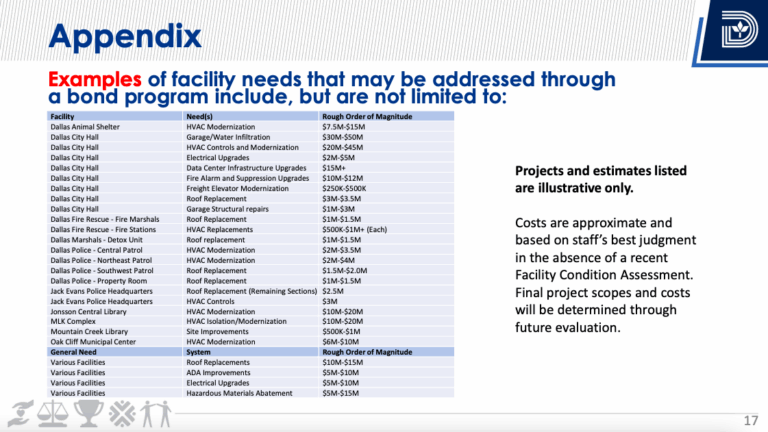
The city also spent $2.6 million replacing four aging rooftop HVAC units at Dallas Animal Services, where more than 500 HVAC-related service calls over five years had already generated more than $1 million in reactive repair costs. Replacement of the remaining five units is planned pending FY 2026-2027 funding.
Another $3.4 million-plus went toward storm repairs and modernization at Family Gateway, while $700,000 in Community Development Block Grant funding addressed plumbing, appliances, fire suppression and laundry capacity at The Bridge. The city is also progressing with repairs at the Kleberg-Rylie Branch Library after a January freeze and flooding event damaged the facility. Facilities Management signed off on reconstruction of damaged walls and ceilings, which are expected to wrap up by late October.
The improvements come as Dallas continues grappling with a much larger deferred maintenance problem. The city manages more than 500 properties totaling roughly 9.6 million square feet, with an average age of 47 years and a combined value of about $1.5 billion.
Dallas has historically spent less than 1% of the portfolio’s replacement value on maintenance, well below the 2-4% recommended under industry standards. Facilities officials estimated last year that another $15 million annually would be needed to bring spending up to that benchmark.
Nowhere has the problem been more visible than Dallas City Hall, where years of underinvestment have contributed to problems ranging from water infiltration and aging elevators to outdated mechanical and electrical systems. Those problems have since become central to the debate over whether Dallas should pour potentially hundreds of millions of dollars into repairing 1500 Marilla St. or relocate municipal operations and redevelop the property.
New TIF Arrangement To Support Community Park at Fair Park
Council members signed off on a tax increment financing agreement with the nonprofit Fair Park First on Wednesday, directing up to $3 million from the Deep Ellum TIF District to help close a funding gap for the long-promised 10.5-acre Community Park at Fair Park.
Fair Park First has so far raised about $33.1 million through federal, state, and philanthropic sources, according to the city. The project is estimated to cost $40.6 million. Remaining funds are expected to be raised privately.
“Community Park at Fair Park is more than a capital project — it’s a commitment that delivers on a promise to the families and neighborhoods that have waited far too long for this meaningful investment,” said Council Member Adam Bazaldua (District 7). “This park will create new opportunities, strengthen community pride, and build a healthier future for South Dallas.”
The arrangement comes after a turbulent few years for Fair Park First. The nonprofit previously managed the entire Fair Park campus before the city took day-to-day operations back in-house amid controversy over the use of restricted donor funds by subcontractor Oak View Group. Fair Park First has since assumed a narrower role focused on fundraising for and delivering the Community Park.
Community Park itself has been promised to surrounding South Dallas neighborhoods for years. Frustration over repeated delays became so pronounced that the city council stripped the Dallas Park & Recreation Board of authority over the project. A subsequent agreement approved in February put Fair Park First in charge of designing, funding, and constructing it.
Plans call for converting more than 10 acres of surface parking into green space with playgrounds, walking trails, shaded gathering areas, a fitness hub, market grove, community pavilion, and stage. The concept has evolved considerably since Fair Park First unveiled earlier plans in 2023.
Construction is now anticipated to begin later this year, with completion targeted for December 2028.
City Staff Health Plan Targeted in Proposed Budget
Dallas employees and retirees will have fewer health insurance options next year if City Manager Kimberly Tolbert’s proposed budget gets adopted.
“Employer-sponsored health insurance premiums have increased sharply nationwide,” said Tolbert. “Without adjustments, an increasing share of City of Dallas resources would be directed to health care costs rather than essential city services, employee compensation, and staffing.”
Under Tolbert’s proposed FY 2026-2027 budget, Dallas would discontinue its current PPO health plan beginning in January 2027 while retaining two Blue Cross Blue Shield options: an HSA plan and a PCP plan.
Tolbert said many employees already participate in the two plans that will remain. Officials also estimate about 90% of providers in the existing PPO network will still be available through those plans.
Medical costs have emerged as a persistent strain on the city budget. Back in April, the city projected its employee health plan fund would exceed this year’s budget by $13.8 million because of higher medical and pharmacy claims. Staff said 116 employees had generated medical claims exceeding $100,000, while pharmacy expenses were being pushed higher by specialty medications and GLP-1 drugs.
Those costs, coupled with disappointing sales tax revenues and higher public safety spending, contributed to a roughly $30 million current-year budget shortfall that prompted Tolbert to impose mandatory furloughs on many non-uniform employees and selective hiring freezes this summer.
Before open enrollment, Dallas plans to hold virtual and in-person sessions to help PPO participants navigate the change. Tolbert said the city will continue evaluating its health benefits over the coming year with an eye toward balancing employee needs against the program’s long-term financial sustainability.