
Fight for Dallas City Hall’s Future Rekindles Over Plan to Lower Vote Threshold
Share News:

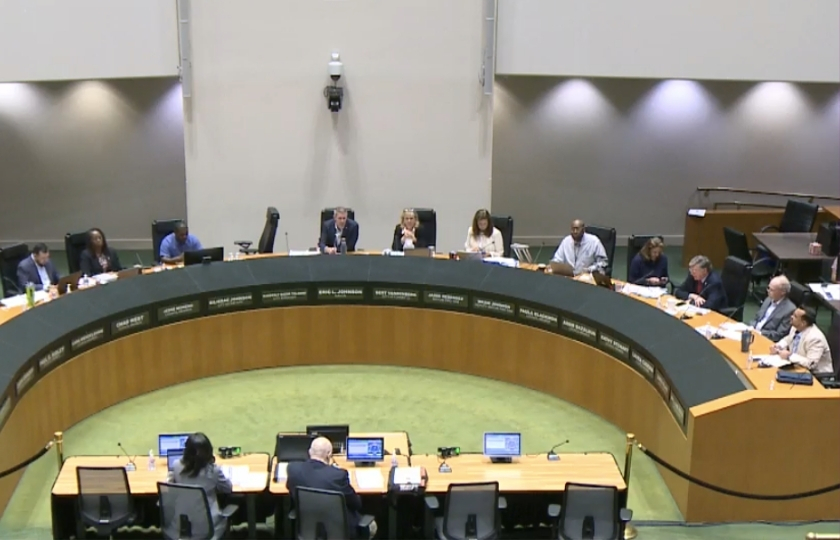
The first committee meeting back from summer break had council members squaring off at City Hall over a potential rule change that would allow a simple majority of the Dallas City Council to authorize new, replacement, or reopened city facilities.
While the revision was part of an array of proposed changes to the city’s Financial Management Performance Criteria (a set of guidelines governing the city’s financial planning), it predictably became a center of controversy, with skeptics suggesting staff is trying to remove a possible barrier to relocating City Hall.
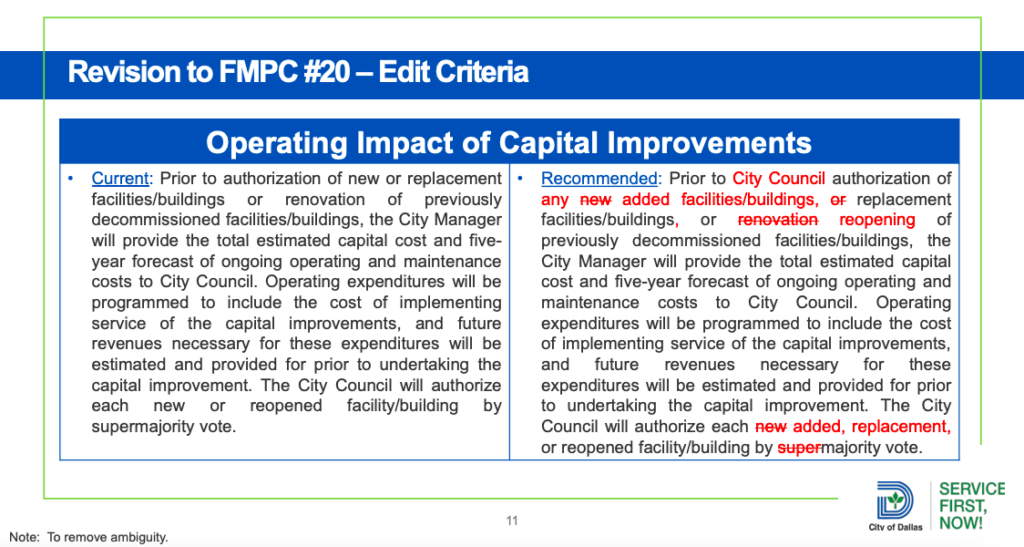
Currently, the FMPC requires an otherwise undefined supermajority of council members to authorize “each new or reopened facility/building.” That component is just one small part of a larger criterion detailing operating cost projection deliverables that the city manager must provide prior to a facility’s authorization.
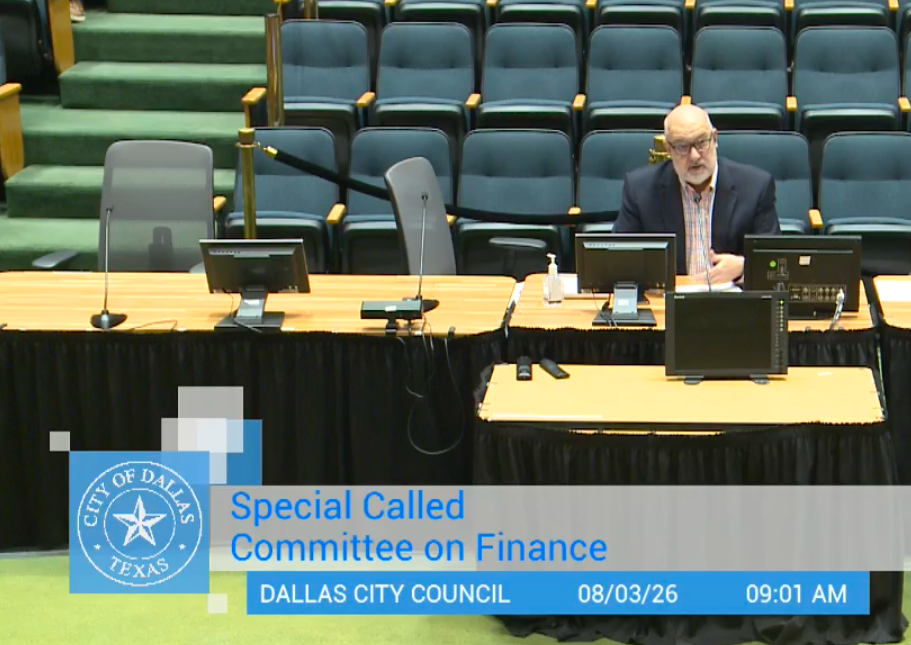
Jack Ireland, the city’s CFO, said at Monday’s special called Finance Committee meeting that the provision has gradually drifted away from its original purpose. According to Ireland, the rule was designed to ensure the city council considered the operating costs associated with opening new facilities or reopening buildings that had previously been closed.
“This had always been a criteria about operating cost,” Ireland said. “This is not a real estate criteria.”
Staff recommends striking the supermajority requirement in favor of a simple majority and rewriting the rule to apply to any “added, replacement, or reopened facility/building.”
Council Member Gay Donnell Willis (District 13) said she was puzzled by why a supermajority was ever affixed to the provision in the first place. She interpreted that requirement as 12 of the council’s 15 members.
“That’s 12 out of 15, and when part of our task is to look at real estate and how we might divest or be smart about it, that seems like quite a hurdle,” she said.
Responding to questions, Ireland said the FMPC supermajority criteria, to his knowledge, had never been invoked and that most city council actions only require a majority vote — including closing a facility without replacement.
Council Members Zarin Gracey (District 3) and Maxie Johnson (District 4) described suggestions that the move to eliminate the supermajority requirement was meant to facilitate relocation from City Hall as “toxic advocacy” and “misinformation.”
The supermajority provision has hovered over City Hall relocation debates this year, with the Save Dallas City Hall Coalition citing the rule in at least one of its notices of claim against the city. Votes have often broken down 9-6 in favor of advancing exploratory work to identify alternative City Hall sites and entertain redevelopment opportunities for 1500 Marilla St.
Ireland suggested that if litigation were to ensue, points of contention could include what constitutes a new or reopened facility and how many votes would be needed for a supermajority.
“That’s the ambiguity that we need to clear up so that we’re not in court trying to figure out what an FMPC means,” he said.
Some of the council members who openly oppose relocating City Hall, none of whom sit on the Finance Committee, attended Monday’s meeting and questioned the wisdom of the proposed rule change.
“We should have limitations and double-checking on making real estate decisions,” Council Member Bill Roth (District 11) said. “One of our biggest assets is our real estate … and we should have supermajority if we have to replace or create a new building or add or reopen a facility.”
Council Member Adam Bazaldua (District 7) noted that the 2021 amendment establishing the supermajority requirement was approved unanimously, with several current council members — Mayor Eric Johnson, Chad West (District 1), Jesse Moreno (District 2), Jaime Resendez (District 5), Paula Blackmon (District 9), Cara Mendelsohn (District 12), Gay Donnell Willis (District 13), and Paul Ridley (District 14) — taking part in the vote.
He argued that staff could clarify the existing language without lowering the vote threshold.
West, the chair of the Finance Committee, expressed support for many of the other proposed changes to the FMPC, but he said he had reservations about the supermajority provision.
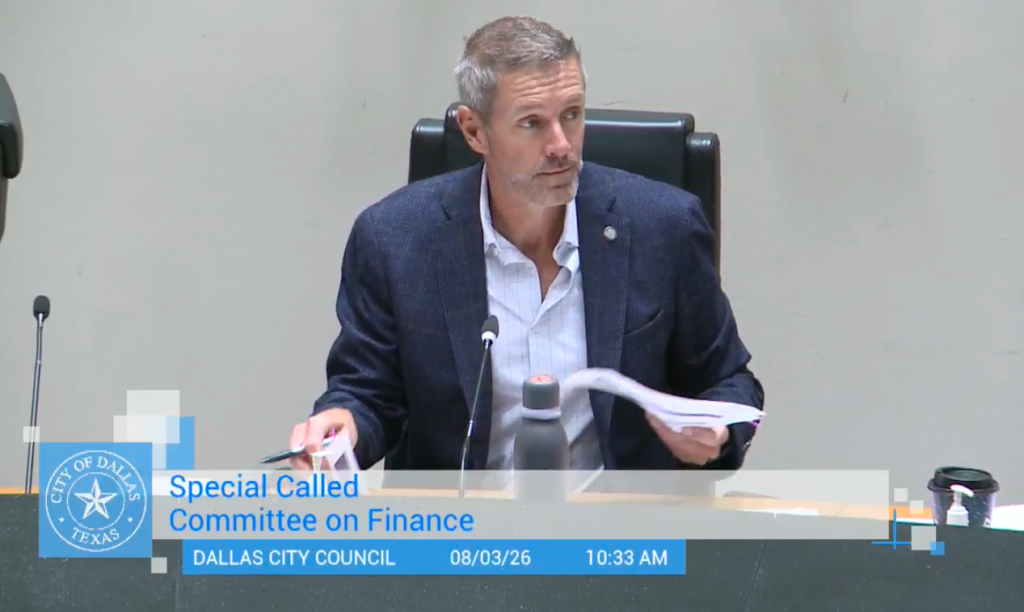
“The council is waiting right now on the final numbers to understand the cost of renting or leasing an alternative to the City Hall site. This financial decision should be made under the rules we have already set to protect taxpayers from bad real estate decisions,” he said. “I don’t believe the rules should change before the decision on City Hall just so we can have a rushed result.”
No recommendation vote was held. West noted the committee discussion was intended to gather feedback before the proposal reaches the full council later this month, where members will have another opportunity to debate the revisions before taking formal action.
Staff plans to bring the FMPC revisions to the full council for a briefing on August 19. A vote could be held on August 26, the same date City Manager Kimberly Tolbert is supposed to have concrete relocation and redevelopment options for council members to consider.