
City Council to Reconsider Dallas Convention Center Design After Oak Cliff Blowback
Share News:

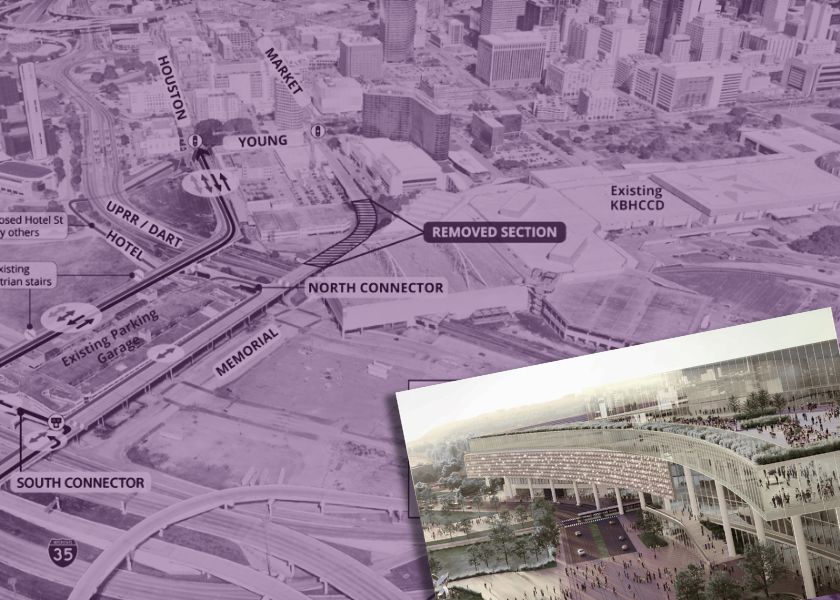
Should Dallas preserve key connections between Oak Cliff and downtown, even if doing so tacks on roughly $600 million to the Kay Bailey Hutchison Convention Center redevelopment? That’s the question Dallas City Council will face next week.
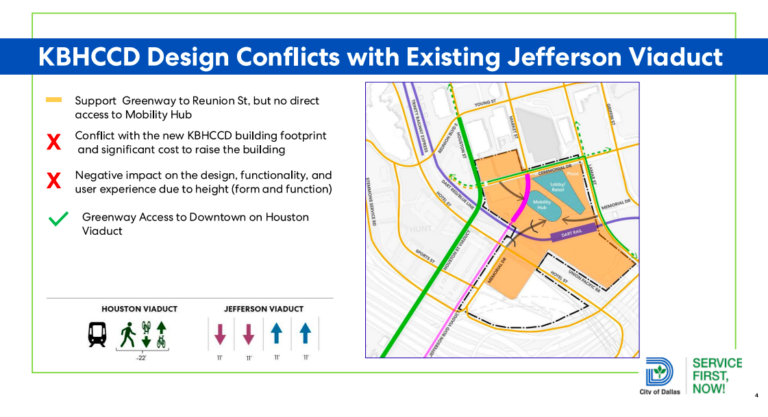
The Transportation & Infrastructure Committee recommended raising the height of the project last month after considerable uproar broke out over the current design’s implications for the Jefferson Boulevard and Houston Street Viaducts. Oak Cliff residents argue the two bridges are critical for maintaining connectivity between downtown and southern Dallas.
Significant delays have already plagued the KBHCC redevelopment. Originally expected to open in 2028, completion has been pushed to at least 2029 after FIFA World Cup 2026 selected Dallas to host its International Broadcast Center. Now, with another potential redesign on the table, it’s not expected to open until at least 2030, according to a memo by City Manager Kimberly Tolbert.
“There is the potential for a longer-term delay as our partners slow their work while awaiting clear policy direction from the full City Council,” Tolbert wrote.
Last year, staff reduced the convention center’s footprint last year in an effort to save roughly $500 million (something pushed for by some council members). That redesign would eliminate the existing path of the Jefferson Boulevard viaduct that funnels commuters into downtown, forcing a reconfiguration of both bridges. At the time, only Council Member Chad West (District 1), who represents parts of Oak Cliff, questioned the implications of the redesign, and staff said they would come up with rerouting options, which they subsequently presented to the Transportation & Infrastructure Committee.
The proposals ended up triggering significant opposition from Oak Cliff residents and business owners who argued any changes would weaken a historic transportation link between southern Dallas and downtown and directly impact access to neighborhoods like Bishop Arts.
West told CandysDirt.com that he plans on supporting the Transportation & Infrastructure Committee’s recommendation, arguing that the viaduct conflict was a problem created by staff.
“I’m just one council member, but this does affect my district, and any council member who says that they support ‘Grow South’ in any capacity would be crazy to support staff’s plan,” he said, adding that none of the alternative connectivity proposals presented by staff fully restore the existing roadway connections that would be lost by keeping the convention center at grade level.
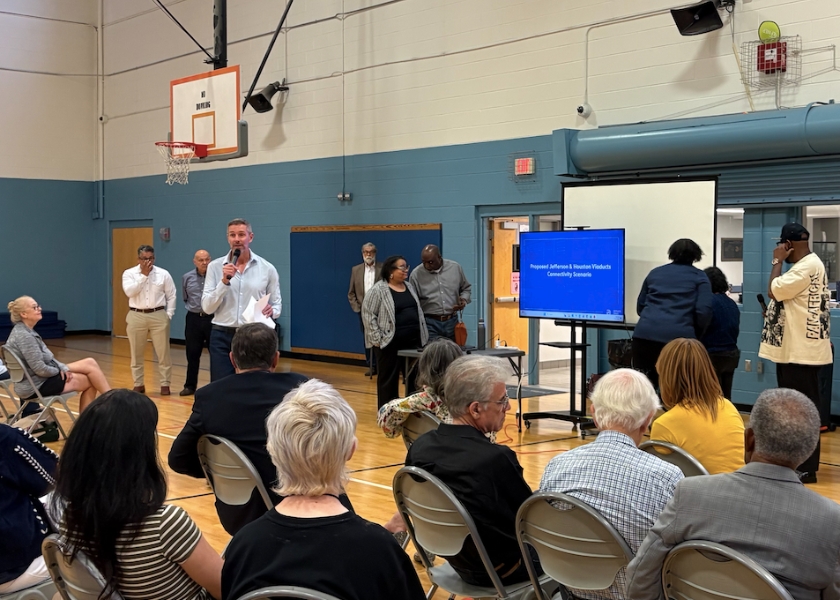
The controversy escalated in May when a community meeting drew even more criticism of the proposed traffic changes and concerns that the implications for Oak Cliff had not been adequately communicated during the convention center planning process. Viaduct advocates have since been waging an information campaign about the potential impact, which intensified Thursday morning with a rally on the Jefferson bridge and another planned for Friday morning at 7:30 a.m.
Media strategist and former local reporter Brett Shipp, who has been active in the campaign, said there would also be rallies Monday, Tuesday, and Wednesday of next week.
“Why? Because half-a-million southern Dallas County residents who often use these bridges to get to work or play in our ‘allegedly’ dying downtown, will have one of our major access routes devastated, if not destroyed by city staff’s profoundly ruinous proposal to reroute traffic to accommodate the surprise new convention center design,” Shipp told CandysDirt.com.
Earlier this week, convention center stakeholders started sounding the alarm about additional potential losses on the convention booking front. Between the curveball from FIFA, which required the convention center to close last July for preparations, and the redevelopment itself (demolition is already underway), the city is already out $13.7 million in tax revenue. Visit Dallas CEO Craig Davis said every month the convention center isn’t up and running would cost roughly $1.4 million.
“Any delay further than 2030 will only exacerbate what we have right now in terms of loss,” he said, per WFAA.
Dallas voters approved the new convention center in 2022, passing $1.5 billion in bond funds for the project. Officials also raised the city’s hotel occupancy tax by 2% to pay for it. Estimated costs are currently well over $3 billion.
Shipp said people are excited about the new convention center and don’t want construction delayed any further, calling the project a “grand downtown showcase for decades to come.” But he stressed that the existing corridor in and out of Oak Cliff needs to remain intact.
“At this point, we are left with two choices, supporting the original win-win design proposal or settling for the insulting, discriminatory redline redo to which the southern sector of our city has grown accustomed,” he said. “The latter option is totally unacceptable, and until city staff or the powers that be decide to include us in the negotiations, or even a real, productive conversation, we will stand up for our bridges and our dignity.”





Oh, please. The most recent proposal seems to retain access in the final build-out scenario just fine. The interim would certainly be annoying, but that’s the nature of construction. Ain’t like that’s something we aren’t used to in DFW… all that said, I think Transportation should have rung alarm bells very early as soon as Council decided they needed to magically save half a billion dollars. It probably wouldn’t have gotten to this point had it been made clear from the jump that the tradeoff for saving all that moolah would be major bridge reconfigurations.
I think this is exactly why business leaders have a hard time working with city leadership. Every time someone doesn’t like something, without concern, the cost of a multibillion-dollar project increases, and progress is put on hold over every whim or complaint.
The truth is that there are going to be some concessions on a project of this scale. There were many opportunities for public input, but at this stage of the project, that time has passed. Unfortunately, I wish City Hall would simply stand up and admit that this is what they agreed to for the financial health of the city, or acknowledge that they should never have approved the changes in the first place (assuming they actually read and comprehended the plans presented to them). Some accountability would be nice instead of claiming they were “blindsided.”
The departure of so many businesses from Downtown Dallas suggests that business leaders are tired of dealing with the city’s leadership and their constant shenanigans. At this point, the $51 million budget shortfall—and the fact that council members didn’t care enough to show up and discuss it earlier this week—suggests that the City Council is also too tired to perform even their most basic responsibilities. Truthfully, I think the council is more focused on their July summer break and vacations than on anything else.
Dallas needs to wake up soon and start electing members with business acumen, basic reading comprehension, fiscal responsibility, accountability, and, most importantly, a genuine desire to work.
Thank you for providing additional details in your article.
I lived in North DALLAS at the corner of Sunnybrook and DeLoach. If PRESTON Road or Inwood Road was being closed to downtown in order to accommodate a convention center rebuild that was just thrown on me on March 23, 2026 I would feel unrepresented. I did live there and I moved here. My point. Would anyone in the southern sector or in Oak Cliff have consented to building a $3.9 billion convention center if it meant disenfranchising a third of the city. This plan will lose the the affected property value which will result in less revenue. And then we’ll hear we need to raise taxes. This is a poor plan in order to have 103,000 square-foot ballroom. They should redesign. A third of the city should not be disenfranchised.
The two bridges that connect North Oak Cliff (Southern Sector) and downtown most definitely need to remain in tact. If the City chooses to update them that’s one thing but under no circumstances should access to those bridges on both sides of the Trinity be demolished. When there is an accident or the highway is gridlocked for some reason, you can always hop on one of the bridges to get you in and out of downtown. For instance, with the construction of the convention center, taking one of the bridges to get into downtown is the best route. If you don’t and you try to exit at Griffith or where ever you can, you will wind up on one way streets that lead you in a circle! It happened to me when I was trying to get to City Hall 3 weeks ago. It was a mess!