
Oak Cliff Residents Up in Arms Over Plans To Reroute Viaduct Traffic
Share News:

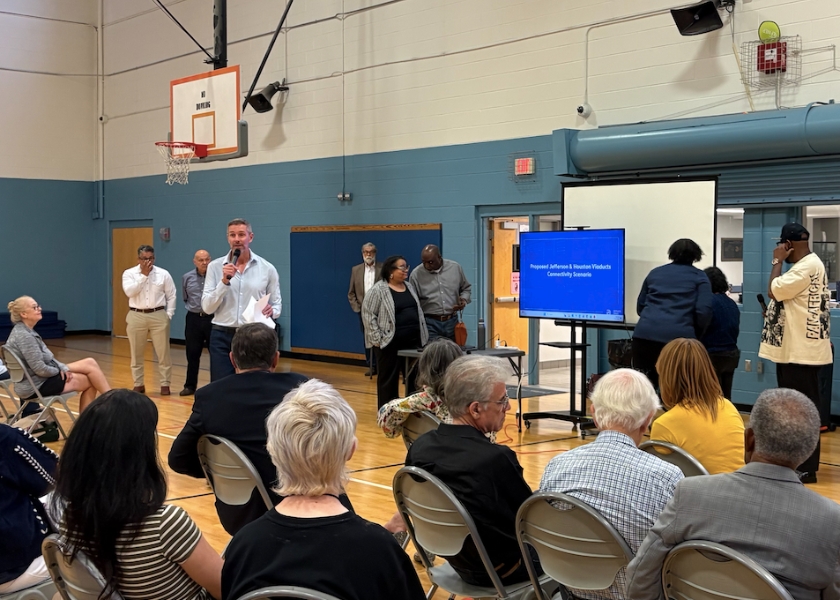
Virtually no one was happy at a community meeting over city staff’s latest proposal to reroute traffic on the Houston Street and Jefferson Boulevard Viaducts, which connect Oak Cliff to downtown. And the upset went beyond the specific plan presented.
Several dozen people turned out to the Eloise Lundy Recreation Center on Friday for the presentation ahead of a special called Transportation & Infrastructure Committee meeting on May 19. The Kay Bailey Hutchison Convention Center redevelopment design is stepping onto the Jefferson Viaduct, forcing officials to consider short-term construction traffic and long-term reconfiguration of the three lanes that carry drivers across the Trinity River and directly onto Market Street. Committee members gave staff’s initial proposals an icy reception back in March, directing them to try again.
“I will never support any plan that takes away access from southern Dallas,” said Council Member Maxie Johnson (District 4), who co-hosted Friday’s meeting with Council Member Chad West (District 1).
Critics of any changes to viaduct traffic have been trying to mobilize the community, arguing that Oak Cliff residents and business owners have depended on the two bridges connecting the neighborhood to the central business district for decades. Officials have also been eyeing the conversion of the Houston Viaduct into a pedestrian, bike, and public streetcar only bridge with a greenbelt, per the recommendations of the Oak Farms Transportation Corridor Study, which seeks to increase the viaduct’s longevity by offloading vehicular traffic.
West said he wasn’t a fan of any of the plans he’s seen so far, including the one previewed on Friday. Still, he noted that convention center construction is going to cause disruption regardless for at least a couple of years. There’s also the expected rehabilitation of both viaducts at some point down the line.
“Like many of you, I use these viaducts every single day,” West said. “They are critical connections for residents commuting to jobs, schools, parks, and recreation downtown. They also help bring visitors into Oak Cliff to support our small businesses and our neighborhoods.”
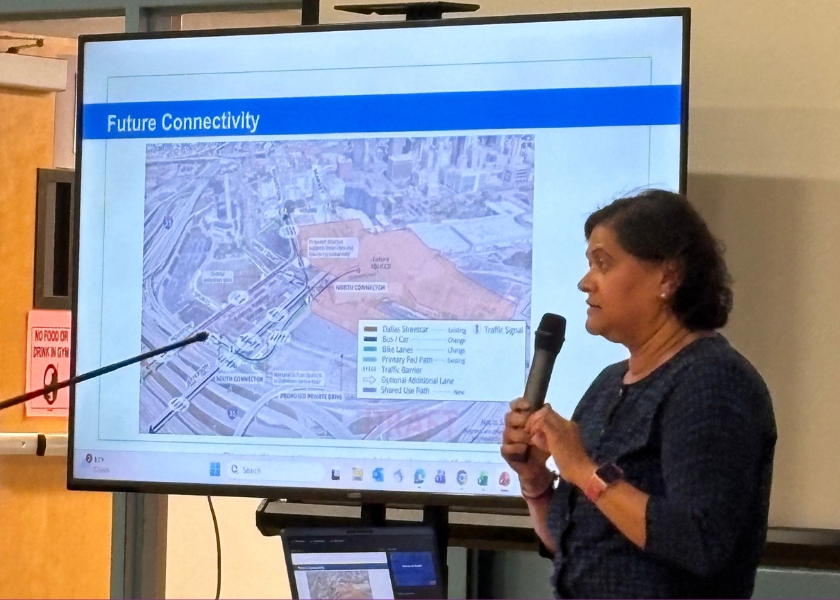
Staff gave a brief presentation on their latest proposal and then fielded questions from the crowd. There was a good deal of frustration on the part of a number of attendees who said they were unable to see the PowerPoint on the relatively small TV or follow the explanation provided. The short notice given for the meeting was also criticized, with staff saying it was the only day and time between finalization of the plan and Tuesday that officials’ schedules aligned. Residents were also upset that the presentation wasn’t posted online for review prior to Friday’s gathering (as of Saturday, May 17, 11:00 a.m., it still wasn’t available on the committee agenda).
In a nutshell, Houston Street, which currently comprises two southbound lanes from Young Street, would be converted to a two-way road that links up with an existing connector to Jefferson, allowing connectivity into downtown from Oak Cliff via a new bridge connector. Both viaducts would be made two-way for certain stretches, and car traffic would be allowed to continue on Houston Street — at least for now.
Staff stressed the plan is still in the conceptual stage and that there will be a series of community engagement meetings, public hearings, and approvals from different city bodies before any final decision is made.
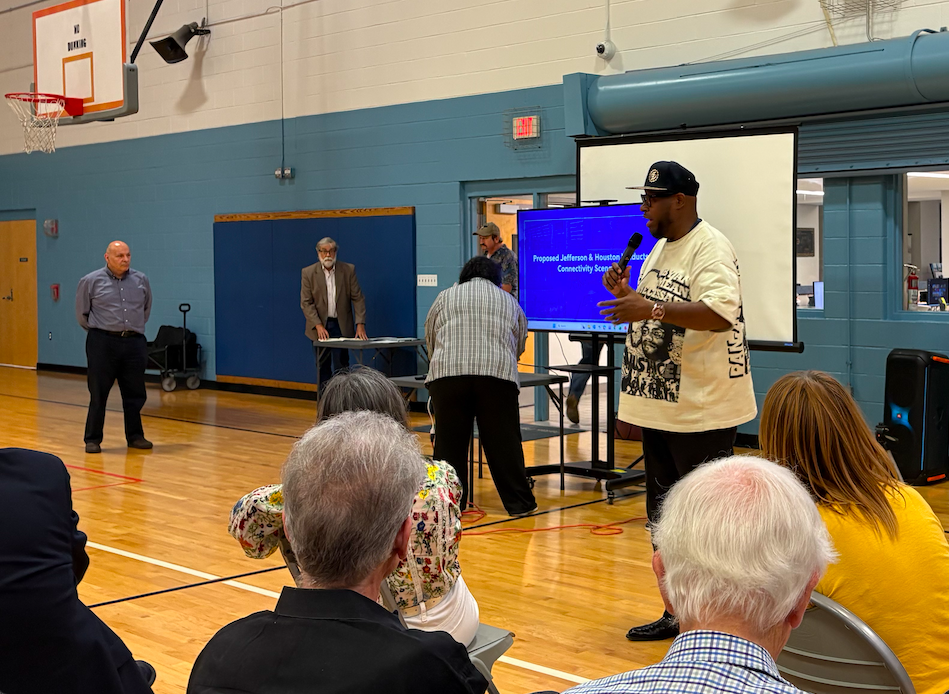
Residents in attendance were largely not impressed. Some voiced concerns with the feasibility and safety implications of the proposal for both motorists and cyclists, not to mention the potential for congestion. Others seemed to take issue with the convention center redevelopment in its entirety, arguing Oak Cliff shouldn’t have to lose its existing access to downtown for the project with no apparent direct benefit to the neighborhood.
“The convention center has great access from the east and the north and the west of Dallas,” said one resident. “South Dallas has very limited access because of the natural barrier of the Trinity, and I don’t believe that any convention center plan should ever have been approved without first considering the impact on the access of the south to downtown.”
Public convention center plan meetings have been held over the past couple of years, but it wasn’t until more recently that the traffic implications for Oak Cliff came into sharp relief. Assistant City Manager Dev Rastogi explained that the Texas Department of Transportation required the city to move the convention center footprint to accommodate the state agency’s future work I-30 on the Union Pacific railroad tracks. This put the project in conflict with the Jefferson Viaduct, which was originally going to run under a raised convention center, more or less maintaining a straight shot into downtown. Efforts to lower costs, however, led staff to bring the complex down to grade, prompting the proposed rerouting.
Even all the way in Uptown, though, there seem to be concerns about messing with the viaducts. Anthony Page, executive committee member of Uptown Dallas Inc. and chair of the nonprofit’s Public Realm & Capital Improvements Committee, came to the Friday meeting.
“Increasingly, residents move fluidly between Uptown, Downtown, The Cedars, southern Dallas, North Oak Cliff, and Bishop Arts for work, dining, entertainment, recreation, and transit access — and the Jefferson and Houston Viaducts are an important part of that connective infrastructure,” Page said. “From Uptown’s perspective, this is not simply a question about rerouting traffic around the building footprint. It’s a question about how Dallas’ major urban districts connect to one another over the long term.”
The long-term plan, at least as far as staff has it, still seems to include eventually getting all vehicular traffic (except for the public street car) off of the Houston Viaduct. While no decision has been made yet, and there are certainly questions about funding priorities these days, the latest rerouting proposal does not preclude putting all vehicular traffic on the Jefferson Viaduct and reserving the Houston bridge for the streetcar and pedestrian and bicycle traffic.
“It’s just not going to happen during the construction phase or once we finish the convention center. Oak Farms was a study. It hasn’t been funded. We don’t have any money for that project at this point,” Rastogi told CandysDirt.com. “[The presentation] is showing that we can align what we’re talking about here in the future connectivity phase with exactly what was in the Oak Farm Study.”
She noted, though, that the TxDOT work to rehab the two viaducts would likely need to happen “before we get to everything that Oak Farms envisioned, and that’s in the 2030-2031 range.”
The situation isn’t sitting well with biking enthusiasts, who have been advocating for more infrastructure accommodations to facilitate a safer environment for pedestrians and cyclists.
“My main goal is for a safe and accessible biking option to be available between Oak Cliff and downtown,” said Rebekah Kornblum, board president of the Dallas Bicycle Coalition. “None of the options presented do that except having the Houston greenway. … There are four or five different ways to drive from Oak Cliff to downtown. There is currently no option to bike or walk or run into downtown from Oak Cliff without one of the viaducts.”
Tuesday’s Transportation & Infrastructure Committee meeting is scheduled for 9 a.m. in council chambers on the sixth floor of City Hall.



“reserving the Houston bridge for the streetcar and pedestrian and bicycle traffic.”
talk about a waste of tax dollars. We already spend over $1million to support the streetcar that no one really rides. as for bicycle traffic there is none. the push for bike lanes come from groups like the Dallas Bicycle Coalition. the Coalition and others pushing for bike lanes are recreational riders not commuter. where is the objective verified data supporting such projects as the Sylvan Ave Bridge. We’re spending $4.9 million dollars to change the traffic pattern. No one will use the bike lanes. Set up surveillance cameras to see how much or how little those lanes are used. Do the same for the Houston St. Viaduct
They have been sent back to the drawing board after today’s meeting.
Unfortunately someone is always working to make money off the tax payers.
Can’t imagine closing the viaduct either way.
This is why the second one was built.
If you really want a greenspace, pedestrian and biker route, build a third viaduct.
Now that’s a novel idea.