
Sector Lines Blur as E-Commerce Reshapes Retail Real Estate
Share News:


Long considered to be distinct market sectors with their own unique dynamics, retail and industrial are increasingly converging as e-commerce and delivery options continue to reshape consumer behavior and real estate.
Online sales, whether for pickup or delivery, have been blurring the lines between retail and industrial space, with storefronts increasingly functioning as fulfillment nodes, showrooms, and last-mile distribution points.
Jim Dillavou, principal and co-founder at Paragon Commercial Group, has been buying up struggling retail properties since the Great Recession. What he’s noticed in more recent years is big-box brands trying to adapt to the new reality of digitally-driven commerce.
“What’s interesting is as these retailers try to survive, as they’re kind of circling the drain, what happens is literally the back wall of the store starts moving towards the front of the house as the back of the house continues to stock up merchandise for last-mile distribution,” he said.
Dillavou and other CRE professionals reflected on some of the changes seen in the retail and industrial sectors during a panel discussion last Wednesday at the Federal Reserve Bank of Dallas’ Breaking Ground on Real Estate’s “New Normal” conference.
“They’re actually making their money through the last-mile distribution from online orders out of the back door,” he said. “We look at space plans, hundreds and hundreds of space plans, as these retailers expand, and that back wall keeps moving in a little bit.”
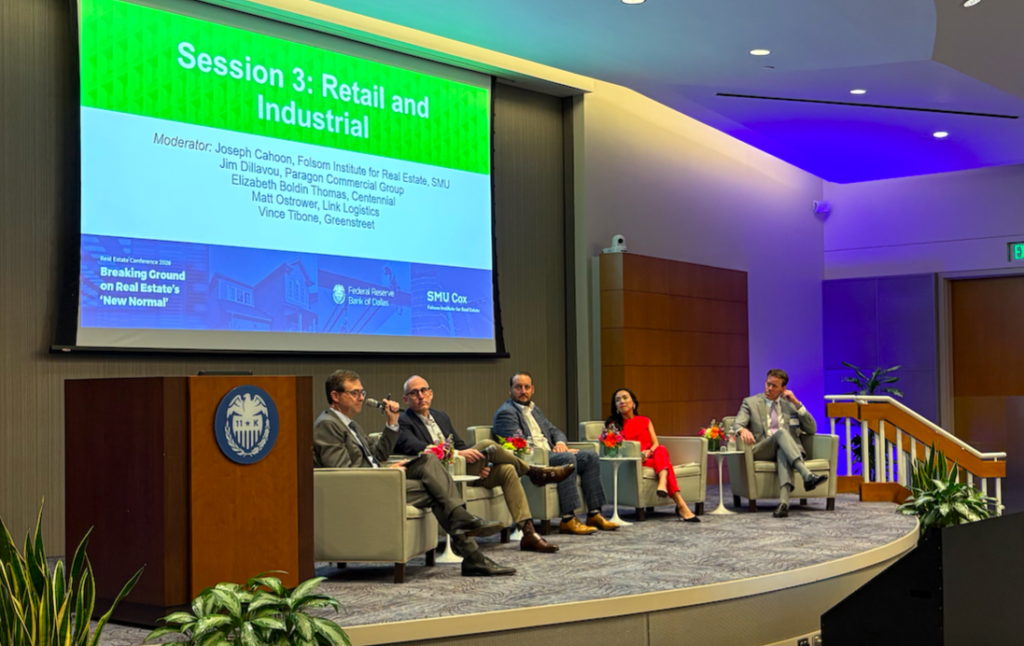
Maintaining brick-and-mortar, even when it might not seem to make sense considering how ubiquitous e-commerce has become, apparently has a measurable “halo effect.” Elizabeth Boldin Thomas, senior vice president of business transformation and intelligence for Centennial, explained how physical stores tend to drive online traffic, increasing the size of purchases.
“Storefronts are used oftentimes as a marketing tool, not so much a sales tool,” she said. “They’re just trying to market to that trade area.”
The dynamic has led to debates about what could and should be reported to landlords in lease negotiations and audits. Implications abound when it comes to considerations like foot traffic and the value proposition of a particular tenant, especially for properties like shopping malls or walkable districts.
“If an online order is fulfilled in-store, does that count towards the retail sales for that store? Are they reporting it? How are they reporting it? How are they categorizing it?” Thomas said. “The same goes for returns. When returns are made, does that count against them? Because we know stores don’t want to report on that, so that’s an ongoing conversation.”
Vince Tibone, managing director at Green Street, criticized the traditional occupancy cost ratio model as increasingly outdated in a world where stores drive value beyond in-store sales and tenants are incentivized to underreport revenues to score better lease terms, judging success by sales and brand awareness in the whole trade area.
“Right now, landlords get none of that benefit,” he said. “I’m talking like Simon and some other very high-quality landlords that should have some pricing power in their metric just have not been able to crack that nut.”
No doubt the issue will only become more pressing as new technologies — namely drone delivery and AI-powered retail strategies — continue to revolutionize how consumers get the things they need and want. Real estate will always be there, obviously, but the industrial creep into retail may well accelerate further.