
City Staff Signal Targeted Shift From Alley Trash Pickup
Share News:

City Manager Kimberly Tolbert and Sanitation Director Clifton Gillespie are poised to catch even more grief following the latest Dallas City Council briefing on alley trash pickup, as it seems a transition to curbside pickup will befall some residents at some point next fiscal year.
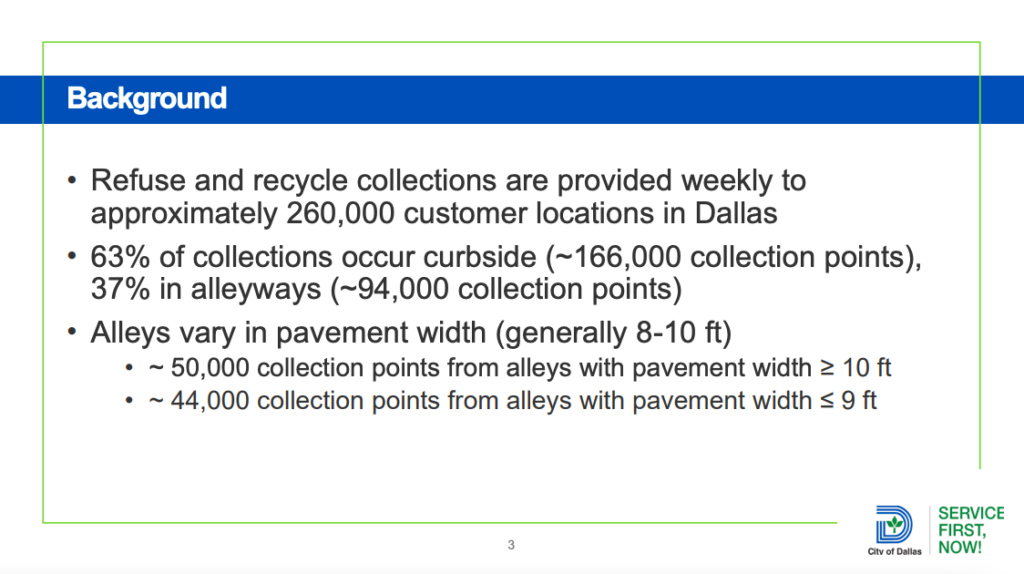
More specifically, the city is going to move forward with a “targeted transition in the most constrained and most problematic alleyways.” Staff have been trying to transition to 100% curbside pickup for a couple of years now, citing workplace injuries and property damage being overrepresented in the narrower alleys.
On Wednesday, council members were briefed on the results of a survey sent to residents with alleys 9 feet wide or narrower to gauge interest in keeping the service at a potentially higher cost. The survey was sent after the latest “refined” proposal to transition roughly 26,000 households to curbside pickup was paused after it sparked an uproar.
Of the approximately 44,000 households contacted, only 23% answered the survey, but the verdict was overwhelming among respondents. A whopping 93% wanted to keep their alleyway service, and 60% said they were willing to pay more to keep it.
Gillespie advised that the results “cannot be treated as a definitive expression of citywide preference, instead it highlights both where customer sentiment is clear and where uncertainty remains.”
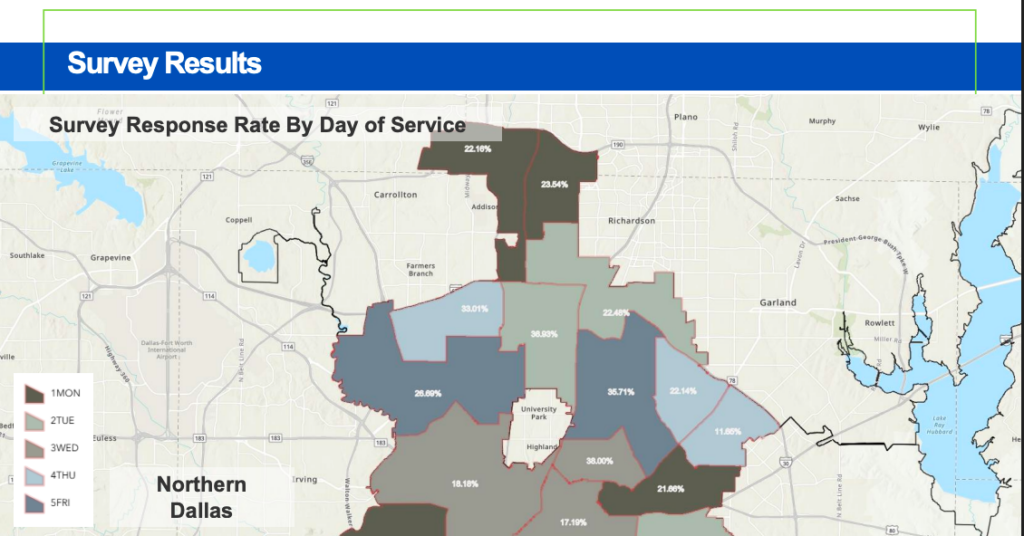
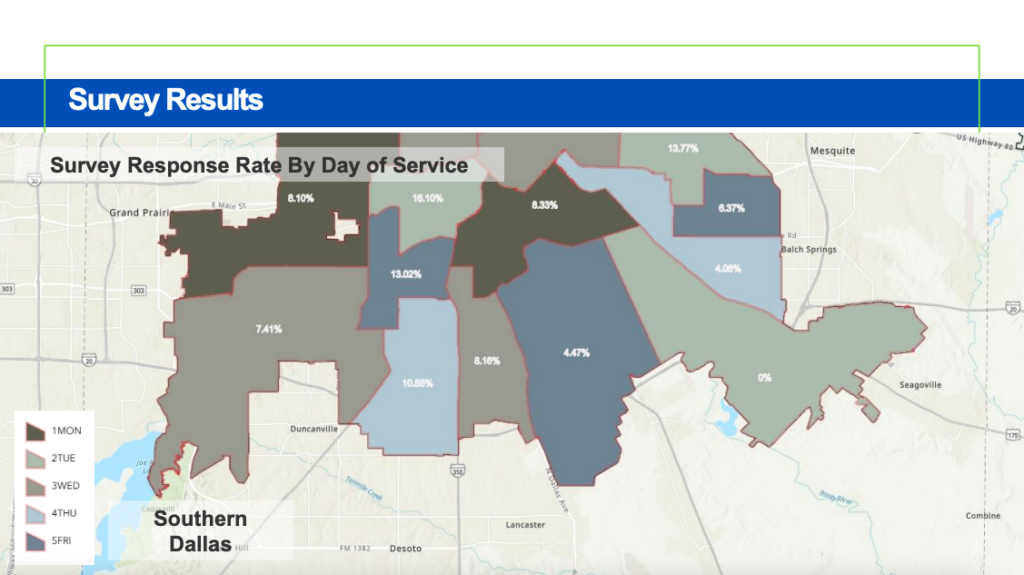
Within the results themselves, there was a significant disparity in response rates, with significantly more responses coming from the northern half of the city than the southern sector.
Staff presented the city council with four options:
- Transition areas with 60% or greater front driveway (the refined proposal impacting 26,000 households);
- Transition only areas with 100% front driveways and a “reasonable distance” from front structure line to curb averaging 50 feet or less (impacting up to roughly 10,000 households);
- Identify collection routes with lowest survey response rates, evaluate for feasible, targeted transition (impacting up to roughly 5,000 households);
- Do nothing and maintain existing alleyway service.
There was no consensus among council members about the preferred way forward. However, the majority sentiment seemed to be that efforts needed to be made to minimize the number of impacted households — even in areas with a low survey respondent rate. Some council members said they were against any transition anywhere.
It’s not up to the city council, though. Rather than a policy matter under the purview of elected officials, the question is an operational one within the sanitation director’s scope of authority, and Tolbert signaled the city would likely develop something between options No. 2 and No. 3.
Gillespie was peppered with questions about why the city had been buying garbage and recycling trucks that were too wide to safely service alleyways, an issue he blamed on changing federal standards over the decades.
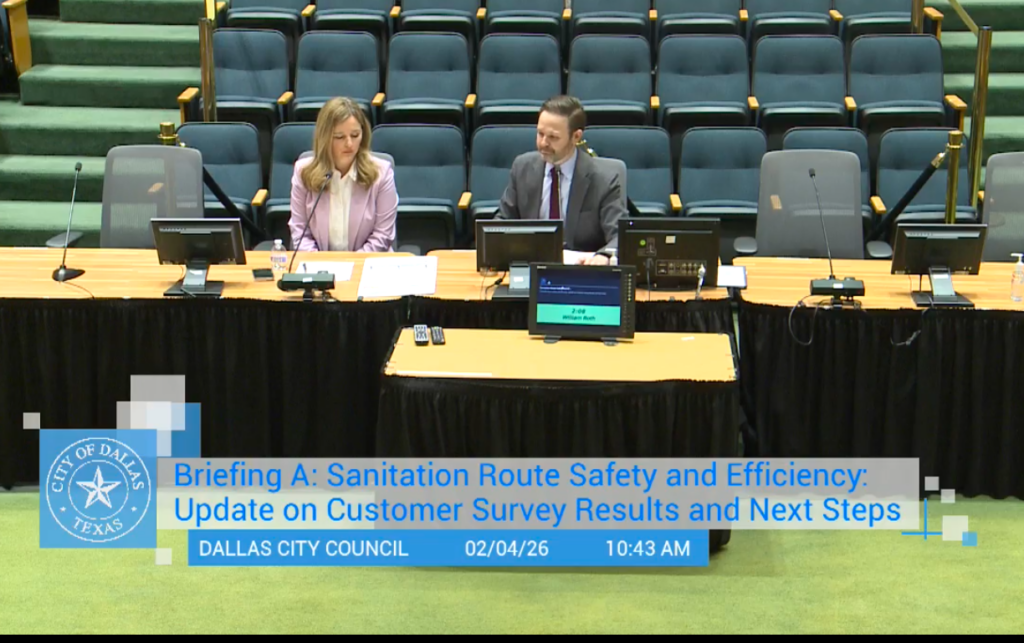
He explained that smaller options (of which the city maintains some) are not much narrower but have significantly reduced carrying capacity, meaning more of them with additional personnel would need to be deployed to keep up with existing service.
“They’re also making twice the number of trips to a disposal site, so that adds additional time,” Gillespie said. “You’re sacrificing quite a bit of efficiency to go that route.”
While some council members offered more measured feedback, Council Members Bill Roth (District 11) and Cara Mendelsohn (District 12) dug their heels in, pointing out that the city needs to do a better job of enforcing code compliance in problem alleys and that the city has failed to properly invest in maintaining alleys generally.
“The city needs to fix the problems it created, but not by imposing additional costs on our residents, not by requiring residents to take the role of garbage collectors, and not by taking away fundamental city services which the residents are already paying for,” Roth said.
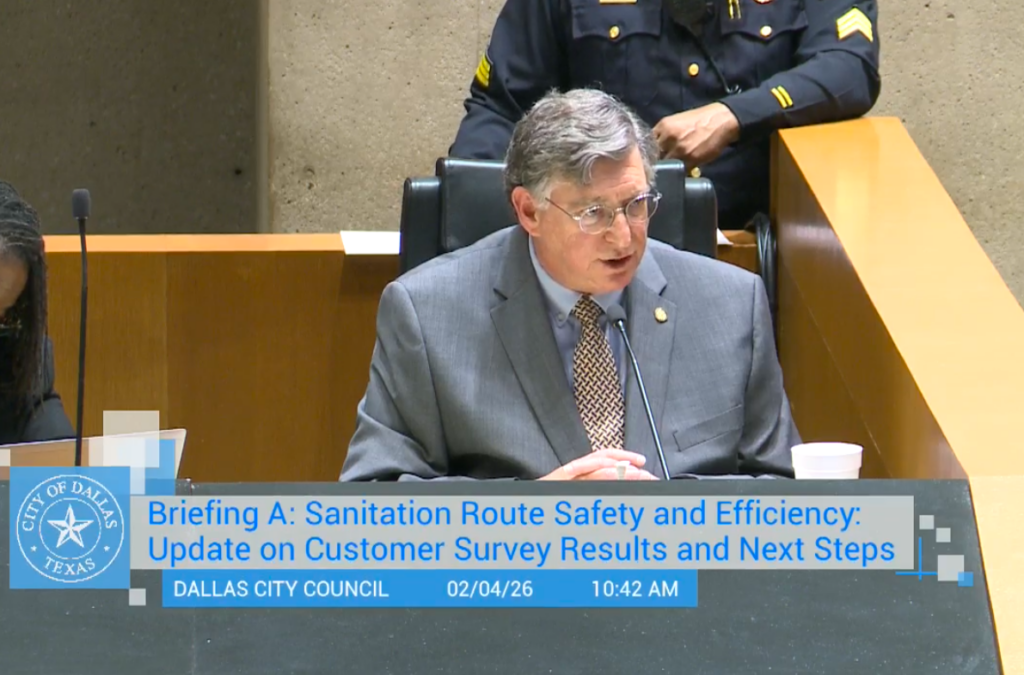
Mendelsohn expressed frustration that staff did not include outsourcing in its presentation, which had been discussed in previous meetings. Gillespie said research would be conducted into third-party vendor options.
Council Member Maxie Johnson (District 4) echoed the concerns of elderly and disabled individuals who would have a difficult time getting their garbage and recycling out front. He and other council members in the southern part of the city also stressed that just because their constituents didn’t answer the survey doesn’t mean they’re okay with a transition to curbside trash pickup. More needed to be done to reach out to households there and educate them on the potential changes that could be coming, they said.
“Based on City Council perspectives on this operational matter, staff will proceed with an incremental approach that advances safety and efficiency through minimal, targeted transitions in the most constrained and most problematic alleyways across the city,” the city said in a press release following the meeting. “At the same time, Sanitation will continue research and concept development to identify emerging solutions that could improve safety in narrow alleys and contain costs over the longer term.”
Hundreds of residents have turned out to city meetings and engagements events, and thousands more have signed a petition opposing the previous phase out plans. Lucky for the city council, they can claim it’s out of their hands.
Meanwhile, Tolbert and her department heads have to balance residents’ wishes with a cost-cutting mandate and the wellbeing of sanitation workers, who currently only make $15-22 per hour.
“We recognize that changes to a service people depend on every week are significant. We will continue to engage with the City Council and the community as we move forward with this transition, prioritizing transparency in our communications and next steps,” Tolbert said.