
Let’s Break Down the Housing Market Signals That Made March Look Like Madness
Share News:

It can be difficult to wrap your head around all the various signals in the housing market these days. What does it mean that new home sales are going up? Prices coming down is a good thing, right? Is the upcoming end of Jerome Powell’s term as chair of the Federal Reserve a big deal?
At the end of the day, what it means to you and yours depends on what side of the deal you’re on and what kind of deal it is. Regardless, forecasts suggest everyone’s in for a bumpy ride as the housing market adjusts to higher construction prices and the possibility of an economic downturn.
Existing Home Sales Dropped
Month to month, sales of existing homes dropped in March, clocking a 5.6% decrease from February, and this was heading into the spring homebuying season. Compared to a year ago, sales dipped by 2.4%.

“Home buying and selling remained sluggish in March due to the affordability challenges associated with high mortgage rates,” said Lawrence Yun, chief economist for the National Association of Realtors (NAR). “Residential housing mobility, currently at historical lows, signals the troublesome possibility of less economic mobility for society.”
Prospective homebuyers have been dealing with relatively high mortgage rates and finding costly inventory in various parts of the country. Valuations have been swelling, which isn’t necessarily the worst thing in the world for families building wealth in their home (if the property tax doesn’t kill you). But that’s not the greatest situation for first-time homebuyers looking to get into an older house. Prospective sellers also need someplace to go.
“Aside from inventory growth, lower mortgage rates will be needed to get homeowners to move,” Yun said.
After all, many of those sitting on potential housing stock got rates as low as 3.15% just four years ago.
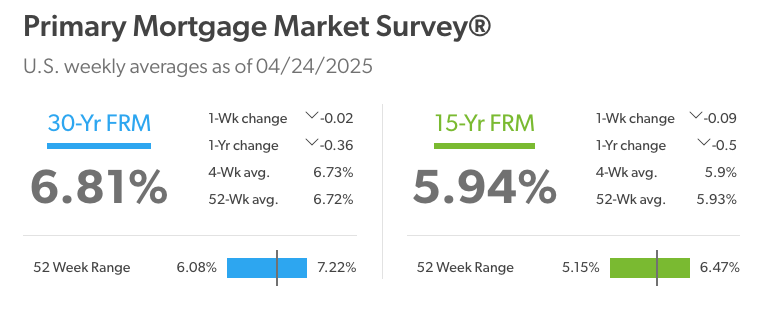
Freddie Mac has the average 30-year fixed-rate mortgage pegged at 6.81% as of April 24.
As previously reported by CandysDirt.com, the Federal Reserve opted not to lower benchmark interest rates at its board meeting last month. Powell cited President Donald Trump’s tariffs as a factor that has the board skittish on issuing another rate cut, fearing that loosening monetary policy would unleash renewed inflation.
Powell’s term as chair ends on May 15, 2026. Trump has reportedly considered firing Powell and replacing him with someone he sees as more open to cutting interest rates. The president was allegedly swayed from taking such action due to the illegality of such a measure and the potential economic shock it could cause to markets.
New Builds Moved
New homes seem to be flying off the shelves in no small part due to so many have been constructed by big builders who can afford to unload them at lower prices. Collin County and Rockwall County, for instance, saw steep year-over-year declines in new home prices in March, as previously reported by CandysDirt.com.
According to Yun, new home sales increased by 7% between February and March of 2025. Year over year, sales increased by 6%. The median price of a newly built single-family home in March came in at $403,600, about 7.2% lower than where it was three years ago. Yun noted that builders were delivering bigger homes back then.
“A wide inventory availability — at 8 months supply — is helping newly constructed home sales to move forward,” Yun said. “The homebuilders’ focus on smaller-sized homes is also attracting buyers.”

There was also some modest relief in the form of mortgage rate fluctuations.
“Lower mortgage interest rates helped boost the pace of new home sales in March,” said Robert Dietz, chief economist of the National Association of Home Builders. “In February, the average 30-year fixed-rate mortgage was 6.84%, while in March it fell to 6.65%.”
The good news here is that plenty of folks got deals on new builds. It’s worth pointing out, too, that big purchases of all kinds spiked in March in anticipation of Trump’s big tariff announcement on April 2, dubbed “Liberation Day.” Cars, in particular, were a hot item, CarPro.com noted.
So, what’s the bad news?
Prelude to Slowdown
While last month’s activity might seem like a boon for builders, the situation is actually a little dire. Trump’s open-ended trade war policy has investors and businesses spooked, with tariffs leading to price increases on important supplies like lumber, gypsum, and steel. Those costs will more likely than not be passed on to the consumer, especially for new construction by smaller builders.
Larger firms have a much greater chance of mitigating price hikes on the building materials side due to their bargaining power, but the economic uncertainty unleashed by the tariffs and talk of a possible recession means there will almost certainly be a slowdown in housing construction of all types.
“The financial rationale to move forward with projects is no longer penciling out,” said Associated Builders and Contractors chief economist Anirban Basu, speaking with NBC News.
A lot of that has to do with consumer confidence. If Americans are bracing for an economic slowdown, how many of them can you reasonably expect will jump into the housing market if they absolutely don’t have to?
John Burns Research & Consulting recently published the results from its March Household Sentiment Survey, which, mind you, was conducted before Liberation Day. Mortgage rates, unsurprisingly, loomed large on the homebuying front.
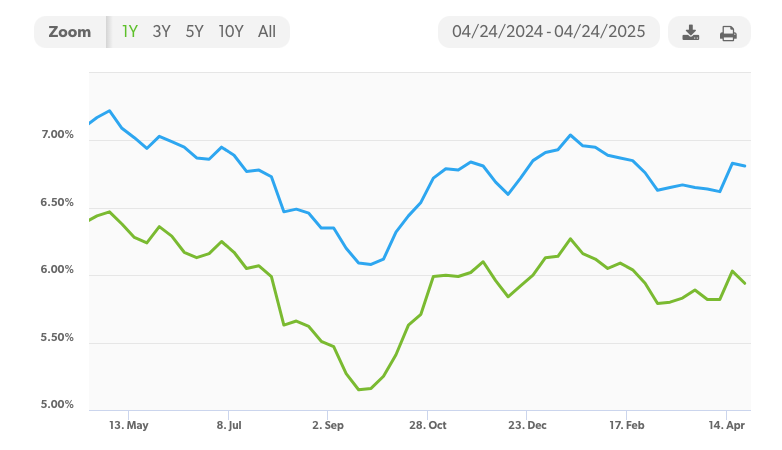
“Most consumers’ homebuying plans will likely remain in limbo as they wait for signs of market stability,” wrote research managers Maegan Sherlock and Alex Thomas. “Prospective homebuyers continue to hold out hope for a return to sub-5.5% mortgage rates, with 78% believing that rates will return to historic lows of the recent past within the next year. As in our prior surveys, 5.5% continues to be the ‘magic mortgage rate’ for consumers, the rate at which we would expect housing demand to unlock at scale.”
The Fed’s board will meet again on May 7 to reassess the benchmark interest rate.