
With Another Appeal, City of Dallas and Short-Term Rental Alliance Continue Legal Battle
Share News:


From Staff Reports
After years of litigation and two unsuccessful attempts in both district and appellate courts to ban short-term rentals (STRs) from single-family neighborhoods, the City of Dallas is still not giving up its fight.
The City has appealed the Feb. 7 decision from the Dallas Fifth Circuit Court of Appeals, in which Senior Justice Yvonne Rodriguez said the City was “mistaken.” She wrote in her response, “Having overruled the City’s four issues on appeal, we affirm the judgment of the trial court.”
The court also noted that the City cited no evidence to support its claims that nearly half of STR owners were not paying the required hotel occupancy tax (also called the HOT tax).
The opinion means that the applicants successfully made their case and can continue to operate.
A Brief History of the Case
This all stems from citizen and city council member concern about short-term rentals operating as Airbnbs and VRBOs in Dallas. Coming to Dallas City Hall with signs and matching t-shirts, housing advocates spoke out against short-term rentals in their single-family neighborhoods during the June 2023 city council meeting.

Dallas City Council took swift action, banning STRs in single-family neighborhoods, but the Dallas Short Term Rental Alliance sued the city and later was granted an injunction allowing them to operate while the case was in courts.
The City of Dallas appealed the ruling in January 2024, and after a few court delays, a Dallas appellate court in November 2024 heard testimony from both sides.
This latest Feb. 7 opinion upheld the original injunction and means that short-term rentals can continue to operate in Dallas.
‘Without Injunctive Relief’
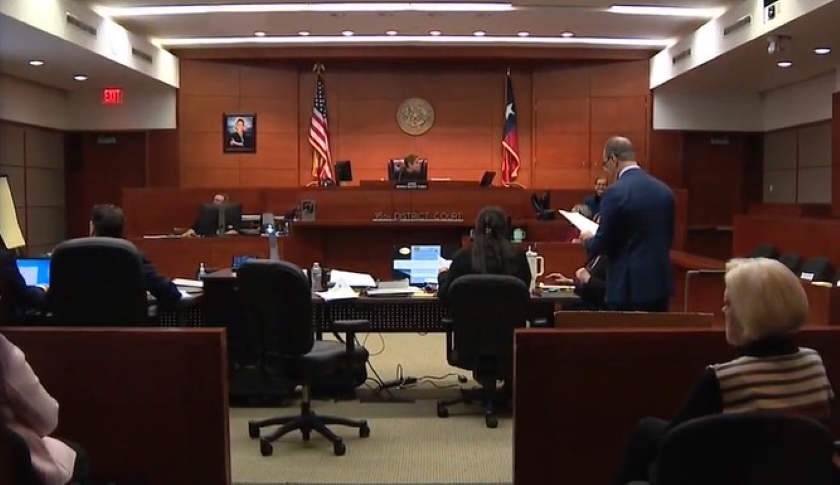
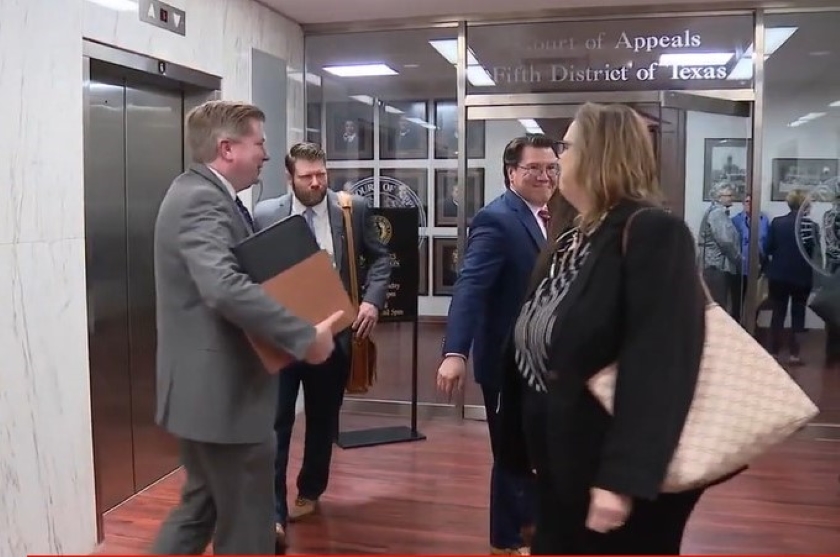
Judge Yvonne Rodriguez, a senior justice in the Dallas Fifth Circuit Court of Appeals, wrote in her Feb. 7 response, “This evidence supports the trial court’s finding that without injunctive relief, appellees would suffer probable, imminent, and irreparable injury to their vested property rights.”
Dallas had argued the Dallas Short Term Rental Alliance failed to establish the right to relief and didn’t prove irreparable injury. Also, that House Bill 2127 (the “Death Star” bill) was irrelevant and that the STR operators had “unclean hands” because some don’t pay hotel occupancy taxes.
For those struggling to follow along, you’re not wrong. Now, the City has appealed the response, arguing that two Dallas ordinances — registration for short-term rentals, and zoning that banned STRs in single-family residential — should be separated because Dallas short-term rental hosts originally agreed on registration.
However, the STR Alliance points out that the City initially said the two ordinances were interconnected and had to be passed simultaneously.
“While we may have agreed on the original ordinance, we did not agree with all the amendments tagged onto that original ordinance,” spokesperson Lisa Sievers told CandysDirt.com.
So let’s explain those ordinances.
The Two Original City Ordinances


“The City is asking for something that is not a legal judgment,” said DSTRA attorney David Coale of Lynn, Pinker, Hurst, and Schwegmann. “The opinion the court wrote is that the two ordinances are clearly joined together because that is the way they were written by the City. The registration says it applies to property where you can still have an STR under the terms of the zoning ordinance.”
“The court is not in the business of rewriting ordinances,” Coale said.
“If they want to rewrite it, they know where we are, and we are happy to talk to them about it. It would frankly make more sense for them to do that. It’s not the court’s call.”
The Dallas City Attorney’s office has said they cannot comment on pending litigation.
The City of Dallas’ reasoning stemmed from an Austin STR case, where the City lost because it implemented a registration program first, inadvertently granting operators settled rights — creating complications when Austin later attempted to ban certain STRs. Dallas attorneys contended that passing only the registration ordinance would similarly establish settled rights for all STR operators, making a future ban more difficult to enforce.
You can watch the June 2023 City Council meeting here. City Attorney Tammy Palomino explains the Austin STR case at this timestamp and why the ordinances were discussed together.
Problematic Short-Term Rentals?


Short-term rental (STR) is defined as a full or partial rentable unit containing one or more kitchens, one or more bathrooms, and/or one or more bedrooms that is rented to occupants for fewer than 30 consecutive days or one month, whichever is less, per rental period.
City of Dallas
Short-term rentals have existed in Dallas for decades, specifically in the city’s oldest neighborhoods where so-called granny flats pre-dated city ordinances.
In Dallas’ earlier days of STRs, a 2021 study conducted by the City of Dallas found that “Short-Term Rental
properties, at the aggregate level, do not have a negative impact on the surrounding neighborhoods. The data shows that there are a few problematic properties; these are outliers. [Short-term rental] properties are almost indiscernible in the data from non-[short-term rental] residential properties,” according to the City of Dallas’, Short-Term Rental Data Analysis: An Analysis of the Impact of Short-Term Rental Properties from May 3, 2021.
By June 2023, city staff reported “95 (4%) of residential STRs generated 3 or more for the calls for the 103 call type and were considered outliers.”
A November 8, 2024 memorandum to the Mayor and Members of the City Council reported:
- 1% of STR properties generated 20 or more 911 calls
- 2 % of STR properties generated 10 or more 911 calls
- Overall citywide, on average, 72% of STRs did not generate a 911 call.
However, problematic STR owners continued to make headlines as neighbors argued their safety and quality of life suffered when repeat STR offenders allowed parties in their rented homes. So, how do you handle that handful of out-of-compliance STR owners?
Regulating STRs
Approximately 3,495 short-term rentals were in existence as of September 2024 or 1% of all dwellings (per the most recent U.S. Census records), according to the City of Dallas presentation.
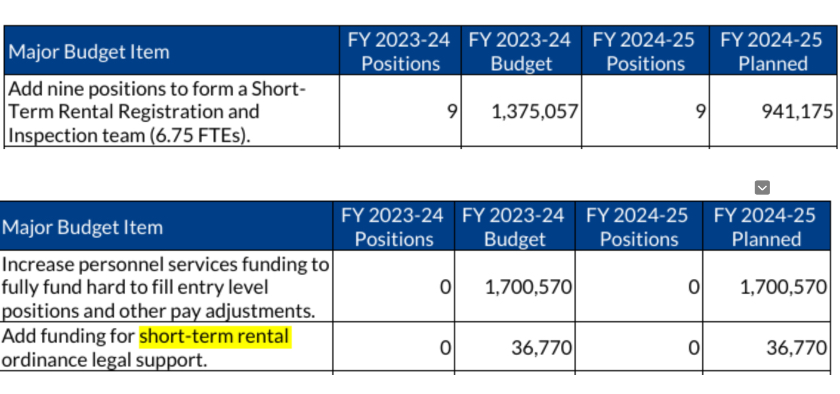
The Economic Development Committee presentation on November 2, 2024, reported it would cost $1.37 million to set up an initial team to monitor short-term rentals. The yearly cost to maintain was estimated at $931,175. The yearly projection for 2026 is $964,074 and for 2027, $999,391.
What About Potential Revenue?
Before the council voted to ban STRs in single-family neighborhoods in 2023, the City of Dallas had a website for registration. On November 15, 2019, the city sent a letter to suspected short-term rental owners informing them of the requirement to register and pay HOT taxes through their website, dallas.munirevs.com. The City contracted with MUNIRevs for $495,000 in April 2019 to collect tax for short-term rentals. It is unknown if or how the city collected short-term rental tax prior to 2019.
Municipalities can work with platforms like Airbnb and VRBO to collect the city tax and avoid this cost, just as the state of Texas has state tax collected by the platforms. When platforms collect state and city taxes they are deducted before host payments are issued.
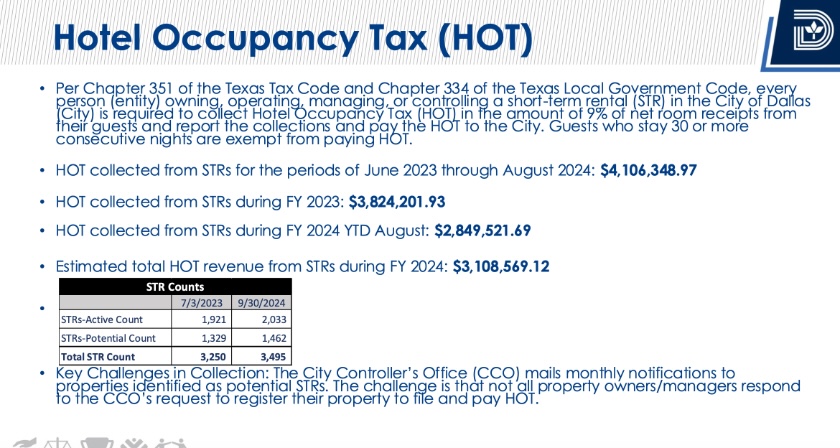
Presently, registered STRs generate over $3 million in HOT revenue as of the city’s latest data on September 16, 2024. This tax is specifically used “… under Texas law, only to directly promote tourism and the convention/hotel industry. This means the proceeds should be spent on projects or events that result in visitors or attendees staying overnight in the community, generating more hotel occupancy tax.”
Next Steps
Filing a rehearing motion freezes everything until the court of appeals hears it. The court can ask for a response. They then review and, generally speaking, deny the motion or make a modification to an opinion if there is an error somewhere. It is rare for the court of appeals to wipe the slate clean and begin again with a 13-member court.
The City can also appeal to the Texas Supreme Court in 45 days for a petition to review.
The City can also allow the case to return to Judge Monica Purdy for trial, and the parties can discuss what, if anything, remains for trial after the court of appeals ruling.
“While we are happy that short-term rental owners/operators are able to continue to operate under the injunction and hope to prevail in the rehearing, our goal has always been to sit down with the City of Dallas and get a fair and reasonable ordinance passed,” Sievers said. “We worked for several years on three different City of Dallas STR Task Forces to craft a good registration ordinance. We’d like the city to return to the original ordinance and work with us to get the job done.”