
Dallas Plan Commission Says No to Multiplexes as a Primary Use in Single-Family Neighborhoods
Share News:


Dallas plan commissioners on Monday voted unanimously to recommend changing multiplexes from a primary to secondary use in the “Community Residential” — or single-family neighborhood — placetype of the ForwardDallas comprehensive land use plan.
A new draft of ForwardDallas was posted last week — billed as a compromise with a preference toward greater density on corner lots and along transportation corridors rather than smack in the middle of neighborhoods — but a vocal opposition group still didn’t like the primary use language. Monday’s amendment addressed that issue, but the plan is still a long way from final adoption.
In the plan, a primary use is a “more prevalent and prominent land use that plays a pivotal role in characterizing a placetype.” A secondary use is a “less prevalent use that may serve to support or complement the primary land use in a placetype.” Multiplexes are defined as multifamily with less than nine units and differ from the Apartment placetype with 10–plus attached units.
Opponents’ usual arguments were raised at the City Plan Commission public hearing Monday: that an updated land use plan won’t solve affordable housing and that developers will fluidly interpret the guiding document as permission to tear down single-family homes and replace them with multiplexes.
Both arguments are red herrings, proponents of the plan say. No one is suggesting that ForwardDallas will eliminate the housing crisis, and the document does not call for multiplexes in the middle of established neighborhoods.
The CPC discussed several changes to the plan during Monday’s eight-hour meeting. It’s still subject to change. The panel is scheduled to meet again at 9 a.m. Thursday. Officials have said the document will be presented to the Dallas City Council for adoption in the fall.
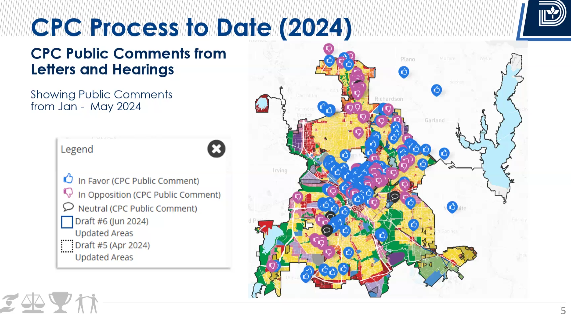
Read the latest version of ForwardDallas here on the City of Dallas site. Most of the updates are in pink text.
Public Comments on ForwardDallas
Resident Ed Zahra kicked off the public comment portion of Monday’s meeting by saying that “ForwardDallas has gone backward.”
“The new version of ForwardDallas, dropped on us like a bomb without any public input, is another attempt to destroy single-family neighborhoods,” he said. “The community residential placetype now includes tiny homes instead of [accessory dwelling units], so anyone with a garden hose, extension cord, and compost toilet can put a mobile home on their lot.”

Housing advocates Bryan Tony with Dallas Housing Coalition and Adam Lamont with Dallas Neighbors for Housing spoke in favor of the plan.
“This new draft is actually a strong compromise [with] improvements including design standards, context language, and locational strategies,” Tony said. “What’s most important here is that we are creating an inclusive city, one that has a vision where everyone can succeed here, can age in place, and our young adults and students can prosper. This is equally a fair housing issue. All neighborhoods must accommodate more housing.”
Resident Diane Birdwell and Parks and Recreation board member Rudy Karimi said they would remember how this matter was handled when the 2025 City Council elections come up. CPC members are not elected but are appointed by council members.
The neighborhoods that will be negatively impacted by greater density are the middle-class and working-class neighborhoods like Casa View, Buckner Terrace, Parkdale, Pecan Heights, and Dolphin Heights, Birdwell said.
“What it’s gonna do is negatively impact us, jamming more people … into the same area where we have not enough resources right now for garbage collection, power grid, cops and fire and ambulance. It’s ridiculous,” Birdwell said. “When the next three elections come up, we are going to remember how this commission voted on everything and we are going to remember who appointed y’all.”
City Plan Commission Votes on Multiplex Use
CPC commissioners made thoughtful comments during Monday’s meeting about the 2.5-year process of developing the comprehensive land use plan.

Vice Chair Brent Rubin, who chaired the Comprehensive Land Use Plan Committee, said Dallas is in the midst of a substantial housing shortage which has led to housing prices that have become increasingly unattainable for many.
“All of that has happened under existing development code and our existing zoning,” Rubin said. “We need to address that housing shortage both today and to account for future projected growth of the city. This draft calls for a number of strategies to increase attainable and affordable housing in the city, including facilitating transit-oriented development, mixed-use redevelopment in existing commercial areas and along corridors that are almost exclusively retail today, and missing middle housing and gentle density.”
None of the solutions will be sufficient on its own, Rubin said. Some of the opposition to missing middle housing stems from problematic design standards for duplexes and other structures, he added.
“It’s out of scale with existing housing and neighborhoods and too often we see homes with four front-loaded garage spots, too much concrete in the front yard, and entrances that aren’t oriented to the street. Moving forward we need design standards in our code that are meaningful and language to address where and how missing middle housing can be built.”
Plan Commissioner Darrell Herbert made the motion to change multiplexes to a secondary use in the Community Residential and Small Town Residential placetypes. Herbert added language to implement design standards into the development code and strengthen the Neighborhood Stabilization Overlay ordinance to address things like height, roof design, garage parking placement, lot coverage, impervious surfaces, and setbacks.
“Land use and zoning decisions should proceed from the fundamental tenet that all residents of Dallas are equal and can live and thrive as neighbors in all parts of the city,” Herbert said.
Stay tuned to CandysDirt.com as we continue to follow this story.


Excellent article. Very useful, well written. Forward Dallas needs to be more inclusive earlier in their process.
The ForwardDallas planners are saying that the new proposal will not put multi plexes in the middle of a neighborhood but on corner lots and transportation corridors. How is a corner lot in the middle of a neighborhood not in the middle of a neighborhood? Multiplexes will erode neighborhoods from the edges and entrances of every block.
As regards transportation corridors that is just another name for roads. They don’t provide a map or even a definition of what a transportation corridor is. One would have to assume most of the historic districts are bordered or have transportation corridors running through them as well as estate home neighborhoods.
This is not what homeowners and neighborhoods desire. The last time the city of Dallas imposed density in neighborhoods it brought a rapid decline. If this passes it will bring a decline again and encourage families to move out of the city.